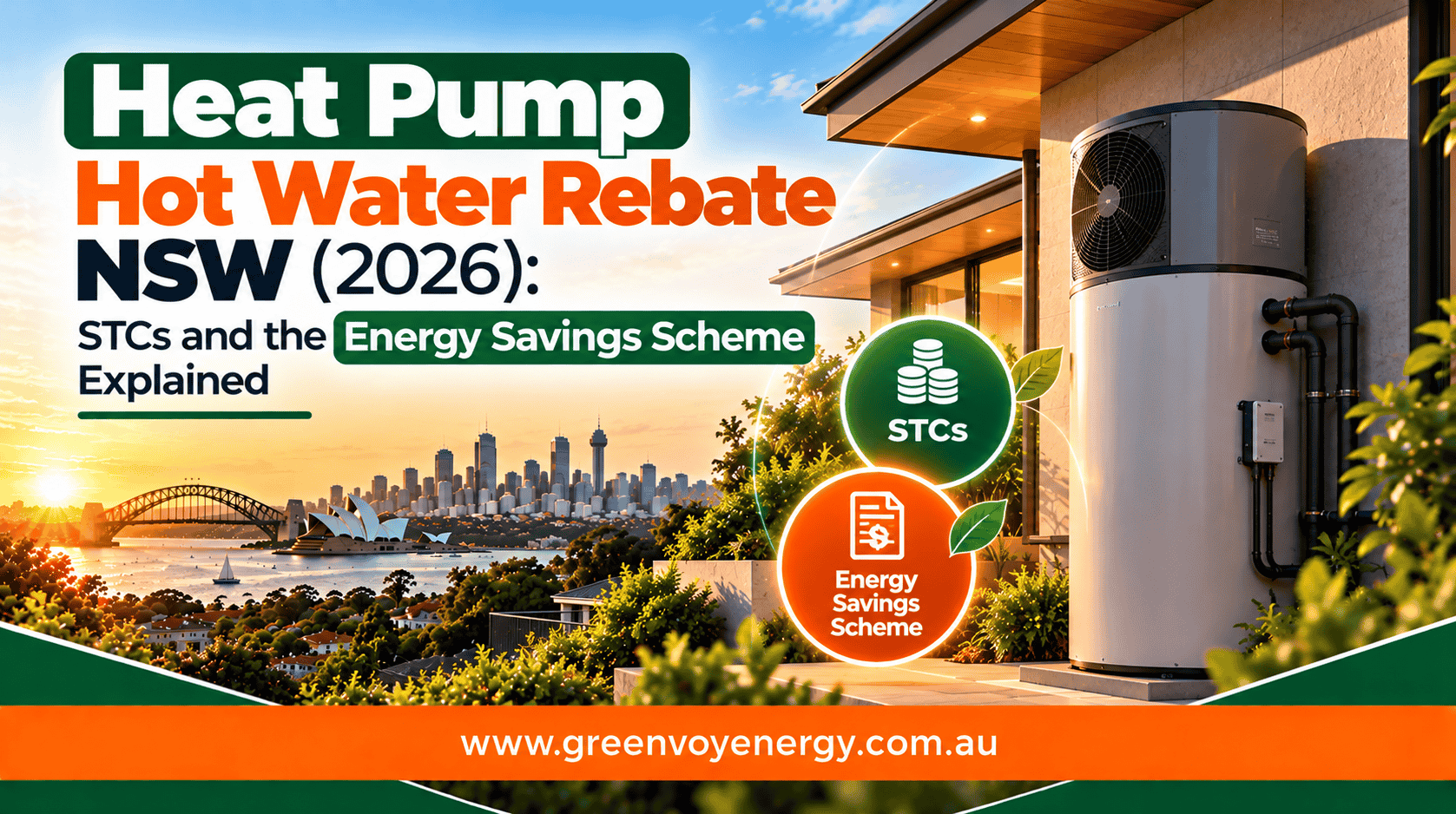
The first cold shower was an inconvenience. The second sent Michael outside to inspect the aging hot water tank beside his Sydney home. Replacing it suddenly became more urgent than researching it. Then the quotes arrived. One mentioned STCs, another listed an ESS discount, and a third advertised a heavily subsidised upgrade. Were they describing the same rebate?
Michael is a fictional homeowner, but the confusion is familiar. This Heat Pump Hot Water Rebate NSW guide explains the main incentives in 2026 and how hot water upgrades fit into the wider energy planning discussed with Greenvoy Energy.
Why a Heat Pump Can Change Your Hot Water Costs
A heat pump water heater draws warmth from surrounding air and transfers it into stored water. It still needs electricity, but uses a different process from a conventional electric tank that heats water through a resistance element.
Efficiency depends on the product, weather, installation and household demand. A rebate helps with the purchase; sensible sizing and operation influence ongoing value. For Michael, reliable morning showers mattered as much as lowering the bill. Choosing equipment around actual hot water use was the first step.
Two Incentives With Different Rules
Homeowners often use “rebate” to describe both federal and NSW support. However, these incentives come from separate schemes, with their own calculations and eligibility checks.
| Incentive | What supports the discount | What to confirm |
| Federal STCs | Certificates under the Small-scale Renewable Energy Scheme | Eligible model, postcode and installation date |
| NSW ESS | Energy Savings Certificates from qualifying efficiency upgrades | Existing heater, replacement equipment and provider arrangements |
Both can contribute to an eligible installation. Neither creates a universal payment available to every household, and the same certificate entitlement cannot be claimed twice.
How Federal STCs Work in 2026
An eligible air source heat pump can generate small-scale technology certificates, known as STCs. Homeowners commonly assign their certificate rights to a registered agent in return for a purchase discount.
The system must meet federal requirements, including listing on the Clean Energy Regulator’s register. For air source heat pumps, the regulator specifies a capacity below 425 litres. Check the exact model rather than relying on a brand name or assuming every size qualifies. The federal register and the NSW requirements should both be checked.
Why the Installation Year Matters
Federal support changes with time. The STC deeming period is five years for installations in 2026 and four years in 2027. Heat pump calculations apply the relevant annual multiplier to the registered entitlement, with fractional certificates rounded down.
Use the regulator’s calculator with the model, postcode and installation date to establish the actual certificate count. A figure from an old advertisement may no longer apply. Booking in December does not make a January installation eligible for the previous year’s calculation.
How Much Is the NSW Hot Water Incentive?
The NSW Government publishes indicative discounts of up to $640 for replacing an electric water heater with a heat pump and up to $330 for replacing a gas water heater.
These are guide amounts, not guaranteed entitlements. The actual installation discount depends on the equipment, provider and job. Existing energy-efficient hot water systems may not qualify for replacement support. Ask the installer to confirm eligibility against the current ESS rules and show the discount within a written quote.
What the Energy Savings Scheme Actually Does
The Energy Savings Scheme encourages energy-efficient upgrades through Energy Savings Certificates, or ESCs. Accredited Certificate Providers manage eligible activities and certificate creation. Participating installers may work with these providers to deliver discounted upgrades.
This explains why the incentive is usually reflected in the installation price rather than arriving as a government refund afterwards. It also explains why competing quotes can show different benefits. The scheme supports qualifying savings, while suppliers still set their equipment prices and installation charges.
Can You Combine STCs and ESS Discounts?
Yes, eligible households can seek both federal and NSW incentives for the same installation. Meeting one scheme’s requirements does not automatically satisfy the other, so obtain confirmation for both before proceeding.
For illustration, suppose an installed system costs $4,200, with an assumed $600 STC discount and $500 ESS discount. The remaining price would be $3,100. These figures are hypothetical, not Greenvoy Energy pricing or a promised rebate. Compare final payable totals as well as discount amounts; a larger discount can accompany a higher starting price.
Be Careful With “Free Heat Pump” Advertising
For standard household upgrades, the ESS generally requires a minimum contribution of $200 excluding GST, or $220 including GST where applicable. Some approved low-income or exempt programs can have different arrangements. Actual costs may be substantially higher.
Ask whether the quote includes electrical work, plumbing changes, removal of the old tank and any necessary gas disconnection. A minimum contribution is not a standard installation price. Michael found that a short advertised price told him far less than a detailed breakdown of the work.
Larger Discounts Are Limited to Selected Postcodes
NSW also offers enhanced heat pump discounts through the Safeguard Acceleration Program in selected postcodes. This requires a contracted business and installation by 30 June 2027, subject to available funding.
The enhanced offer should not be confused with standard ESS support across NSW. Check your address against the current postcode list and confirm provider participation. Being located in NSW, or working with a solar company, does not automatically qualify a household for the larger discount.
Complete the Paperwork Before Installation
Discuss incentives before authorising work. Under the standard NSW process, the nomination form must be completed before installation begins; completed work cannot simply be reimbursed afterwards.
Also compare tank capacity, recovery time, outdoor noise and access for servicing. A busy family may need a different setup from a two-person household. Tell the installer when showers usually happen and whether visitors regularly stay, so the recommendation reflects your routine rather than guesswork.
Keep the agreed quote, eligibility documents and warranty information together. Confirm who manages the certificate paperwork and which licensed tradespeople perform the work. Eligible household heat pumps also need a minimum five-year defect warranty meeting scheme requirements. Clarify coverage for the tank, heat pump unit and supplied components, alongside any separate installation warranty.
Connect Hot Water Planning With Greenvoy Energy
A heat pump can complement rooftop solar by heating stored water during suitable daytime periods. However, buying panels, a battery and a water heater together deserves a detailed household calculation rather than separate sales estimates.
Discuss solar panel options with Greenvoy Energy around daytime demand, then ask your hot water installer about suitable scheduling. If considering Greenvoy Energy’s solar battery options, allow for evening appliances and charging needs. Heating water and charging a battery can compete for available solar output. Their benefits should be assessed together, without counting the same electricity saving twice.
Final Thoughts: Plan Beyond the Rebate With Greenvoy Energy
Michael’s decision became clearer once he separated the incentives from the equipment choice. He compared eligible models, checked paperwork and looked at what each quote actually included.
The Heat Pump Hot Water Rebate NSW can reduce upfront costs, but long-term value depends on reliable equipment and a suitable installation. For the solar side of your upgrade, request a Greenvoy Energy quote and discuss your wider energy needs. Confirm heat pump supply, installation and incentive arrangements separately with the relevant participating provider before committing to a purchase.
Frequently Asked Questions
Q1. How much is the Heat Pump Hot Water Rebate NSW?
Published standard NSW guide amounts are up to $640 for electric-to-heat-pump replacements and up to $330 for gas replacements. Actual discounts vary.
Q2. Can I receive federal STCs and NSW ESS support together?
Yes, where the installation meets both schemes’ conditions. Ask for each incentive to be identified separately and check the final payable price.
Q3. Do I need solar panels to qualify?
No. Heat pump incentive eligibility does not require rooftop solar. Panels may help supply daytime electricity, but qualifying equipment and installation rules still apply.
Q4. Can I claim the NSW discount after installation?
The standard NSW nomination must be completed before installation starts. Arrange eligibility checks and paperwork beforehand rather than expecting a retrospective refund.
Q5. Can Greenvoy Energy help with my wider energy upgrade?
Contact Greenvoy Energy about solar panels, batteries and related energy needs. Verify heat pump installation and rebate administration with the appropriate participating installer or certificate provider.


Leave a comment