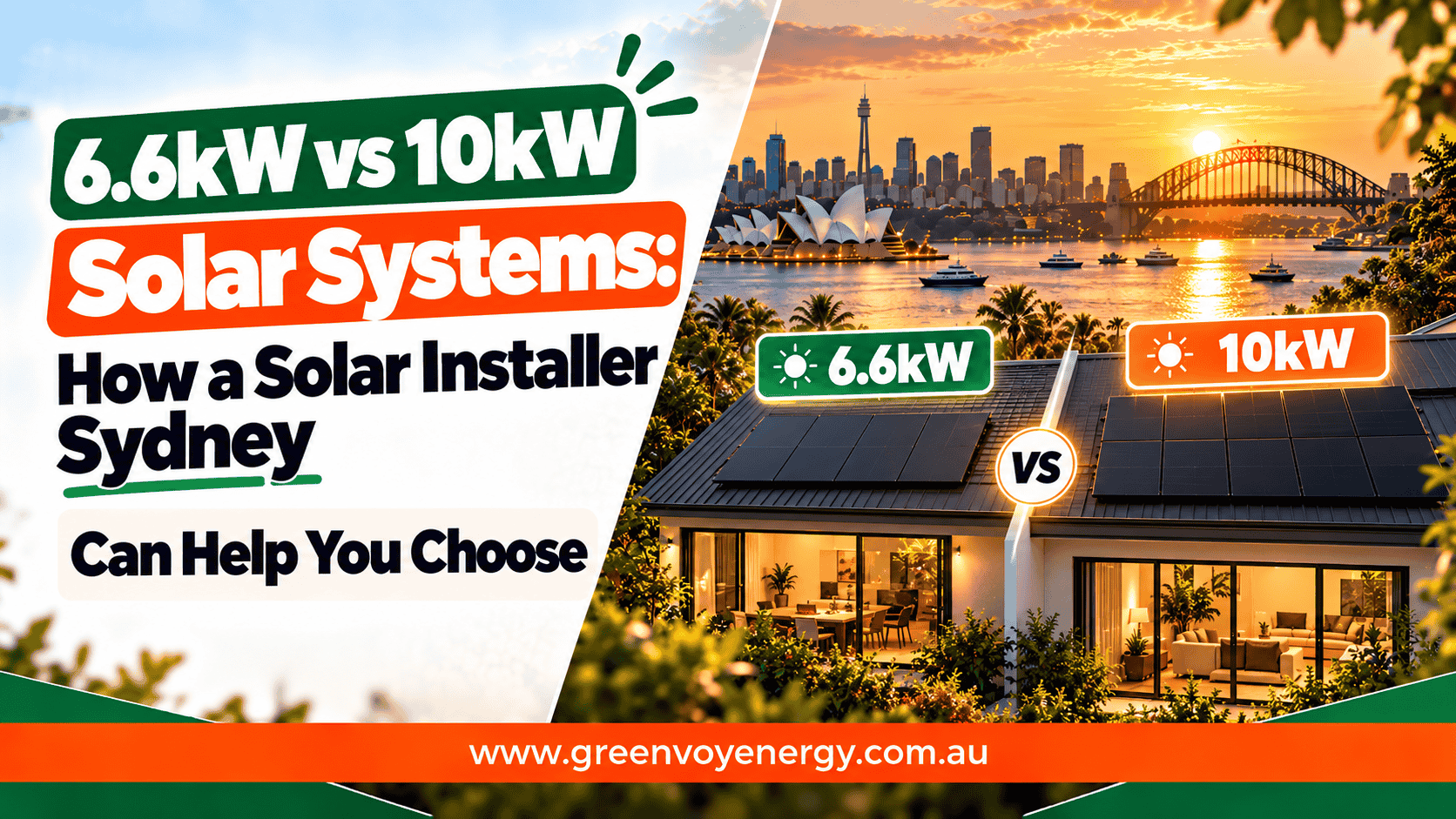
Chris had almost accepted a 6.6kW solar quote when a neighbour suggested going bigger. “Once you get an electric car, you’ll probably wish you’d chosen a 10kW system,” he said.
It sounded reasonable. But Chris had no EV yet, and nobody had checked whether his roof could comfortably fit the larger system.
Chris is an illustrative homeowner, but the decision is familiar. Homeowners searching for Solar Installer Sydney services need advice that goes beyond suggesting a standard package. Greenvoy Energy offers solar solutions that can be discussed against your electricity use, roof conditions, budget and future plans.
What do 6.6kW and 10kW actually mean?
These figures describe the combined rated capacity of the solar panels under standard test conditions. These ratings do not guarantee daily electricity production and may differ from the inverter’s capacity. Energy generated over time is measured in kilowatt-hours, or kWh.
For example, fifteen 440W panels total 6.6kW. Twenty 500W panels total 10kW. These are arithmetic examples, not prescribed layouts or specific Greenvoy packages.
When discussing Greenvoy Energy’s solar panel solutions, request the exact panel model, quantity and array capacity. That makes comparisons clearer than relying on a package name alone.
How much electricity might each generate in Sydney?
Australian Government guidance gives Sydney a broad annual-average benchmark of about 4 kWh daily for each kilowatt of panels. Actual output depends on orientation, shade, weather, season and system conditions.
Using this benchmark, a 6.6kW system would generate approximately 26.4 kWh daily and a 10kW system about 40 kWh daily, averaged over the year. These figures are indicative calculations, not predictions for your roof. Winter output can be substantially different from summer output.
Ask Greenvoy Energy for a property-specific estimate showing monthly generation. That helps you understand whether extra capacity contributes useful winter energy or mainly adds summer surplus.
Start with when you use electricity
Chris’s quarterly bill showed his total consumption. His interval data revealed something else: the house was often quiet during the day, while cooking and cooling increased demand after sunset.
A system producing enough electricity across a day does not automatically supply every evening appliance. Comparing generation with consumption timing is essential when assessing either size.
Share twelve months of bills and available interval data with Greenvoy Energy. Explain which loads can realistically move into daylight hours. Rescheduling the dishwasher may be straightforward, while changing a family’s working hours is usually less practical. The assessment should reflect those differences.
When a 6.6kW system deserves consideration
A 6.6kW solar system Sydney proposal can be a sensible starting point where suitable roof space, upfront budget or daytime electricity needs are limited.
It deserves a closer look if the estimated generation already covers a useful share of your household’s daytime demand and the larger option would mostly produce low-value exports.
That still requires modelling. Ask how the system performs in winter, how much electricity you would still need from the grid and what future upgrades the design can accommodate.
Greenvoy Energy can discuss the proposed equipment and layout against your priorities. Choosing a smaller system should be an informed decision about value and fit, rather than simply selecting the lowest advertised price.
When a 10kW system may make more sense
A 10kW solar system Sydney proposal becomes worth assessing when there is suitable roof space and a credible use for additional generation.
For Chris, this could include definite plans to charge an EV during the day, switch to electric hot water or spend more time using electricity at home during work hours. These are questions to investigate, rather than reasons to assume that larger always wins.
Compare the extra installed cost with the expected additional benefit. Ask Greenvoy Energy to show how much of the larger array’s output would be used, exported or potentially curtailed. A bigger solar system should serve a clear purpose within your household’s energy plans.
Compare the two sizes against practical priorities
The most useful comparison gives both proposals the same assumptions. Keep the electricity tariff, consumption profile and equipment quality consistent wherever possible.
| Consideration | 6.6kW proposal | 10kW proposal |
| Rated panel capacity | Lower | Higher |
| Roof layout | Fewer panels if using identical modules | More panels if using identical modules |
| Added generation | Assess against current needs | Identify a use for the extra output |
| Upfront expense | Request an itemised quote | Check the incremental cost |
| Future demand | Test against planned changes | Model realistic electrification plans |
For a Solar Installer Sydney assessment, ask for both layouts and a written explanation of the recommendation. The comparison should reveal trade-offs you can understand.
Roof space and shading can change the answer
Chris’s roof had an area facing the street. A closer assessment would need to account for vents, access, roof condition and the afternoon shade from a neighbouring tree.
Panel dimensions matter, so fixed panel counts or roof-area promises can mislead. Ask for a scaled layout using the quoted modules.
Panels facing north typically produce the most electricity overall, while east-facing panels generate more in the morning and west-facing panels later in the day. Shading patterns also vary with the seasons.
Discuss those conditions with Greenvoy Energy before comparing capacity alone. More panels on an unsuitable section may contribute less than the headline system size suggests.
Inverter sizing and export approval need checking
A 5kW inverter is often used with 6.6kW of solar panels, provided the combination meets equipment specifications and system design requirements. The panels’ rated capacity and the inverter’s output rating measure different things.
The 10kW proposal also needs an appropriate inverter arrangement, assessed against your electrical supply and network connection requirements.
Explore Greenvoy Energy’s solar inverter options alongside the panels. Ask about phase configuration, export settings and any additional electrical work.
Network approval can limit inverter capacity or electricity exports. An export limit is not the same as panel capacity, and it should be reflected in the proposed design and savings estimate.
Compare savings using realistic tariff assumptions
Additional generation has different values depending on where it goes. Electricity used in the home can avoid a grid purchase, while exported electricity earns the applicable feed-in tariff.
For example, imagine the additional panels generate 5 kWh that your household uses in place of grid electricity costing $0.30 per kWh. That represents $1.50 of avoided usage charges.
Exporting the same 5 kWh at an assumed $0.05 feed-in tariff earns $0.25. These are example rates, not current offers.
Ask Greenvoy Energy for assumptions covering self-consumption, exports, seasonal variation and the extra system cost. A payback estimate is only as useful as its inputs.
Think about batteries and EVs without overbuying
An EV purchase can increase electricity demand, but its parking schedule determines whether it can use daytime solar directly. Discuss residential EV charging around your actual routine.
A battery can store surplus generation for later use, although its costs, capacity and compatibility need separate assessment. Backup also requires a suitable configuration.
Explore Greenvoy Energy’s solar battery solutions alongside both array sizes. Compare what each combination achieves. Neither installing a battery nor choosing 10kW automatically guarantees a better financial result.
Check the complete installation proposal
Compare panel and inverter models, electrical work, mounting, monitoring and warranty terms. Confirm the installation scope, exclusions and responsibility for connection arrangements.
Ask about the accredited installer, site assessment and handover documents. Government guidance recommends checking installer accreditation and obtaining comparable quotes.
Greenvoy Energy’s active monitoring service is another topic to discuss, including features and ongoing costs. Clear aftercare arrangements help you assess the complete offer.
Final Thoughts: Choose capacity with a clear purpose
Chris does not need to decide based on his neighbour’s system. He needs a design that suits his roof, consumption and realistic future plans.
For homeowners comparing a Solar Installer Sydney, Greenvoy Energy offers a starting point for discussing both sizes.
Request a quote from Greenvoy Energy with your electricity bills and property details. Ask which option offers stronger value for your household and why.
Frequently Asked Questions
Q1. Is 10kW always better than 6.6kW?
No. Additional capacity needs suitable roof space and enough financial benefit to justify its cost.
Q2. Can 6.6kW cover my entire electricity bill?
Not necessarily. Usage timing, weather, tariffs and supply charges affect the electricity bill that remains.
Q3. Does 10kW require a 10kW inverter?
Not automatically. The inverter must suit the array, manufacturer requirements, electrical supply and approved connection.
Q4. Should I choose 10kW for a future EV?
Model the additional demand and parking schedule first. Daytime availability affects direct solar charging opportunities.
Q5. Can Greenvoy Energy compare both sizes?
Ask Greenvoy Energy for property-specific layouts, quotes and generation estimates for the options under consideration.


Leave a comment