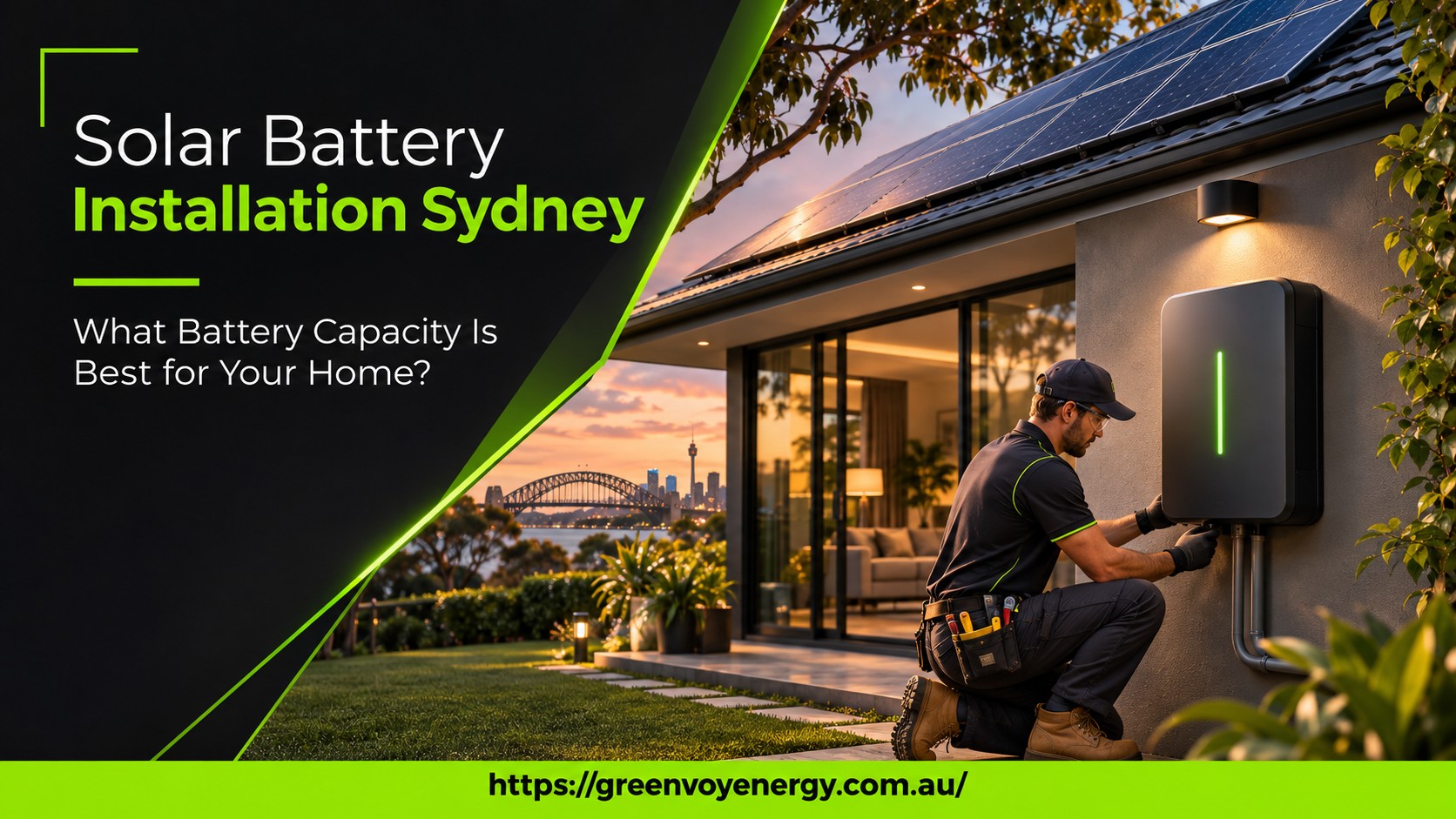
When Emma and her husband started exploring solar batteries for their Sydney home, they expected one straightforward answer. They already had rooftop solar, their electricity bills were climbing, and a battery seemed like a sensible next step.
But after comparing several options, they were left wondering whether a 5kWh, 10kWh or 15kWh battery would actually suit their household. The larger systems looked impressive, although neither wanted to spend thousands on storage they might barely use.
Emma’s story is illustrative, but the decision is familiar to many homeowners considering Solar Battery Installation Sydney. The best battery isn’t necessarily the biggest. It’s the one that matches your electricity consumption, available solar generation and everyday routine.
At Greenvoy Energy, Sydney homeowners can explore battery storage solutions suited to their existing solar systems and future energy requirements. Understanding battery capacity before requesting a quote can make that conversation much more productive.
What Does Solar Battery Capacity Actually Mean?
Battery capacity describes how much electricity a battery can store, measured in kilowatt-hours (kWh). A 10kWh battery, for example, can store approximately 10 kilowatt-hours of energy, although the amount available for everyday use depends on its usable capacity.
This is different from power output, measured in kilowatts (kW), which determines how much electricity the battery can deliver at once. A battery might store enough energy for several hours but still have limits on which appliances it can operate simultaneously.
Emma initially assumed a larger capacity meant better performance in every situation. Understanding the difference between storage and output helped her ask more useful questions about the systems she was considering.
What Size Solar Battery Does a Sydney Home Need?
Australian households commonly consider battery systems within the 5kWh to 15kWh range, although larger configurations are available. The appropriate capacity depends on evening electricity usage, daytime solar surplus and whether backup power is important.
A smaller household with modest overnight consumption may find a 5kWh battery worth considering. Families using air conditioning, electric cooking and several appliances after sunset might need more storage.
For home battery storage Sydney, Greenvoy Energy recommends exploring capacity alongside actual household requirements rather than relying on a standard package.
Your electricity bills provide a starting point, but usage patterns and solar monitoring records are often more useful for determining suitable storage capacity.
Is a 5kWh Solar Battery Enough for a Small Home?
A 5kWh battery may suit households with relatively low evening consumption and enough daytime solar generation to recharge it regularly.
For example, a couple working from home might use much of their solar electricity during daylight hours, leaving only modest demand after sunset. In that situation, a smaller battery could provide useful storage without unnecessary capacity.
However, 5kWh doesn’t guarantee that every appliance can operate throughout the evening. Heating, cooling and other high-consumption equipment can use stored electricity surprisingly quickly.
Homeowners exploring Greenvoy Energy’s solar battery solutions should compare usable capacity, power output and their actual electricity requirements before choosing a smaller system.
Is a 10kWh Battery the Best Choice for Families?
For Emma’s household, a battery around 10kWh initially seemed like a reasonable middle ground. Their family used considerable electricity after school and work, particularly for cooking, entertainment and occasional air conditioning.
A 10kWh battery can offer more flexibility than a smaller system, but its usefulness still depends on how much electricity the household consumes and how much surplus solar is available.
If a home regularly uses approximately 8kWh during the evening, that may suggest a useful starting point for sizing discussions. Battery efficiency, reserve settings and seasonal variations must also be considered.
Greenvoy Energy can help homeowners compare storage options against their consumption patterns rather than selecting capacity based on household size alone.
When Should You Consider a 15kWh or Larger Battery?
Larger battery systems may appeal to households with substantial evening electricity demand, multiple occupants or plans to introduce additional electrical appliances.
For example, a family using electric heating, hot water and vehicle charging may need considerably more energy than a household operating basic appliances after sunset.
However, a larger battery only delivers value when there is enough electricity available to charge it and sufficient demand to use the stored energy.
Emma realised that buying extra capacity for occasional high-consumption days might not justify the additional investment.
For residential solar battery installation Sydney, it’s worth comparing realistic usage scenarios before deciding that a larger battery is automatically better.
Match Battery Capacity with Your Existing Solar System
A battery needs electricity to charge, which makes rooftop solar generation an important part of the calculation.
A household with a 6.6kW solar system may produce useful surplus electricity during sunny periods, but actual generation depends on roof orientation, shading, weather and daytime consumption.
If the household uses most of its solar power immediately, there may be limited electricity remaining for storage.
Reviewing Greenvoy Energy’s solar panel options can help homeowners considering a system upgrade.
For existing installations, check generation records across different seasons before selecting battery capacity. A system that performs well during summer may produce considerably less surplus during Sydney’s shorter winter days.
How Much Electricity Does Your Household Use at Night?
One of the most useful steps in battery sizing is identifying how much electricity your home consumes between sunset and the following morning.
Emma checked her electricity bills, but those figures didn’t clearly separate daytime usage from evening consumption. Reviewing available smart meter data gave her a better understanding of when the household relied on grid electricity.
Appliances such as air conditioners, ovens, washing machines and electric hot water systems can influence overnight demand.
For solar battery sizing Sydney, examine several weeks or months of consumption rather than relying on one typical evening.
An appropriate battery should reflect normal household behaviour, not an unusually low-usage day or the highest consumption figure ever recorded.
Should Your Battery Provide Backup During Blackouts?
Some homeowners want a battery primarily for reducing grid electricity purchases. Others are particularly interested in keeping essential appliances operating during a power outage.
These goals require different considerations.
A battery doesn’t automatically provide blackout protection simply because it stores electricity. The system must support backup operation, and the installation may require additional equipment and dedicated circuits.
Emma wanted to keep her refrigerator, lighting and internet operating during an outage. That made backup capability an important part of her battery comparison.
Explore Greenvoy Energy’s solar inverter solutions when discussing battery compatibility and backup arrangements.
Confirm the supported circuits, available power output and expected backup duration before accepting a proposal.
Comparing Tesla Powerwall, Sungrow and Sigenergy Batteries
Different battery manufacturers offer varying capacities, expansion options, monitoring features and installation requirements.
Greenvoy Energy features Tesla Powerwall 3, Sungrow and SigenStor among its battery solutions. These provide options for homeowners comparing storage capacity and system configuration.
For example, modular battery systems may allow additional storage modules to be installed, subject to compatibility and manufacturer requirements.
However, comparing battery brands without considering the exact models can be misleading. Usable storage, inverter compatibility, backup capabilities and warranty conditions should all be reviewed.
Ask Greenvoy Energy to explain which configuration best matches your home rather than choosing equipment based on brand recognition alone.
Can You Add More Battery Capacity Later?
Some battery systems support expansion, which may appeal to homeowners expecting their electricity needs to increase.
Emma and her husband were considering an electric vehicle in the future. Rather than purchasing the largest possible battery immediately, they wanted to understand whether additional storage could be added later.
Expansion depends on the battery model, inverter configuration, available installation space and manufacturer requirements.
If future upgrades matter, discuss them during the initial design stage. An expandable system can provide flexibility, but adding modules later may involve additional equipment, installation expenses or compatibility restrictions.
How Much Does Solar Battery Installation Cost in Sydney?
The cost of Solar Battery Installation Sydney depends on the selected capacity, battery manufacturer, electrical configuration and installation requirements.
A larger battery generally involves greater equipment costs, although total pricing also depends on inverter arrangements, switchboard modifications and backup components.
Available government battery incentives may influence the final price, but eligibility and program conditions must be confirmed for the proposed installation.
Request a detailed quotation showing equipment, usable storage capacity, installation work, warranty coverage and any applicable discounts.
Greenvoy Energy can help homeowners explore battery solutions and discuss what is included in a proposed installation.
Final Thoughts: Choose the Right Battery with Greenvoy Energy
Emma eventually understood that choosing a solar battery wasn’t really about finding the biggest capacity within her budget. It was about understanding how much electricity her family used, how much solar energy they could store and what they expected from the system.
For Solar Battery Installation Sydney, a suitable battery capacity should balance available solar generation, overnight demand, backup priorities and future household needs.
Greenvoy Energy offers solar battery solutions for Sydney homeowners looking to make better use of their rooftop solar electricity.
Request a quote from Greenvoy Energy to discuss your electricity consumption, existing solar equipment and the battery capacity that may suit your home.
Frequently Asked Questions
Q1. What is the best solar battery size for a Sydney home?
The best capacity depends on overnight electricity demand, available surplus solar and backup requirements. Common options include 5kWh, 10kWh and 15kWh systems, but individual needs vary.
Q2. Is a 10kWh solar battery enough for a family?
A 10kWh battery may suit some families, particularly those with moderate evening electricity use. Actual suitability depends on usable capacity, consumption patterns and solar generation.
Q3. Can a 6.6kW solar system charge a 10kWh battery?
Potentially, yes. However, the amount of surplus electricity available depends on weather, system performance and household daytime consumption.
Q4. Should I choose a bigger battery for blackout protection?
Not necessarily. Backup performance also depends on inverter output, system configuration and protected circuits. Capacity alone doesn’t determine blackout capability.
Q5. Can Greenvoy Energy help choose a suitable battery capacity?
Yes. Greenvoy Energy provides solar battery solutions for Sydney homeowners and can discuss storage options based on existing equipment, electricity usage and household requirements.



Leave a comment