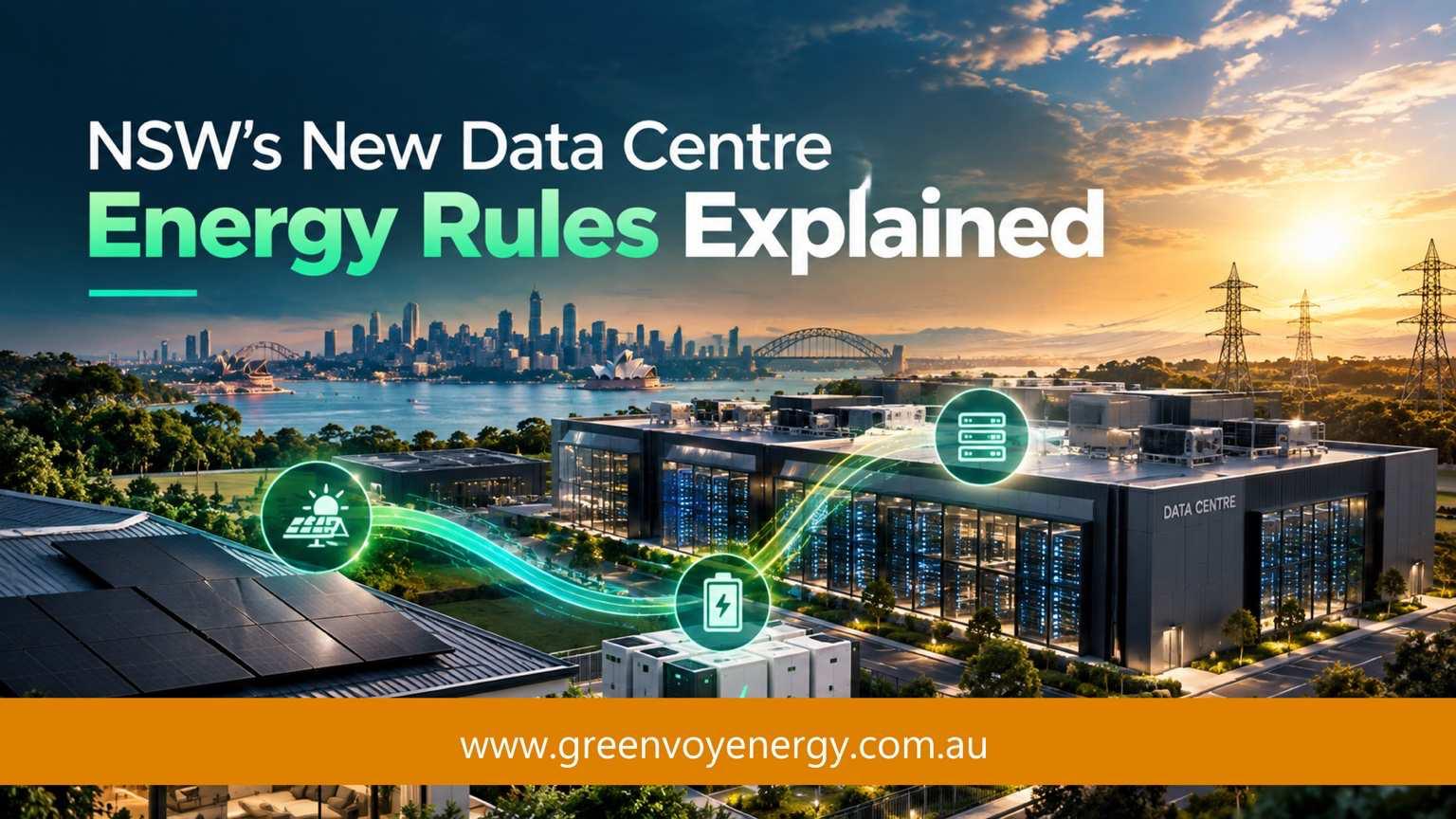
Australia’s data centre industry is growing quickly, and New South Wales is sitting right in the middle of that expansion. Cloud services, artificial intelligence, streaming, online business systems and everyday digital services all rely on large facilities that need a dependable supply of electricity around the clock.
That growth brings investment and jobs, but it also creates a very practical question: who pays for the extra energy infrastructure needed to support all those new facilities?
The NSW Government is now moving to change the way those costs are handled. Its proposed data centre energy reforms are designed to make sure new data centre developments pay for the additional electricity network infrastructure they require, rather than passing those costs on to households and small businesses.
For businesses and property owners across Sydney, Newcastle and Wollongong, the changes are worth watching. They also point to a broader shift in the way large commercial energy users may need to approach solar, batteries, energy efficiency and long-term power planning.
Why NSW Is Bringing in New Energy Rules for Data Centres
The scale of planned data centre investment in NSW is a major reason the government is taking action now.
As of July 2026, data centre projects seeking network connections represented up to 28 gigawatts (GW) of capacity. Around 13 GW of that capacity was already in advanced discussions to connect, which NSW says is more than the state’s average daily electricity demand.
Those numbers put the issue into perspective. A new data centre is not simply another commercial building plugging into the existing network. These facilities can require enormous amounts of electricity, and several large developments connecting in the same area can put significant pressure on generation, transmission and distribution infrastructure.
The NSW Government’s proposed reforms are intended to make sure that expansion is managed more fairly. In simple terms, data centre operators would be expected to cover the additional network investment needed to service their projects, helping prevent those costs from being spread across other electricity customers.
The approach forms part of the broader NSW Data Centre Policy Framework, released in August 2026. The framework has three main parts: planning guidelines for data centres, energy-sector reforms focused on infrastructure cost recovery, and an IPART review of water pricing for data centre customers.
It is not about stopping data centre investment. Quite the opposite. NSW sees the sector as an important source of private investment, employment and digital infrastructure. The aim is to make that growth work without creating unnecessary costs for the wider community.
What the New Rules Could Mean for Sydney’s Growing Data Centre Market
Sydney is already a major centre for Australia’s digital infrastructure, so it is likely to feel the impact of these changes more directly than many other parts of the state.
AEMO reported that, in the first quarter of 2026, 11 large data centre projects were progressing through the transmission connection process across the National Electricity Market, representing 5.4 GW of maximum capacity. About 60 per cent of that capacity was in NSW.
For Sydney, the issue is bigger than simply finding enough electricity. New developments also need suitable network connections, planning approvals and reliable access to energy as their computing loads increase.
The government’s new framework puts greater emphasis on coordinated planning. It also establishes expectations around environmental performance, energy efficiency and additional energy supply. Data centre proponents are being asked to think beyond the building itself and consider the wider infrastructure their projects rely upon.
That could influence how future projects are designed and where they are located.
It may also encourage developers to look more seriously at on-site energy strategies. Solar generation, battery storage, demand management and energy-efficient equipment will not replace the grid for a large data centre, but they can become useful parts of a broader energy plan.
For businesses operating around Sydney, there is another lesson here. Large energy users are facing a future where energy planning is becoming more closely tied to business planning. Simply accepting a growing electricity bill may not be the best long-term strategy.
How Newcastle and Wollongong Could Benefit from Smarter Energy Planning
Sydney may dominate the conversation, but Newcastle and Wollongong are also worth keeping an eye on as NSW looks for responsible ways to accommodate future energy demand.
The NSW Data Centre Guidelines encourage projects to consider regional opportunities, investment in additional energy and water supply, local infrastructure and employment. The guidelines also call for data centres to impose no net cost on consumers and communities.
That does not mean Newcastle or Wollongong will suddenly become major data centre hubs. Local electricity network capacity, land availability, planning requirements, fibre connectivity and the needs of individual operators will all play a role.
What is clear, though, is that the conversation is widening beyond simply adding more grid capacity.
Regional locations can potentially form part of a more balanced approach to infrastructure development, particularly where suitable sites can access reliable power and telecommunications while meeting planning and environmental requirements.
There could also be opportunities for surrounding commercial and industrial businesses. As more attention is placed on local generation and storage, businesses may have greater reason to assess whether rooftop solar, commercial batteries or better energy management can reduce their reliance on the grid during expensive or constrained periods.
For a business in Newcastle or Wollongong, this does not necessarily mean making a large investment tomorrow. It means understanding where energy use is heading and whether the current setup will still make sense as electricity costs, demand and network conditions change.
Why Renewable Energy and Battery Storage Are Becoming Part of the Conversation
One of the most interesting parts of the NSW approach is its focus on additional energy supply, including renewable generation and storage.
The government has made it clear that the goal is not simply to connect more large electricity users. It also wants the growth of the data centre sector to support additional generation and storage capacity.
That matters because data centres have very different energy requirements from many ordinary businesses. Their systems run continuously, and reliable power is essential. At the same time, NSW is working through a broader transition in its electricity system as older coal-fired generation eventually leaves the market.
Battery storage can help businesses manage the timing of their electricity consumption. A properly designed system can store energy when conditions are favourable and make that stored energy available when solar production falls or demand is higher.
Solar can also reduce the amount of electricity a commercial site needs to purchase from the grid during the day. For warehouses, factories, offices and other large premises with suitable roof space, the combination of solar generation and battery storage can form part of a sensible long-term energy strategy.
Greenvoy Energy, which provides solar and battery services across Sydney, Newcastle and Wollongong, focuses on tailored energy solutions for homes and businesses. Its services include solar panels, inverters, battery systems and ongoing system monitoring.
Of course, the right solution depends on the site. A battery is not automatically worthwhile for every business, and solar sizing should be based on actual electricity use, available roof space, network requirements and future demand.
That is why a proper site assessment matters more than simply choosing the biggest system available.
How Greenvoy Energy Can Support NSW Businesses Through the Changing Energy Landscape
The new NSW data centre reforms are aimed primarily at large-scale data centre developments, but the wider message is relevant to commercial energy users across the state: energy is becoming something businesses need to plan for, rather than simply consume.
As electricity infrastructure comes under increasing pressure, businesses can benefit from understanding how much energy they use, when they use it and what options they have for reducing their exposure to grid prices.
For some sites, that may mean installing commercial solar. For others, a battery could make more sense, particularly where there is significant evening usage or a need to manage peak demand. In other cases, the best first step may simply be improving monitoring and understanding the site’s energy profile.
A good energy strategy should start with the business, not the equipment.
Greenvoy Energy offers onsite consultations and tailored solar and battery recommendations based on a customer’s energy needs and site conditions. The company also provides installation, monitoring and after-sales support.
For businesses in Sydney, Newcastle and Wollongong, that approach can be useful as the state’s energy landscape continues to change.
The NSW Government’s data centre reforms are still moving through consultation and legislative processes, so the final arrangements may change before they are implemented. The consultation period currently runs from 17 August to 14 September 2026, with further regulations expected to follow subject to the proposed legislation being passed.
What is unlikely to change is the direction of travel. NSW wants large-scale digital infrastructure to bring investment and economic benefits without leaving households and smaller businesses carrying the cost of the extra energy infrastructure.
For commercial operators, that makes now a good time to take a closer look at energy use, solar generation, battery storage and future power requirements. The businesses that understand their energy position early will be in a much better place to make sensible decisions as the rules and the electricity market continue to evolve.





Leave a comment