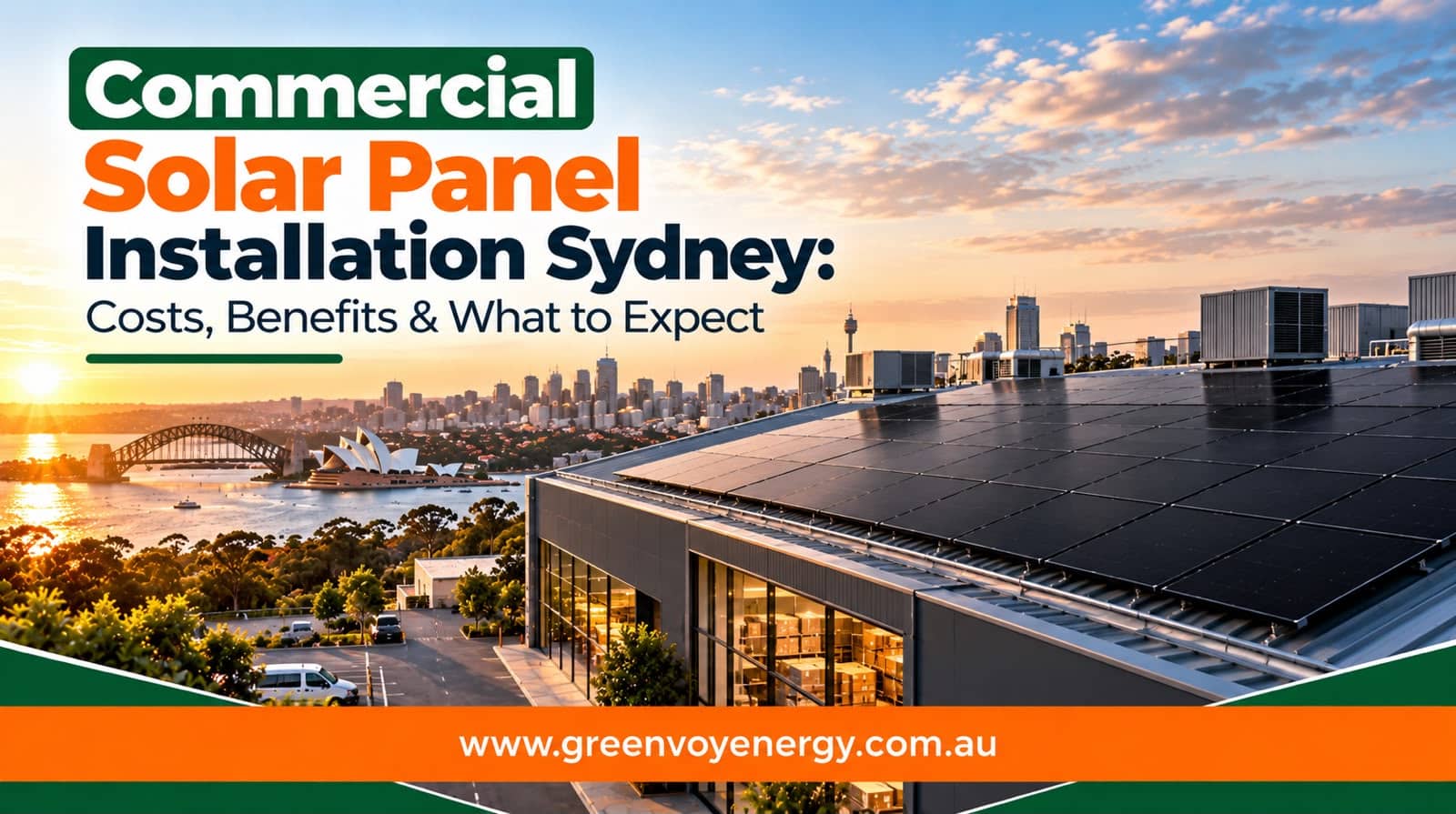
Electricity is a major operating cost for many Sydney businesses, particularly warehouses, factories, offices, retail sites and other properties that consume large amounts of power during the day. That is one reason Commercial Solar Panel Installation Sydney searches have become increasingly common among business owners looking for more control over their energy costs.
Commercial solar is not simply residential solar with more panels. The system size is larger, electricity usage is more complex, network requirements can be different, and the financial case depends heavily on when the business actually consumes electricity.
At Greenvoy Energy, we believe a commercial solar project should begin with the business itself. Electricity bills, interval data, roof space, operating hours and future energy requirements should be understood before anyone starts discussing how many panels can fit on the roof.
Here is what Sydney businesses should know about commercial solar installation, including costs, benefits and what to expect during the process.
What Is Commercial Solar Panel Installation?
Commercial solar panel installation involves designing and installing a photovoltaic system for a business, industrial building or commercial property rather than a standard residential home.
These systems can range from relatively modest installations for offices and retail stores to much larger rooftop arrays for warehouses, factories and industrial facilities. Commercial properties often have one significant advantage: large amounts of unused roof space.
Instead of allowing that roof area to sit empty, solar panels can turn it into an onsite electricity-generating asset. The electricity produced can then be used directly by the business during operating hours, reducing the amount of electricity that needs to be purchased from the grid.
This is particularly useful for businesses with strong daytime consumption because solar generation typically overlaps well with normal business hours.
How Much Does Commercial Solar Cost in Sydney?
There is no single price for commercial solar panel installation in Sydney because every commercial site is different. System size, roof type, electrical infrastructure, access, panel and inverter selection, network requirements and structural work can all change the final cost.
Current NSW market estimates show how wide the range can be. A smaller 10kW commercial system may fall around 8,000–14,000 installed, while a 50kW project may be roughly 35,000–60,000. Larger 100kW commercial systems can reach around 70,000–120,000 depending on equipment and site complexity. These figures should only be treated as broad 2026 market indications rather than guaranteed prices.
A proper quote should therefore come after understanding the site. Greenvoy Energy offers onsite consultation and tailored recommendations based on site conditions and energy requirements rather than relying on a generic price-per-kilowatt calculation.
What Determines the Final Commercial Solar Installation Cost?
The size of the solar system is obviously important, but it is only one part of the price. Two Sydney businesses installing the same number of panels can still receive quite different quotes.
Roof height, roofing material, access equipment, structural requirements, switchboard condition and cable runs all affect installation complexity. Network connection requirements can also become more involved as system size increases.
Equipment selection matters as well. Higher-quality commercial solar panels and inverters can increase the initial investment, but the cheapest products are not always the cheapest option over the working life of the system.
For Greenvoy Energy, this is why commercial solar design is site-specific. The objective is not simply to cover the roof in panels. The system has to work with the business’s actual electrical infrastructure and energy profile.
Can Sydney Businesses Access Solar Incentives?
Eligible Australian businesses installing rooftop solar may be able to benefit from the federal Small-scale Renewable Energy Scheme through Small-scale Technology Certificates, commonly known as STCs.
The Australian Government states that eligible rooftop solar systems can receive STCs for systems with capacity up to a maximum of 100kW. The value is generally incorporated into the solar quote as an upfront reduction when the certificates are assigned to the retailer or installer.
Eligibility also depends on requirements such as using appropriately accredited installers and approved equipment. Solar Accreditation Australia currently operates the accreditation scheme, and SAA-accredited designers and installers are required to interact with the federal small-scale scheme.
Businesses should confirm their individual eligibility rather than treating an advertised rebate as guaranteed.
How Can Commercial Solar Reduce Business Energy Costs?
The strongest financial benefit usually comes from using solar electricity directly while it is being generated.
Consider a warehouse operating from morning until late afternoon. Refrigeration, machinery, lighting, air conditioning and office equipment may all be consuming electricity at the same time solar panels are generating power.
Instead of purchasing all of that electricity from the grid, part of the demand can be supplied by the commercial solar system.
The exact savings depend on electricity tariffs, system output and self-consumption. A business that uses most of its solar generation onsite may have very different economics from a property that exports a large portion of its production.
That is why Greenvoy Energy looks at the relationship between generation and consumption before recommending a commercial system.
Commercial Solar Can Make Better Use of Large Roof Areas
One of the most obvious advantages commercial properties have is roof space. Warehouses, manufacturing facilities, shopping sites and offices can sometimes have hundreds or thousands of square metres available.
That space often has little economic use on its own. Commercial solar allows the business to turn part of that roof into a productive energy asset without sacrificing usable floor space.
However, roof size alone does not determine system size. Orientation, shade, structural condition and network export limitations still need to be considered.
A professional commercial solar installer in Sydney should therefore assess both roof capacity and electricity consumption instead of automatically proposing the largest possible system.
How Long Does Commercial Solar Take to Pay for Itself?
There is no universal commercial solar payback period. Electricity prices, daytime consumption, system price, financing and solar generation can all change the result considerably.
Some 2026 Sydney industry estimates place commercial solar payback in the range of roughly three to five years for well-matched projects, but those figures rely on specific assumptions about tariffs and self-consumption and should not be treated as a promise for an individual business.
A useful commercial proposal should show how the assumptions were calculated. If projected savings rely on unrealistic electricity prices or almost 100% self-consumption, the headline return may look much better than the real result.
At Greenvoy Energy, the financial case should make sense using the property’s actual energy profile, not just attractive marketing numbers.
Should a Commercial Solar System Include Battery Storage?
Commercial battery storage is becoming increasingly relevant for businesses, but a battery should not automatically be added to every solar installation.
Solar produces electricity during daylight hours. If a business already consumes most of that electricity as it is produced, solar alone may provide strong value. However, if significant solar generation is exported or the business has high electricity demand later in the day, a battery may become more interesting.
A commercial battery energy storage system can store electricity and make it available later. Depending on the site’s tariff and load profile, batteries may also help businesses manage peak demand or improve solar self-consumption.
NSW introduced a business battery incentive from 1 September 2026, with larger discounts potentially available when an eligible battery is installed alongside new or additional solar. Eligibility and actual discount values depend on the scheme requirements.
Greenvoy Energy assesses commercial solar and batteries together when the site’s energy usage supports that approach.
What Happens During a Commercial Solar Installation?
The process should begin well before installers arrive with solar panels.
A commercial project usually starts with reviewing electricity consumption, understanding operating hours and assessing the site. The roof, switchboard, electrical supply and possible panel locations need to be considered before a final system is designed.
The next stage involves engineering, equipment selection, network requirements and preparing the installation plan. Once approvals and site requirements are ready, installation and commissioning can take place.
After the system goes live, monitoring becomes important. Greenvoy Energy provides solar panels, inverters, battery solutions, active monitoring, repairs and maintenance, giving businesses access to support beyond the original installation.
Why Monitoring and Maintenance Matter for Commercial Solar
A residential solar fault is inconvenient. A commercial solar fault on a large system can represent a more meaningful loss of generation. That is why ongoing monitoring matters. If an inverter problem or system fault reduces production, detecting it early can help prevent weeks or months of unnoticed lost energy.
Regular maintenance also gives businesses an opportunity to identify physical damage, electrical problems or performance issues before they become more serious. Greenvoy Energy provides 24/7 active monitoring alongside repair and maintenance services, helping commercial customers keep a closer eye on system performance over the long term.
Why Choose Greenvoy Energy for Commercial Solar in Sydney?
A commercial solar project should be designed around the business, not around whichever solar package happens to be on promotion that month.
Greenvoy Energy provides renewable energy services across Sydney, Newcastle and Wollongong. Its process includes onsite consultation, tailored system recommendations, SAA-accredited designers and installers, and ongoing support after installation.
For businesses considering Commercial Solar Panel Installation Sydney, Greenvoy Energy can assess the relationship between electricity consumption, roof space, solar generation and potential battery storage before recommending a system.
That matters because a successful commercial solar project is not simply about installing more panels. It is about producing useful energy at the times your business actually needs it.
Final Thoughts
Commercial Solar Panel Installation Sydney can give businesses a practical way to reduce grid electricity consumption, make better use of large roof spaces and gain greater control over long-term energy costs.
But commercial solar should not be purchased from system size alone. The strongest projects start with electricity data, operating hours, roof conditions, network requirements and realistic financial modelling.
For some businesses, solar on its own may be the right first move. For others, combining commercial solar and battery storage could provide additional flexibility.
Greenvoy Energy can assess your Sydney commercial property and develop a tailored solar or solar-and-battery solution based on how your business actually uses electricity. Businesses ready to explore their options can also request a solar assessment through Greenvoy Energy’s quote service.
Frequently Asked Questions
Q1. How much does commercial solar panel installation cost in Sydney?
Commercial solar costs vary significantly by system size and site conditions. Current 2026 NSW market estimates suggest around 22,000–38,000 for some 30kW systems and approximately 35,000–60,000 for 50kW installations, although complex sites or premium equipment can cost more. A site-specific quote is the most reliable way to understand the actual investment.
Q2. Is commercial solar worth it for Sydney businesses?
Commercial solar can be attractive for businesses that consume significant electricity during daylight hours because the generated solar power can be used directly onsite. The financial result depends on system price, electricity tariffs, solar production and how much generation the business can consume itself.
Q3. Can businesses receive solar rebates in NSW?
Eligible systems may receive federal STCs under the Small-scale Renewable Energy Scheme for solar systems up to 100kW. Eligibility conditions apply, including installer accreditation and approved equipment requirements.
Q4. What businesses are suitable for commercial solar?
Warehouses, factories, offices, retail centres, workshops, hospitality venues and other businesses with usable roof space and meaningful daytime electricity consumption can all potentially benefit. The suitability of commercial solar should still be assessed using the individual property’s electricity profile.
Q5. Do I need a commercial battery with solar panels?
Not necessarily. Businesses with strong daytime consumption may already use a large proportion of their solar generation directly. Batteries become more interesting where there is excess solar production, evening electricity demand, peak-demand concerns or specific backup-power requirements.
Q6. How long does a commercial solar installation take?
The physical installation may only represent one part of the project. Site assessment, engineering, equipment procurement and network connection requirements can take additional time, particularly for larger systems. The timeframe therefore depends heavily on project size and complexity.
Q7. Does Greenvoy Energy install commercial solar in Sydney?
Yes. Greenvoy Energy serves businesses and customers across Sydney, Newcastle and Wollongong and provides solar panels, inverters, batteries, active monitoring, repairs and maintenance. Its commercial approach focuses on site conditions and actual energy requirements rather than using the same system design for every property.

Leave a comment