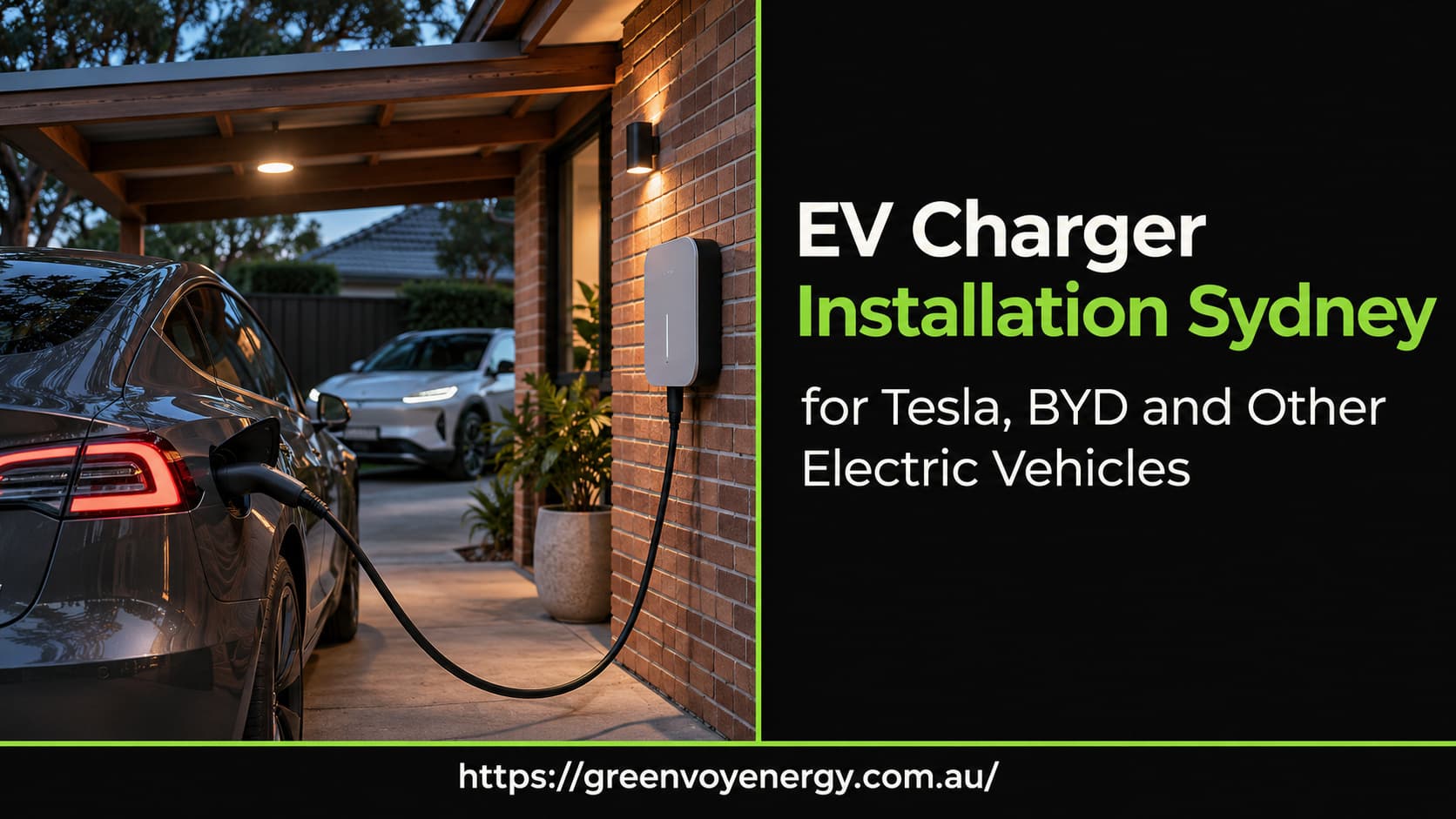
The first time Priya tried to charge her Tesla Model Y at home, she parked the way she always did. Then she got out, looked at the charge port and realised the spot she’d picked for a wall charger was on the wrong side of the garage. Her partner was looking at a BYD Seal, which raised a second question over dinner. Would they need two chargers?
Priya’s household is an illustrative example from Sydney’s Inner West, but the dilemma is a familiar one. One compatible Type 2 wall charger can often serve a Tesla, a BYD and other electric cars, one vehicle at a time. If you’re researching EV charger installation in Sydney, check the cars’ AC charging limits and where they actually park before choosing a charger. Greenvoy Energy helps Sydney households plan around those details.
Can Tesla, BYD and other EVs share a home charger?
Type 2 is the AC connector used by many electric cars sold in Australia. Tesla Australia says its Wall Connector can charge compatible vehicles from other brands, and BYD Australia lists Type 2 compatibility for its home AC charger. A third-party Type 2 wallbox can also be an option. With any charger, confirm the plug, vehicle inlet and access settings before buying.
That was good news for Priya. The couple could plan for one wallbox and take turns plugging in. If you’re comparing a Tesla Model 3 or Model Y with a BYD Atto 3, Dolphin or Seal, check the Australian specifications for the exact model year and variant. The same advice applies to a Kia, Hyundai, MG or Polestar, particularly if you’re buying an imported vehicle.
The inlet tells you whether the plug fits. The car’s maximum AC charging rate tells you how much power it can accept from a wallbox. Those are two separate checks, and both matter if you’re choosing equipment for more than one car.
Is a 7 kW or 11 kW home EV charger right for you?
A 7 kW home EV charger is a common option where the home has a suitable single-phase supply. An 11 kW setup generally requires three-phase power and a vehicle that can accept 11 kW on AC. Your charging rate is limited by the lowest of what the car accepts, what the wallbox can supply and what the installation is configured to deliver.
Priya drove about 50 km on a busy weekday. At an illustrative consumption rate of 18 kWh per 100 km, that trip would use around 9 kWh. At a steady 7 kW, replacing that energy would take about an hour and a quarter before charging losses. In practice, she’d allow a little longer. That was still comfortably within the hours the car usually spent in the garage.
If two cars regularly arrive home low on charge and both need to leave early, the calculation changes. Estimate the energy each car needs before its next trip and how long each can stay plugged in. If you’re weighing up two wallboxes, ask about load sharing, which lets compatible units divide available power between them.
Where should you put a wall charger?
Before the couple settled on a location, they parked the Tesla as usual and opened the garage door. They also checked how the BYD would sit in the space and where its charging port would end up. A wall on the other side of the garage looked better on paper. In practice, the cable would have crossed the route they used to bring the shopping in.
Think about cable reach with both cars in their normal positions, including whether you park nose-in or reverse in. With a tethered wallbox, the charging cable stays attached, so you can plug in as soon as you park. A socketed charger lets you unplug the cable and store it separately. For a driveway or carport, ask about outdoor suitability, weather exposure and a mounting position that keeps the cable out of the way.
What does an EV charger installer check?
In NSW, a fixed home wallbox should be installed by a licensed electrician. The installer assesses the supply and switchboard, the home’s existing electrical demand and the cable route to the parking space. A garage beside the switchboard may be straightforward. A detached carport across the garden can involve considerably more work, even with the same charger.
It’s also worth mentioning the appliances that tend to run at the same time. If the air conditioning, induction cooktop and car charger are all on during dinner, the installer can assess whether dynamic load management suits the property. On compatible equipment, this can turn the charging rate down while household demand is high and bring it back up when capacity becomes available.
If you live in a strata building, speak with your strata manager or owners corporation early, especially if the cable route crosses common property or the charger would use shared electrical infrastructure. Ask how charging would be metered and billed. That can affect the proposal as much as the wallbox itself.
Should you choose a smart or solar-compatible EV charger?
Priya’s Tesla was usually home after dark, while the second car would spend more time in the driveway during the day. For that household, overnight scheduling and surplus-solar charging could both come in handy. If your electricity plan has off-peak rates, a charging schedule can shift grid use into the cheaper window. If you’re home during the day, a compatible charger can adjust its output as surplus solar changes.
Greenvoy Energy lists the Zappi EV charger among its home EV charging options. Ask how its solar modes would work with your existing setup and what happens on cloudy days when generation dips. If you mainly want the car ready by 7 am, check how easily you can override a schedule for an unexpected trip. Greenvoy’s smart EV charging guide explains how scheduling and solar controls affect charging costs.
What affects EV charger installation costs in Sydney?
Two quotes for the same wallbox can look quite different once you account for the property. Cable length, access, switchboard work and any hardware for solar integration or load management can all affect the price. If you’ve already bought a charger, share the exact model so the installer can check what’s included and what still needs to be supplied.
Ask for an itemised quote covering the unit, cabling, electrical protection, labour, testing and charger setup. If the quote allows for a standard cable run, check the included length and what additional work would cost. It also helps to ask who’s responsible for equipment warranty support if you supply the unit yourself.
Plan your home EV charger installation with Greenvoy Energy
Priya and her partner started out wondering whether a Tesla and a BYD needed separate chargers. By the time they’d compared their routines, they had a clearer brief: one compatible wallbox within reach of both cars, with enough power to cover their usual driving. They could price that setup first and revisit a second charger if their schedules changed.
If you’re planning an EV charger installation in Sydney, contact Greenvoy Energy for a home charging quote. Share your suburb, vehicle model and where you park. If you already have rooftop solar or expect to add a second EV, mention that too, so the team can discuss a setup that fits your household.
Frequently Asked Questions
Q1. Can I charge a BYD with a Tesla Wall Connector?
Yes, a compatible BYD with a Type 2 AC inlet can generally use an Australian Tesla Wall Connector with access configured to allow it. The car and installation determine the charging speed.
Q2. Do I need three-phase power for an EV charger at home?
A suitable single-phase supply can support a home wallbox. Three-phase power is generally needed for an 11 kW AC setup, and the vehicle must also support that rate.
Q3. Can I install an EV charger without solar panels?
Yes. A home charger can run on grid electricity. If your plan offers cheaper overnight rates, you can schedule charging for those hours using compatible vehicle or charger controls.
Q4. Can I charge two electric cars from one wallbox?
Yes, if both vehicles are compatible, you can use one wallbox and charge them in turn. For simultaneous charging, ask about separate charging points and how they’d share the available supply.
Q5. Can Greenvoy Energy help me choose a charger before my EV arrives?
Yes. Tell Greenvoy Energy which model you’ve ordered and where you plan to park. The team can discuss charger compatibility, cable reach and how the installation could work with your property’s electrical supply.

Leave a comment