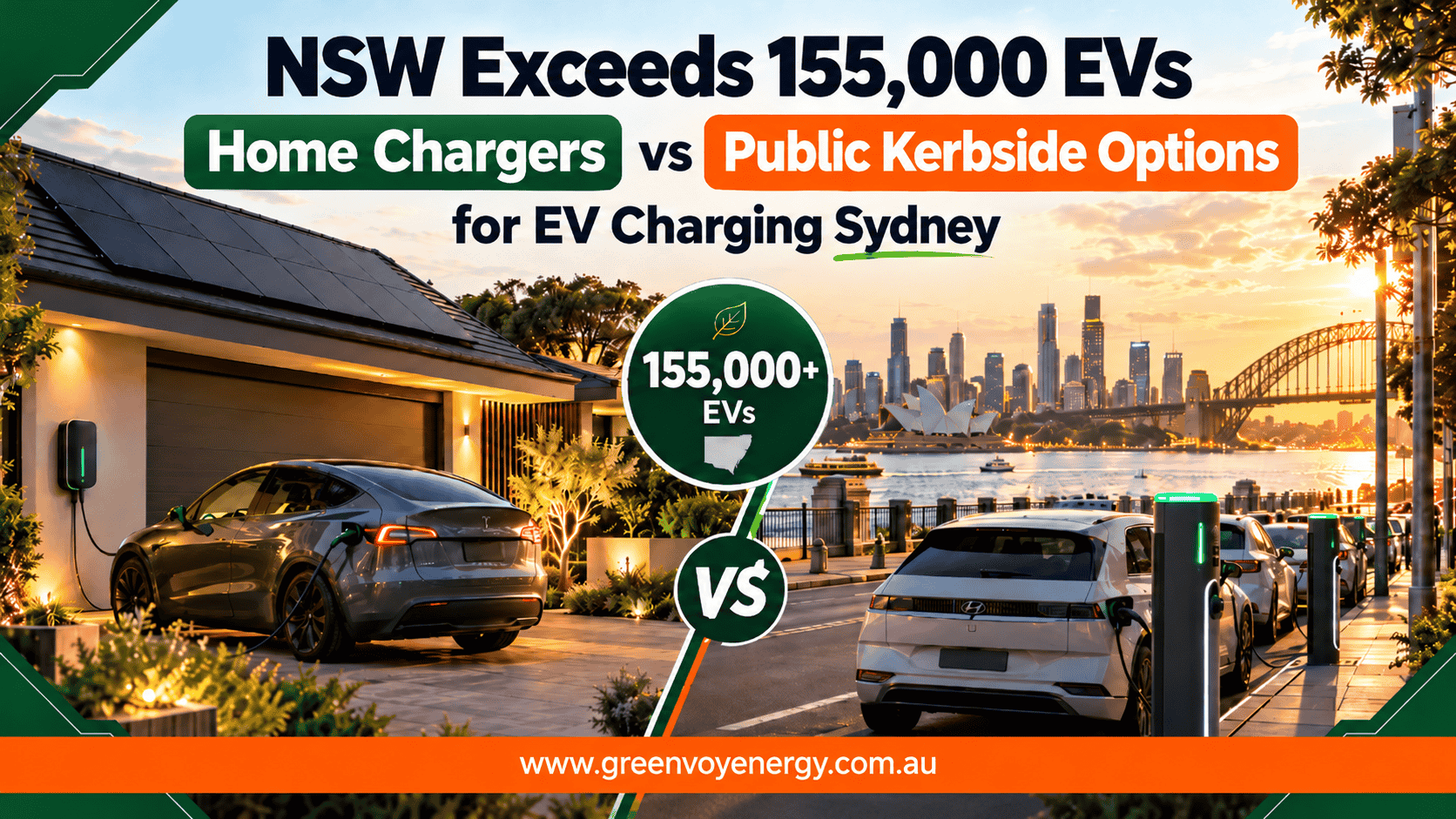
On Sunday evening, Ben checks his calendar: school drop-offs, a Parramatta meeting and a weekend visit to family. His new electric car can handle the driving. Finding a charging routine still takes some thought.
Ben is a fictional Sydney homeowner, but his question is practical: should he install a home charger or rely on public charging nearby?
Choosing between EV Charging Sydney options begins with your parking arrangements, daily driving distance and electricity rates. Greenvoy Energy offers residential EV charging solutions, giving homeowners a starting point for planning charging around everyday life.
Why Sydney’s charging conversation is changing
On 19 September 2026, the NSW Government reported more than 155,000 registered EVs across the state. It also announced another $5 million in co-funding for public kerbside charging, aimed at helping drivers who cannot charge at home.
That investment matters for apartment residents and households without driveways. However, a funded charger is not necessarily an operating charger outside your street today. When comparing options, check what is available now, where you can park and whether the location fits your routine.
For Ben, convenience means knowing he can plug in after dinner. For his apartment-dwelling sister, a reliable charger near the supermarket might be just as useful.
Home charging: convenience starts in the driveway
With an EV charger at home, you can conveniently recharge your car while it’s parked. Depending on compatible equipment and settings, charging can be scheduled around cheaper electricity periods or available solar generation.
Greenvoy Energy’s residential EV charging service is worth exploring if you have suitable private parking. Bring your vehicle details, electricity bill and a photo of the switchboard to the conversation.
You may not need the highest-powered wallbox. A driver covering modest distances can have different requirements from someone returning home late after a long commute. First, work out how much charge you need to add before your next trip.
Public kerbside charging: useful without private parking
Kerbside EV charging brings public charging closer to homes, including through installations on suitable poles, verges and in car parks. NSW’s program specifically supports drivers with limited access to private off-street parking.
The attraction is straightforward: you can use a public charger without installing equipment at your property. The trade-off is sharing access. A convenient space may be occupied, and parking restrictions can affect how long you stay.
Before depending on one location, visit at your usual charging time. Check the connector, operating status, payment method and walking distance. A map pin alone cannot tell you how smoothly charging will fit your week.
Home chargers versus kerbside charging at a glance
Neither option wins for every Sydney household. This comparison outlines what to consider before seeking a quote for installing an EV charger at home.
| Consideration | Home charger | Public kerbside charging |
| Parking | Suitable private space needed | Shared public bay |
| Initial expense | Equipment and installation | No personal installation expense |
| Charging price | Your electricity plan | Operator’s advertised charges |
| Availability | Usually under your control | Depends on access and occupancy |
| Solar use | Compatible system can use rooftop solar | Driver does not control the site’s supply |
| Best starting point | Regular charging at home | Drivers without home charging access |
Many drivers will use both. A home wallbox can cover routine travel, while public charging supports outings, longer journeys or unexpected extra kilometres.
What does EV charging cost in Sydney?
Compare electricity costs first, then factor in any additional fees that apply. The following figures are hypothetical examples, not current retailer prices or Greenvoy Energy quotes.
Suppose Ben purchases 40 kWh of charging electricity each week. At an assumed home rate of $0.25 per kWh, that costs $10. At an assumed public rate of $0.55 per kWh, it costs $22. The difference is $12 weekly, or $624 over 52 identical weeks.
That does not establish the payback period for a wallbox. Installation cost, changing tariffs, charging losses, public fees and actual usage all affect the result. Electricity purchased also differs from energy ultimately stored in the vehicle.
Ask Greenvoy Energy for an itemised installation proposal. Compare it with your available alternatives, including any charging facilities you already use at your workplace.
Charging speed: match the car and the connection
Home wallboxes commonly fall within the 7–22 kW AC range, but actual charging depends on the property’s supply, charger settings and the vehicle’s onboard charging capability. Buying a higher-rated unit does not guarantee the car will accept that output.
For example, delivering 20 kWh at a steady 7 kW takes approximately 2.9 hours mathematically. Real charging takes longer where losses, power limits or changing conditions apply.
Kerbside describes the location, not a guaranteed speed. Check whether the unit supplies AC or DC and which connector your vehicle supports. Some public AC locations also require drivers to bring a compatible cable.
Can rooftop solar make home charging cheaper?
Solar EV charging can make sense when your car is parked at home during daylight hours. Compatible controls can direct surplus generation into the vehicle, reducing the electricity purchased from the grid.
But Ben’s car is away most weekdays. His useful solar charging opportunities may be weekends or occasional days working from home.
Discuss your parking schedule with Greenvoy Energy when reviewing its solar panel solutions. Include the feed-in tariff you give up by using exported electricity yourself. If you are considering home battery storage, assess household and vehicle demand together before choosing capacity.
What should an installation quote include?
A dedicated wallbox requires installation by a licensed electrician. Depending on the property, switchboard or supply upgrades may also be necessary. Apartment installations can involve strata approval and shared infrastructure planning.
Ask for the charger model, installation scope, cable route, electrical work, commissioning and warranty arrangements in writing. Clarify whether monitoring, load management or solar integration needs additional equipment or ongoing subscriptions.
When discussing home EV charger installation with Greenvoy Energy, explain whether another EV might join the household. Planning for future demand can help identify sensible options now. Equally, avoid paying for capacity or features you have no realistic reason to use.
Check public charging fees before plugging in
Public charging costs can include more than the advertised energy rate. Depending on the operator and location, parking charges, session conditions or idle fees may apply. Review the app and local signs before starting.
Also check whether the parking limit gives you enough time to obtain the energy you need. A nearby charger that requires you to interrupt dinner and move your car might be less convenient than it first appears.
Ben’s sister might happily charge during her weekly grocery shop. Ben might prefer scheduled home charging. Both choices can work when the practical details line up.
Final Thoughts: Choose charging that fits your week
The best EV Charging Sydney setup makes everyday driving easier. Suitable private parking and predictable charging needs strengthen the case for a home charger. Reliable public kerbside charging offers an important alternative where installing at home is difficult.
For Ben, the next step is a property assessment and a clear quote. Greenvoy Energy provides a place to start that conversation.
Request a quote from Greenvoy Energy with your vehicle model and parking arrangement. A useful proposal should explain the equipment, installation requirements and how charging fits your household.
Frequently Asked Questions
Q1. Is home EV charging cheaper than public charging?
It can be, especially with suitable off-peak rates or surplus solar. Compare your actual household tariff with public charging prices and fees, then include installation costs before deciding.
Q2. Can I own an EV without a home charger?
Yes. Public kerbside, workplace and destination charging may cover your needs. Check reliable locations along your regular routes and keep an alternative available when your preferred charger is occupied.
Q3. Do I need a 22 kW home charger?
Not necessarily. Your vehicle’s AC limit, electrical supply and driving routine determine what is useful. Ask Greenvoy Energy to discuss suitable options before choosing equipment based on its maximum rating.
Q4. Can a home charger use my solar panels?
A compatible setup can use available solar electricity. The benefit depends on daytime parking, surplus generation and control settings. Confirm compatibility with your existing solar system before installation.
Q5. Does Greenvoy Energy provide residential EV charging?
Yes. Greenvoy Energy lists residential EV charging among its services. Contact the team to discuss your Sydney property, vehicle compatibility and an installation quote suited to your charging needs.


Leave a comment