At 8pm, Alex opened the electricity app while the air conditioner, oven and dishwasher were running. His rooftop panels had finished producing hours earlier. A battery seemed like the obvious next step.
Choosing one was less straightforward. One friend recommended Tesla. Another preferred Sungrow. Online, SigenStor appeared in almost every discussion.
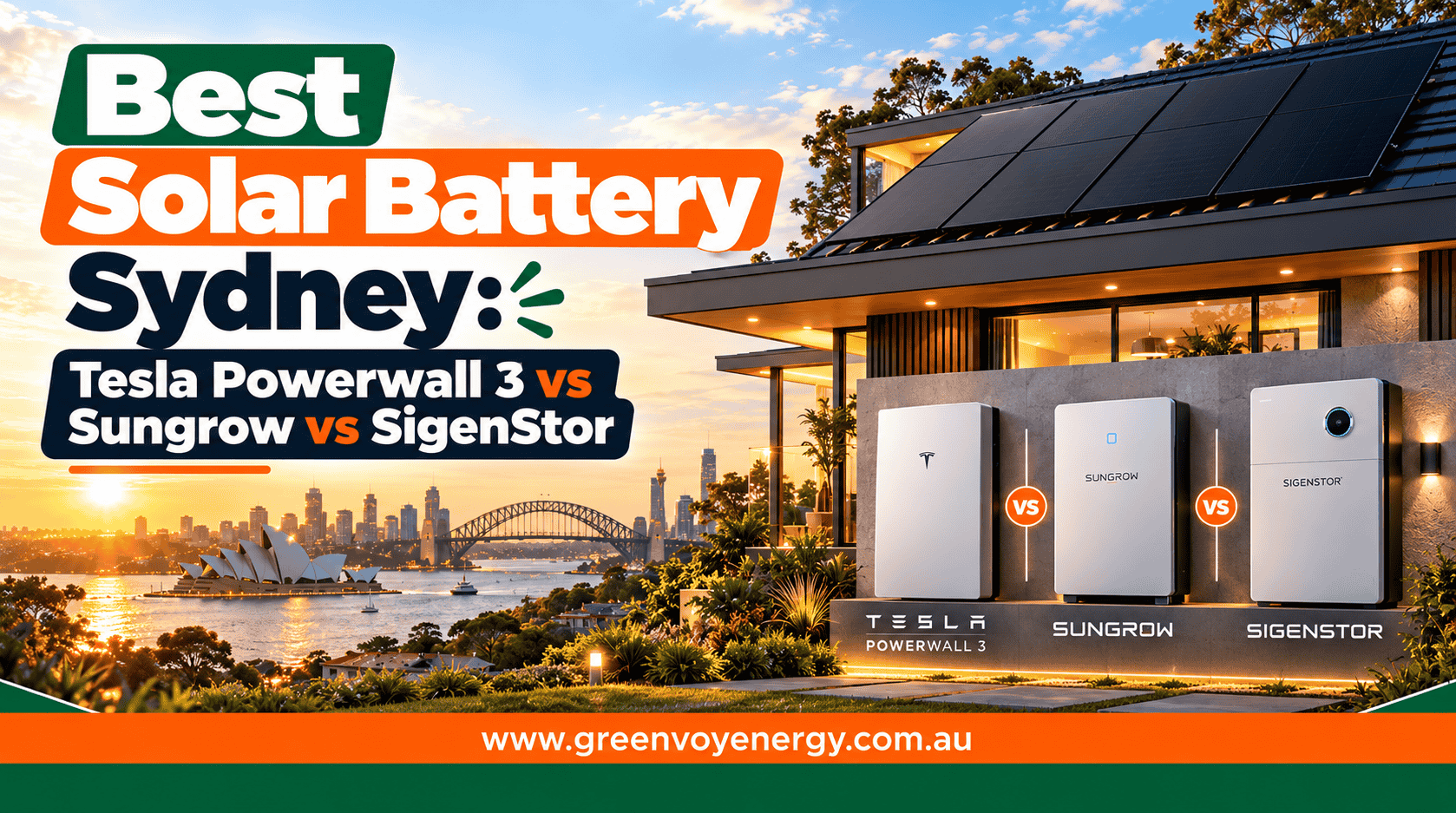
Alex is fictional, but his dilemma is familiar. If you are searching for the Best Solar Battery Sydney homeowners can choose, the answer depends on your property, energy use and budget. This Greenvoy Energy guide compares the three options without pretending one battery suits every household.
Start With the Home, Then Compare the Brands
Before comparing logos, look at how much electricity you use after solar production falls. Check several months of data, including winter, and note which appliances run together.
Share your bills, inverter model and future plans with Greenvoy Energy. An EV, electric heating or a growing household can change the recommendation. Battery capacity matters, but so do available solar surplus, discharge power, backup requirements and installation costs. A smaller system used effectively may offer better value than extra storage that rarely serves useful demand.
A Clear Comparison of Three Battery Options
Powerwall 3 is a specific product. Sungrow and SigenStor cover multiple configurations, so comparing them requires named examples.
| Option | Capacity reference | Main design consideration |
| Tesla Powerwall 3 | 13.5 kWh usable per main unit | Integrated solar inverter and Tesla app |
| Sungrow SBR | 3.2 kWh modules; examples include 12.8 and 16 kWh | Compatible hybrid inverter and selected stack |
| SigenStor BAT 5.0/8.0 examples | 13.0 or 15.6 kWh usable combinations | Battery modules plus an energy controller |
These figures describe specified products and configurations, not every model available. Capacity measurements and conversion boundaries differ between manufacturers, so compare expected energy delivered to your home as well as headline storage.
Tesla Powerwall 3: An Integrated Option to Assess
Powerwall 3 combines 13.5 kWh of usable storage with an integrated solar inverter. Its monitoring and controls operate through the Tesla app. That makes it worth assessing when you want a coordinated battery and solar platform.
Expansion options exist, so Powerwall should not be dismissed as permanently fixed at one unit. However, adding storage does not necessarily increase discharge power proportionally. Ask Greenvoy Energy how the proposed configuration would handle your evening appliances, existing panels and backup circuits. Confirm approved output settings and network requirements rather than relying on overseas specifications.
Sungrow: Compare the Battery and Inverter Together
Sungrow’s SBR range uses 3.2 kWh battery modules, with supported stacks across a 6.4–25.6 kWh range. This offers different capacity choices, including configurations around the size many households initially consider.
The proposed solution includes more than just the battery. Its compatible inverter, module count and electrical design determine performance. If your home already has a suitable Sungrow hybrid inverter, ask whether it can remain in place. Factor in the replacement cost if a new unit is needed. Sungrow also offers other battery ranges, including SBH, so the quote should identify exactly which family is proposed.
SigenStor: Flexibility Depends on the Exact Configuration
SigenStor combines an energy controller with modular battery storage. Using the documented BAT 5.0 and BAT 8.0 examples, one of each provides 13.0 kWh usable capacity; two BAT 8.0 modules provide 15.6 kWh.
Other module generations have different specifications. Ask for the quoted model numbers and actual usable capacity rather than assuming the product name describes the energy available. When exploring SigenStor options with Greenvoy Energy, discuss controller sizing, compatible expansion and any optional equipment. Features mentioned in a platform brochure are not necessarily included in the installation price.
Backup Power Needs More Than a Large Battery
Alex initially wanted “whole-house backup”. Then he considered what that meant: keeping lights, refrigeration and internet running was different from operating every appliance during an outage.
Capacity in kWh affects how long stored energy may last. Power output, measured in kW, determines which appliances can run at the same time. Backup also needs the correct switching equipment, wiring and system configuration. Ask which circuits remain powered, whether solar can recharge the battery during an outage and what happens when the reserve is depleted. Three-phase homes need particular attention to phase coverage.
Compare Installed Prices on the Same Basis
A meaningful solar battery price comparison in Sydney includes the battery, inverter or controller, installation, monitoring equipment and any backup hardware. Switchboard work, cable routes and installation location can change the total.
Ask Greenvoy Energy for itemised alternatives with comparable usable storage and backup scope. Then compare estimated savings using the same electricity tariff and household assumptions. The cheapest equipment package may require additional work, while a more expensive proposal may include features another quote excludes. Neither price alone nor brand reputation establishes the better investment. Confirm how the system will be monitored after installation and commissioning, too.
What the Federal Battery Rebate Changes
The Cheaper Home Batteries Program can reduce eligible installation costs through small-scale technology certificates. Support is commonly delivered as an upfront discount when the homeowner assigns certificate rights.
The capacity taper applies across brands: the first 14 kWh of usable capacity receives the full applicable factor, the portion above 14 through 28 kWh receives 60%, and capacity above 28 through 50 kWh receives 15%. A larger battery does not lose support on its first 14 kWh. Ask Greenvoy Energy to show the maximum applicable entitlement for your eligible system, separately from the final price.
Read Warranty Conditions Beyond the Headline
A ten-year warranty headline does not mean every component or operating pattern receives identical protection. Compare defect cover, retained-capacity terms, throughput limits, internet requirements and responsibility for labour or transport.
Tesla, Sungrow and Sigenergy publish separate Australian warranty documents. Request the current version applicable to your equipment and installation date. Also clarify the installer’s workmanship cover and claim process. Knowing what support is available can be more valuable than a lengthy warranty whose terms are unclear. Keep the quote, commissioning records and warranty documents together.
Check Equipment Versions and Current Approvals
Model details matter when comparing SigenStor. Certain single-phase 8, 10 and 12 kW energy controllers with older quick-connect AC plugs were recalled. The Clean Energy Council documents an approved replacement connection design; the recall does not apply to every SigenStor configuration.
Ask Greenvoy Energy to identify the exact controller version and confirm current product eligibility. Apply the same approval and installation checks to every brand. For an existing affected system, follow the manufacturer’s recall instructions and arrange the required remedy.
Which Battery Should Make Your Shortlist?
Powerwall 3 deserves consideration if its integrated design, capacity and Tesla controls fit your requirements. Sungrow SBR is worth comparing when modular sizing and a compatible hybrid inverter suit the project.
SigenStor warrants a closer look when its controller and modular storage choices match your wider energy plans. These are starting points for discussion, not performance rankings. Alex’s decision became easier once he compared complete systems against his evening usage rather than collecting opinions about brands.
Final Thoughts: Find Your Best Fit With Greenvoy Energy
The Best Solar Battery Sydney choice is the system that matches your home at a sensible installed cost. Tesla Powerwall 3, Sungrow and SigenStor each offer configurations worth assessing, but their suitability depends on the details.
Explore Greenvoy Energy’s solar batteries and discuss your existing inverter setup before deciding. Request a Greenvoy Energy quote to compare usable storage, backup capability, installation scope and available incentives. Bring your electricity data; it will tell you more about the right battery than a popularity contest ever could.
Frequently Asked Questions
Q1. Is Tesla Powerwall 3 the best battery for every Sydney home?
No. Its suitability depends on capacity needs, electrical configuration, backup priorities and the complete installed price.
Q2. How do Sungrow and SigenStor differ from Powerwall 3?
The examples here use modular battery stacks with compatible controllers or inverters. Powerwall 3 integrates storage and a solar inverter in its main unit.
Q3. Can I keep my existing solar inverter?
Possibly. Greenvoy Energy should assess the existing equipment, proposed battery architecture and applicable approval requirements before confirming compatibility.
Q4. Will these batteries automatically provide whole-home backup?
No. Protected circuits, phase coverage, switching equipment and power limits depend on the installed configuration. Request a written backup scope.
Q5. Does choosing Greenvoy Energy guarantee a fixed rebate?
No. Greenvoy Energy can explain applicable incentives, but entitlement depends on the equipment, installation timing and program eligibility.


Leave a comment