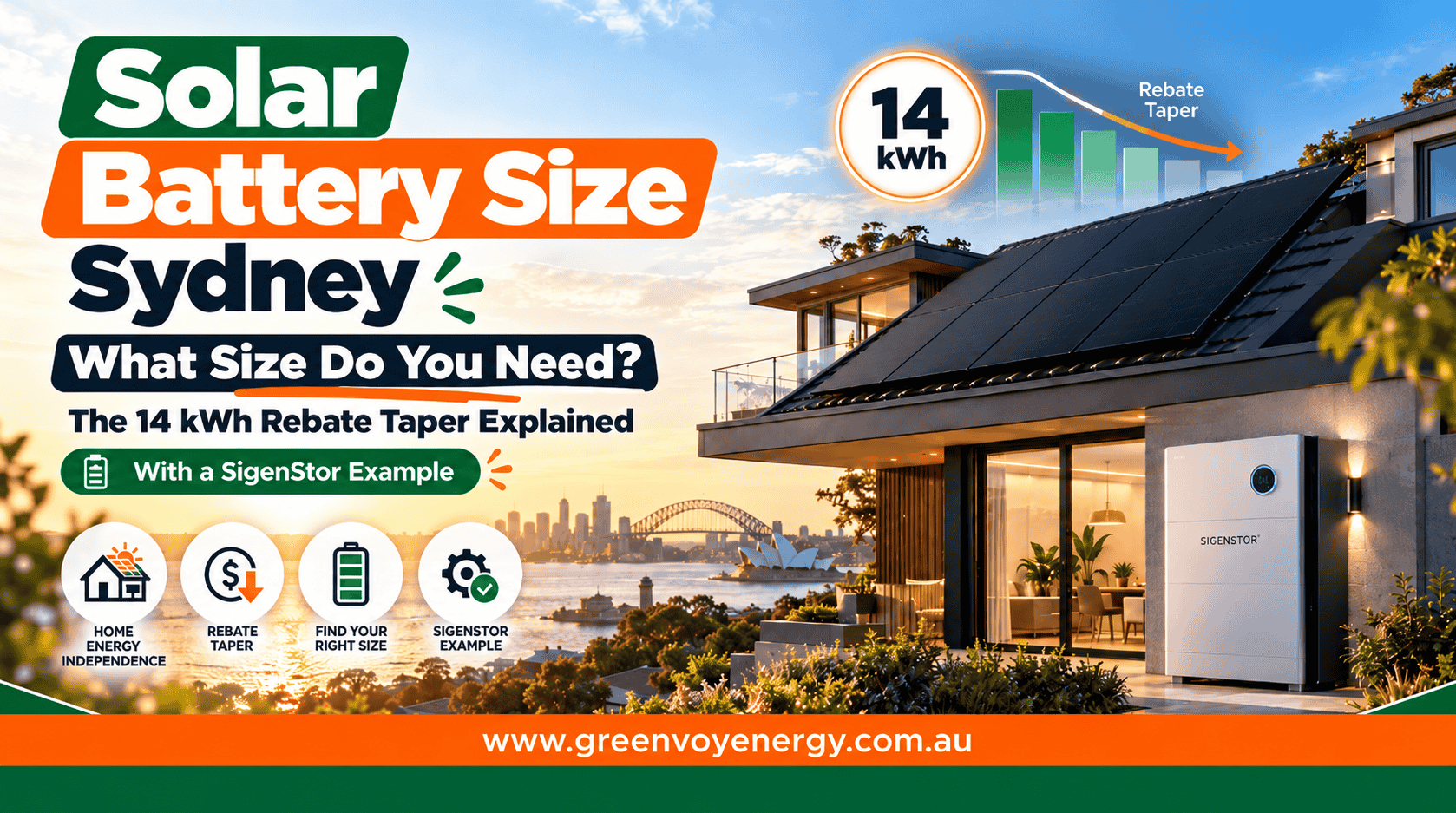
When Nina and Mark began comparing batteries for their Sydney home, Mark circled the largest capacity on every quote. More storage seemed like better value. Nina looked at their electricity app instead: how much energy did they actually buy after sunset?
Then they heard about the 14 kWh rebate taper. Would choosing a larger battery mean losing the rebate altogether?
Nina and Mark are fictional, but their questions are useful. This Solar Battery Size Sydney guide from Greenvoy Energy explains how household demand, usable capacity and the federal incentive work together, using SigenStor configurations as an example.
Start With Your Evening Electricity Use
A daily electricity total tells only part of the story. A household using 30 kWh daily might consume much of it while solar panels are generating. Another home with similar total usage might buy most of its electricity after dark.
Before choosing home battery storage, review smart-meter data across several months. Separate daytime imports, evening demand and overnight use. Share those patterns with Greenvoy Energy, along with any plans for an EV or electric heating. The aim is to understand which electricity purchases stored energy could realistically replace.
What the 14 kWh Rebate Taper Actually Means
Since 1 May 2026, federal battery support has used capacity bands. The applicable STC factor is applied at 100% to the battery’s first 14 kWh of usable storage. The portion above 14 kWh through 28 kWh receives 60%, while capacity above 28 kWh through 50 kWh receives 15%.
Crucially, crossing 14 kWh does not reduce support on the first 14 kWh. Only the additional capacity receives a lower factor. The threshold changes the marginal incentive; it does not establish the ideal battery size for every Sydney home.
Usable Capacity Matters More Than the Product Label
The rebate calculation uses usable capacity. That differs from nominal or total capacity, and neither should be confused with the model’s marketing name.
For this example, Sigenergy’s BAT 5.0 and BAT 8.0 modules have documented usable capacities of 5.2 kWh and 7.8 kWh respectively. One of each provides 13.0 kWh usable capacity; two BAT 8.0 modules provide 15.6 kWh. These are specific model examples, not specifications for every SigenStor generation. Ask Greenvoy Energy to identify the exact modules and approved configuration on your quote.
SigenStor Example: Comparing Five Storage Configurations
For eligible installations from May through December 2026, the full factor is 6.8 STCs per usable kWh, before applying the capacity taper. The final certificate total is rounded down.
The following calculations assume a new, eligible installation using BAT 5.0/8.0 modules:
| Example module combination | Usable capacity | Calculated STCs |
| Two BAT 5.0 modules | 10.4 kWh | 70 |
| One BAT 5.0 plus one BAT 8.0 | 13.0 kWh | 88 |
| Two BAT 8.0 modules | 15.6 kWh | 101 |
| Three BAT 8.0 modules | 23.4 kWh | 133 |
| Four BAT 8.0 modules | 31.2 kWh | 155 |
These are capacity illustrations, subject to equipment compatibility and approval checks. They are not installation quotes or guaranteed discounts.
How the Calculation Works Above 14 kWh
Consider the 15.6 kWh example. Its first 14 kWh generates 95.2 certificates before rounding. The remaining 1.6 kWh generates another 6.528 certificates because that portion receives 60% of the factor.
Together, that is 101.728, rounded down to 101 STCs. Applying 60% to the entire battery would understate support. Applying the full factor to all 15.6 kWh would overstate it. Compare the official calculator result with the certificate calculation shown in your proposed quote.
Does Crossing the Threshold Make a Larger Battery Poor Value?
Moving from 13.0 kWh to 15.6 kWh adds 2.6 kWh of usable storage and, in this example, 13 STCs. At the clearing-house benchmark of $40 per certificate excluding GST, those additional certificates represent $520.
That is a gross illustration, not the extra discount Greenvoy Energy will necessarily quote. Market prices and administration charges can affect the benefit passed on. Compare the final installed price difference with the additional useful storage, rather than choosing solely by the rebate percentage.
When a Smaller Battery May Be Enough
Suppose Nina and Mark usually purchase around 9 kWh between late afternoon and morning. A 13.0 kWh usable system could be a sensible option to assess, allowing for losses, operating settings and any backup reserve.
It would still need a suitable charging source and adequate power output. This is a starting point for design, not a recommendation based on one number. A smaller battery that regularly serves useful demand may provide better value than extra capacity that remains largely unused. Ask how the recommendation changes during cloudy weeks, when stored energy and rooftop production may both be more limited.
When More Than 14 kWh Can Make Sense
A household with substantial evening air conditioning, electric heating or overnight demand may have a genuine reason to consider larger storage. A reduced incentive on additional capacity does not remove the value of energy the household can use.
Look at winter conditions and future loads, too. If an EV arrives next year, estimate how often it will charge at home and whether direct daytime solar charging is practical. Greenvoy Energy can discuss how solar battery options fit those broader energy plans.
Check Charging Supply and Power Output
Capacity in kWh describes stored energy. Power in kW describes how quickly the system can charge or discharge. A battery may hold enough energy for an evening while still needing grid assistance when several large appliances operate together.
Your solar inverter configuration, battery modules and electrical supply influence those limits. Also assess available solar surplus: a large battery cannot fill from rooftop generation that your household has already consumed. Backup needs compatible equipment and configuration, so discuss essential circuits separately from whole-home energy goals.
Plan Expansion and Rebate Eligibility Carefully
SigenStor’s modular format offers flexibility, but later expansion needs compatibility and eligibility checks. Federal support generally cannot be claimed again at the same premises after a battery system has already received program support.
Eligible systems must meet approved equipment and installer requirements and connect with solar PV. Grid-connected systems need VPP capability, although joining a VPP is optional. Ask Greenvoy Energy to confirm the current requirements and maximum applicable entitlement for your proposed installation. Modular hardware should not be mistaken for a promise of another rebate later.
Compare Itemised Quotes With Greenvoy Energy
When reviewing SigenStor battery options with Greenvoy Energy, request the module combination, usable capacity, inverter rating, installation scope and warranty terms. The quote should identify the incentive and final payable amount clearly.
Support is commonly delivered through an upfront discount when certificate rights are assigned, rather than a government cash reimbursement afterwards. The applicable factor also changes with installation and certification timing: January–June 2027 uses 5.7 rather than 6.8. Compare the complete offer, including equipment suitability, rather than assuming an earlier purchase contract fixes the certificate rate.
Final Thoughts: Choose Useful Storage With Greenvoy Energy
Nina and Mark stopped comparing batteries by size alone. They wanted enough storage to serve their evening routine, with room for realistic future needs and a clear explanation of the cost.
For anyone researching Solar Battery Size Sydney, the 14 kWh taper is one part of that decision. It rewards the first capacity band more strongly without making larger batteries automatically unsuitable. Request a Greenvoy Energy quote to compare configurations against your electricity use, solar production and budget. Choose useful capacity first, then check the rebate maths.
Frequently Asked Questions
Q1. Is 14 kWh the best battery size for Sydney homes?
No. The threshold concerns incentive calculations. The right capacity depends on your energy use, charging opportunities, power requirements and budget.
Q2. Does a 15.6 kWh battery lose the full rebate?
No. Its first 14 kWh retains the full applicable factor. Only the remaining 1.6 kWh receives the reduced 60% factor.
Q3. How much usable storage do two SigenStor BAT 8.0 modules provide?
The documented combination provides 15.6 kWh usable capacity. Confirm exact model specifications, equipment compatibility and approved configuration before ordering.
Q4. Can I receive another federal rebate when adding modules later?
Generally not if the battery system at that premises has already received program support. Confirm your circumstances before budgeting for future incentives.
Q5. What should I send Greenvoy Energy for a battery quote?
Provide recent bills, available usage data, solar and inverter details, future appliance plans and backup priorities so Greenvoy Energy can discuss suitable options.



Leave a comment