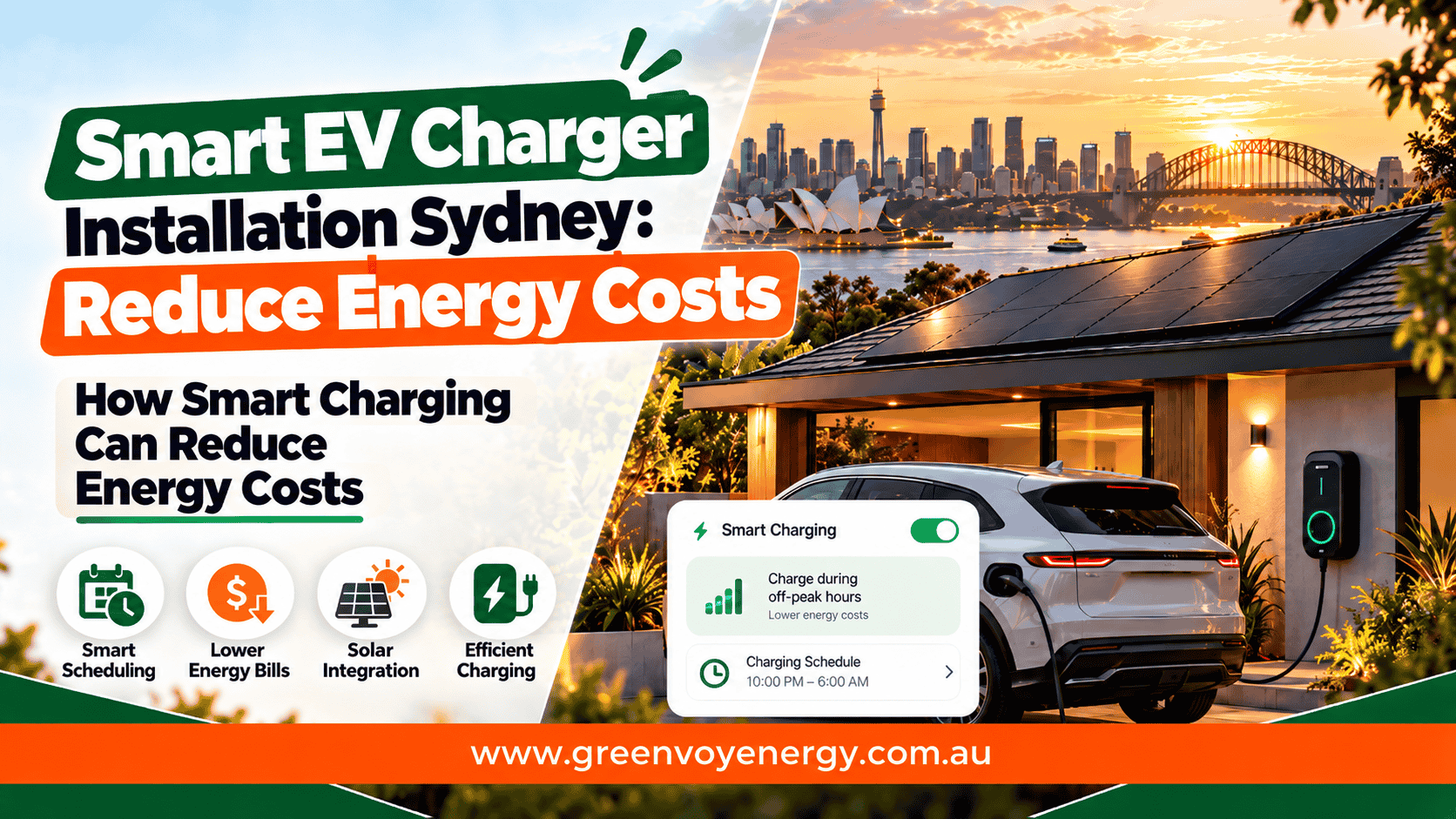
James plugged in his electric car as soon as he got home. Dinner was cooking, the air conditioner was running, and the car would be ready by morning. Everything felt convenient.
Then he looked at his electricity plan. Charging had been starting during an expensive period, even though the car usually stayed parked until seven the next morning.
James is a fictional Sydney driver, but his situation explains why timing matters. With smart EV charger installation Sydney, households can gain greater control over their charging times and settings. Greenvoy Energy offers residential EV charging solutions, providing a starting point for planning a setup around your car, property and electricity use.
What makes an EV charger smart?
Smart charging adds controls beyond simply plugging in. Depending on the equipment, these may include scheduled charging, app access, energy monitoring or adjustments based on available solar generation. Australian Government guidance identifies scheduling and energy management as ways to charge when electricity is cheaper or solar is available.
However, the word “smart” does not promise every feature. Some controls may already exist in your vehicle. Other functions require compatible hardware, metering or software.
Ask Greenvoy Energy which capabilities are included in the proposed charger. Start with the problem you want solved, whether that is evening charging costs, unused daytime solar or a changing driving schedule.
Start with your routine and electricity tariff
James did not need a full recharge every evening. He needed enough energy for tomorrow’s commute, with occasional extra charging before longer trips.
Look at your weekly kilometres, usual arrival time and next departure. Then check the tariff that actually applies to your meter. A flat-rate plan may offer no price advantage from moving charging overnight. A time-of-use plan can have different prices across specified periods.
For Greenvoy Energy, those details are useful when discussing home EV charging options. Bring your vehicle model and a recent bill, rather than choosing a wallbox solely because it advertises the fastest charging.
How scheduled charging can lower costs
The potential saving comes from changing the price paid for electricity, rather than assuming the vehicle suddenly needs less energy.
Consider an illustrative household purchasing 40 kWh of charging electricity weekly. At an assumed peak price of $0.45 per kWh, that costs $18. Moving the same amount to an assumed $0.20 rate reduces it to $8.
That is a hypothetical difference of $10 weekly, or $520 across 52 identical weeks. These are example rates, not current retailer offers or Greenvoy Energy quotations.
Actual results depend on your tariff, charging losses, how much energy shifts and whether the cheaper window lasts long enough. Include installation and ongoing costs when assessing the overall value.
Compare the whole electricity bill
A cheap EV charging rate can look attractive while other charges receive less attention. Check supply charges, electricity prices outside the discounted window, eligibility conditions and any solar feed-in tariff before switching.
Compare plans using your household’s consumption pattern, including the vehicle. Energy Made Easy offers electricity plan comparisons in NSW and can estimate plan costs using available household usage information.
Ask Greenvoy Energy to clarify the charger’s scheduling capabilities, then check retailer terms separately. Equipment installation does not automatically place you on a particular electricity plan. The best match requires both the charging controls and your tariff to suit how your household operates.
Use rooftop solar when the car is home
Solar EV charging can reduce grid purchases when the car is connected during useful generation hours. Compatible equipment can adjust charging to take advantage of surplus solar after other household consumption.
James worked away from home most weekdays. His practical opportunities were weekends and occasional remote-working days. A solar charging feature could still help, but promising daily solar-only charging would ignore his routine.
Discuss solar panel installation with Greenvoy Energy alongside your parking schedule. Consider the feed-in tariff forgone when solar is used in the car instead of exported. Also check whether settings permit grid top-ups when sunlight is insufficient and you need to leave.
Understand solar charging modes before choosing
A solar-compatible charger may offer several operating modes. For example, myenergi describes zappi modes for grid charging, renewable-energy charging and combinations of both. Greenvoy Energy lists a zappi charger on its residential EV charging page.
The important question is what the quoted model will do at your property. Ask how it measures surplus generation, responds to clouds and handles a requested boost.
If your home has a battery, decide when to prioritise EV charging and when to reserve stored energy for household use. Manufacturer documentation describes settings intended to manage battery interactions, but suitability depends on the electrical arrangement and configuration.
Load management needs a clear explanation
Your car can charge while other household appliances are operating. That makes electrical capacity and the proposed charging controls worth discussing before installation.
Ask whether the system includes dynamic load management, what it monitors and how it adjusts charging when household demand rises. Confirm any additional sensors, communications equipment and installation costs.
These questions help Greenvoy Energy explain the complete proposal. A monitoring screen and automatic load management serve different purposes, so request a demonstration of the functions included. If charging slows while other appliances run, understand how that affects the energy available before your next departure.
Match charging power to your car
Dedicated home AC chargers commonly operate within the 7–22 kW range. Actual charging capability also depends on the vehicle and electrical supply; a higher charger rating alone does not guarantee faster charging.
Distinguish power from energy. Kilowatts describe charging power, while kilowatt-hours describe energy delivered over time.
For example, delivering 21 kWh at a steady 7 kW takes three hours mathematically. Real conditions, losses and power adjustments can extend that time. Ask Greenvoy Energy to check whether your intended charging window is realistic before selecting equipment or considering electrical upgrades.
What should the installation quote include?
A dedicated home EV charger must be installed by a licensed electrician. Depending on the property, switchboard or supply upgrades may be required. Shared buildings can also involve strata approval and infrastructure planning.
For smart EV charger installation Sydney, request a written scope covering the exact model, mounting position, cable route, electrical work and commissioning.
Confirm whether solar integration, load management and connectivity equipment are included. Ask about subscriptions, warranty terms and support responsibilities. Greenvoy Energy should have your parking arrangement and vehicle details available when discussing the proposed installation.
Check the settings after installation
The handover should leave you comfortable using the charger. Ask how to change schedules, override a timer and review charging sessions. Clarify what happens if the internet connection fails or your electricity plan changes. Keep this explanation with your installation documents.
James’s next step would be simple: compare several weeks of charging records with the relevant tariff periods. Were sessions starting when intended? Was the vehicle ready each morning?
Keep the vehicle’s timer and charger schedule coordinated. If the controls become confusing, ask Greenvoy Energy which device should manage the routine. Review settings whenever your driving habits change.
Final Thoughts: Make charging fit your household
Smart EV charger installation Sydney offers the most value when useful controls match a suitable tariff and a realistic parking schedule. Solar integration and load management deserve consideration alongside installation costs.
For James, the opportunity was straightforward: use the hours his car already spent parked more thoughtfully.
Request an EV charging quote from Greenvoy Energy with your vehicle details, electricity bill and parking information. Ask for a clear explanation of the recommended features and the costs involved.
Frequently Asked Questions
Q1. Can smart charging reduce my electricity bill?
It can help if charging moves to cheaper periods or uses available solar. Savings depend on your tariff, consumption and setup.
Q2. Do I need solar panels for a smart charger?
No. Scheduling can work with grid electricity. Solar-specific benefits require suitable generation and compatible equipment.
Q3. Will a 22 kW charger charge every car faster?
No. Vehicle limits, supply capacity and installation settings affect charging power. Confirm compatibility before choosing equipment.
Q4. Can smart charging work with a home battery?
Potentially. Ask how the proposed controls coordinate the battery and EV, including priorities for surplus solar and grid charging.
Q5. Does Greenvoy Energy offer home EV charging?
Yes. Greenvoy Energy lists residential EV chargers among its services. Contact the team to discuss your property and installation requirements.


Leave a comment