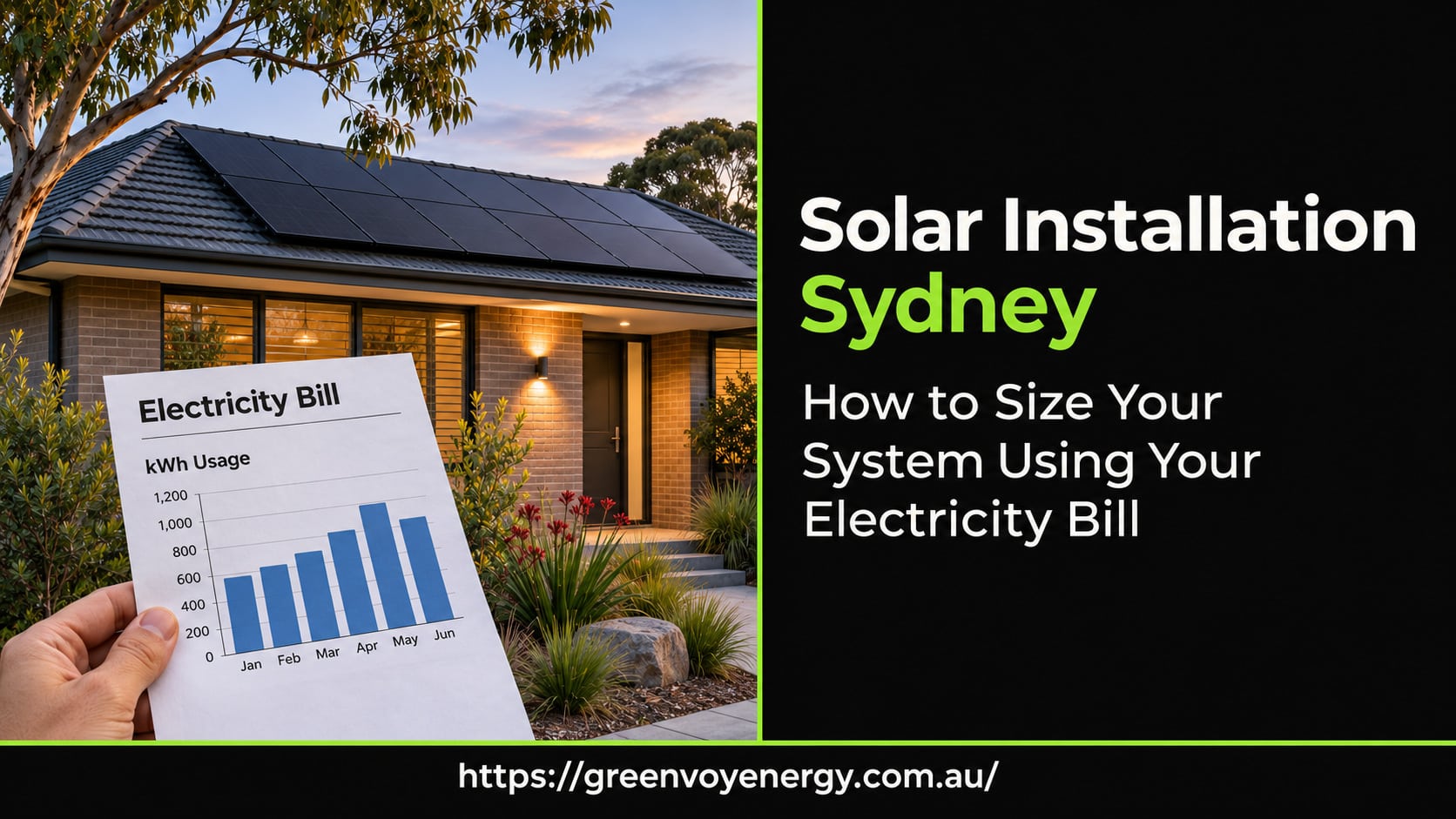
The first time Anita sat down to compare solar quotes for her Parramatta home, she circled the biggest number on the bill. It was the amount due. Fair enough. That was the number she wanted to bring down. One quote proposed 6.6 kW of panels and the other proposed 10 kW. Nothing she’d circled told her which made more sense.
Anita’s household is a fictional example, but the starting point is the same for anyone planning solar installation in Sydney. Find your average daily electricity use in kilowatt-hours (kWh), compare bills from different seasons and check when you use most of that energy. Then ask a Sydney solar installer to model what your roof can generate during those hours. Greenvoy Energy can help turn those figures into a shortlist of system sizes.
Find the number that matters on your electricity bill
Look for “average daily use” or “average daily usage”. If your bill only lists total usage, divide the total kWh by the number of days in the billing period. Anita’s winter bill showed 1,800 kWh over 90 days. That works out to 20 kWh a day. Her spring bill showed 1,380 kWh over 92 days, or 15 kWh a day. Comparing the averages put both bills on the same footing.
The dollar total combines usage charges with things like the daily supply charge, discounts and credits. If your electricity plan changes, the total can move even when you use the same amount of power. If you already have solar, the usage figure on the bill generally shows electricity bought from the grid. Pair it with solar monitoring data to account for the energy you already use straight from the roof.
Check when you use electricity with smart meter data
Anita assumed the heating pushed up her winter usage. Her smart meter data gave her a better clue. On workdays, the biggest spike tended to come just after six, when the heating went on and dinner went into the oven. On Fridays, when she worked from home, there was more daytime use and a smaller jump at dinner.
If your retailer’s app or online account offers an hourly view, start there. For a more detailed solar sizing estimate, ask your electricity distributor for 12 months of interval meter data. Compare weekdays and weekends across seasons. If your plan lists peak, shoulder and off-peak usage, look up the actual hours for each band. A tariff band can include hours when your panels are generating very little.
Two homes can both average 20 kWh a day and need different solar layouts. One might run a pool pump and home office through the afternoon. The other might use most of its energy for evening cooking and heating. The first has more opportunity to use rooftop generation as it happens. The second might have more surplus to export during the day and still buy power at night.
Match your daily usage to what your Sydney roof can generate
The units are easy to mix up. kW measures power and describes the rated capacity of your solar panels. kWh measures energy over time, which is why it appears on your bill. Using 20 kWh a day gives an installer a figure to compare against estimated generation. The size of the array in kW comes from modelling your roof, usage and connection conditions together. If two designs use different solar panels, compare the total rated capacity and panel layout on each quote.
Ask for monthly generation estimates for the proposed panel layout. Direction, tilt and shading can affect how much energy the system produces and when. West-facing panels may give you more generation later in the day, which could suit a household that gets home in the afternoon. A shaded west-facing roof could tell a different story. Start with Greenvoy Energy’s guide to assessing your roof for solar.
The annual figure can look reassuring on a quote. If winter is when your household uses the most energy, look at June and July separately. Anita wanted to know how much grid electricity she could realistically avoid on a cold weekday. A yearly average couldn’t show her what happened during those shorter afternoons.
Compare a 6.6 kW and 10 kW solar system on the same terms
Get both options modelled using the same household usage, tariffs and assumptions about shade. Ask how much electricity each system is expected to generate, how much you could use at home and how much would go back to the grid. Then check what you’d pay for each system fully installed. A larger array could offer good value if your daytime demand is high or likely to grow.
For Anita, the larger quote made more sense if she could move some energy use into the day. She could run the dishwasher at lunchtime, but dinner was always going to be dinner. If an EV arrived next year and could be plugged in on work-from-home days, that would give her another use for the extra generation. See Greenvoy Energy’s 6.6 kW vs 10 kW solar system comparison.
Use your tariffs to put a value on extra solar generation
Find your usage rate, feed-in tariff and daily supply charge. Imagine you pay 32 cents for each kWh you buy and receive 5 cents for each kWh you export. In that example, using one kWh of solar at home to replace a grid purchase saves 32 cents. Sending it to the grid earns 5 cents. Use the rates on your own plan, including any time bands, when comparing quotes.
Ask what export limit would apply at your address and how it was factored into the estimate. That limit governs how much power you can send to the grid at a given time. If a larger system’s projected savings rely heavily on exports, check how much of that extra generation can actually be exported and what your retailer would pay for it.
Factor in future appliances and battery plans
Tell your installer if you’re likely to add an EV, a pool pump or a heat pump hot water system. The timing matters. Hot water that can be heated during the day may use solar generation directly. A car that’s parked elsewhere until late evening will generally need another source of energy when it gets home.
If you’re considering battery storage, ask for the solar-only and solar-plus-battery options to be modelled separately. Use your meter data to estimate evening demand and the proposed system’s daytime output to estimate what could be stored. That gives you a clearer way to compare the added cost against the grid electricity a battery might replace.
Bring your bills to Greenvoy Energy
Once Anita had her winter and spring bills and a look at her meter data, she knew which questions to ask. How much of the extra output would she use? What would winter look like? And would a bigger array help if she added an EV? She could now compare the two quotes on how each system would work at her home.
Gather bills from different seasons, download interval data if available and note any equipment you plan to add. For a proposal based on your roof and electricity use, contact Greenvoy Energy for a solar sizing quote.
Frequently asked questions
Q1. What size solar system do I need if I use 20 kWh a day?
Start by comparing how much of that 20 kWh you use during daylight with how much each proposed system could generate on your roof. A 6.6 kW quote can be a useful comparison point, alongside a larger design if your daytime demand or future plans warrant it.
Q2. Can I size solar from just one electricity bill?
You can make an initial estimate. Bills from different seasons give a better picture, especially if you rely on electric heating in winter or air conditioning in summer.
Q3. Is a 10 kW solar system too big for my house?
It depends on your daytime usage, available roof space, future appliances and export arrangements. Ask an installer to show how much of the extra generation you’d use, store or export.
Q4. How many solar panels make up a 6.6 kW system?
Fifteen 440 W panels add up to 6.6 kW of rated panel capacity. The actual panel count depends on the wattage of the modules quoted and the roof layout.
Q5. Will the right-sized solar system eliminate my electricity bill?
Most grid-connected households still have a daily supply charge and may buy electricity at night or when solar production is low. Ask for an estimate of what your bill could look like after installation using your actual tariffs.



Leave a comment