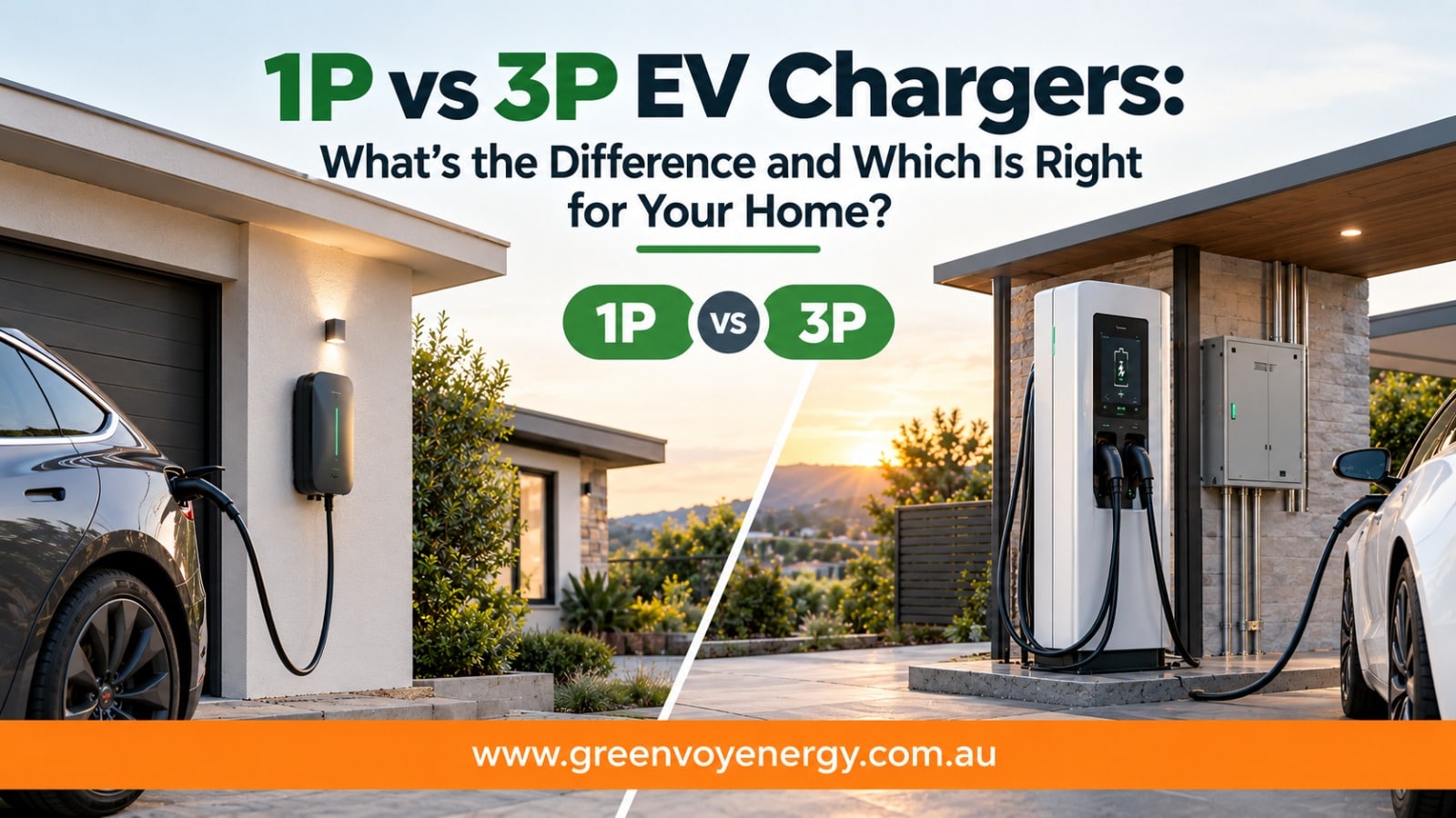
You have bought an electric vehicle, got your parking situation sorted, and now you are ready to install a charger. Then you come across terms like 1P EV charger, 3P EV charger, single-phase, three-phase, 7kW, and 22kW, making the choice seem more technical than you initially expected.
The good news is that the core concept is relatively straightforward. 1P means single-phase, while 3P means three-phase, but choosing between them is not just about picking the charger with the bigger number. Your EV, electrical supply, driving routine, solar system, battery and future energy plans all have a part to play.
At Greenvoy Energy, EV charging is considered as part of the complete home energy picture. Instead of focusing only on charging speed, Greenvoy Energy looks at how your charger can fit into the way your home actually generates and uses electricity.
What Does 1P Mean in an EV Charger?
When you see a 1P EV charger, the “1P” refers to a single-phase electrical supply. Single-phase electricity is widely used in Australian homes, making single-phase EV chargers a common choice for residential charging. A typical example is a 7kW single-phase EV charger.
For many homeowners, this can be more than practical because the EV is usually parked for several hours overnight. You are not standing beside the car waiting for it to charge; it is simply charging while you sleep.
At Greenvoy Energy, single-phase charging can be considered alongside your vehicle and home’s electrical setup. The idea is to make sure the charger suits your actual requirements rather than assuming every EV owner needs a higher-powered system.
What Does 3P Mean in an EV Charger?
A 3P EV charger uses a three-phase electrical supply. The main reason homeowners consider three-phase charging is that it can support higher AC charging power when the charger, property and vehicle are all compatible.
One common example is a 22kW three-phase EV charger. However, a 22kW charger does not automatically mean your EV will charge at 22kW. The vehicle has its own charging limits, and the home’s electrical infrastructure also needs to be capable of supporting the installation.
This is why Greenvoy Energy looks beyond the charger specification itself. Three-phase can open up higher charging capacity, but the real question is whether that extra capacity is useful for your home and your daily driving routine.
1P vs 3P EV Charger: What Is the Real Difference?
The main difference between a 1P and 3P EV charger is the electrical supply used to deliver power. A single-phase charger uses one phase, while a three-phase charger uses three phases and can support a higher level of AC charging power when the complete system is designed for it.
This is why the comparison is often described as 7kW vs 22kW EV charging. But higher charging capacity does not automatically mean a better charging experience for every homeowner.
Imagine you arrive home around 6pm and your EV stays parked until 7am the next morning. You have many hours available for charging, so a 7kW setup may already fit your routine very comfortably.
At Greenvoy Energy, the focus is on finding the charger that works for the way you actually use your EV, rather than simply choosing the highest available rating.
Is a 7kW 1P EV Charger Enough for Home Charging?
For many homeowners, a 7kW single-phase EV charger can be a very practical home charging solution. If your daily driving is moderate and the EV is parked overnight, you may have more than enough time to replenish the energy you used during the day.
This is one reason a 7kW charger can make sense for everyday residential charging. It provides dedicated charging without necessarily requiring the additional electrical capacity associated with a higher-powered three-phase setup.
Your vehicle still matters, though. Every EV has its own charging capabilities, so the actual charging rate depends on the car as well as the charger.
Greenvoy Energy can take both sides of that equation into account, helping homeowners understand whether a 7kW setup matches their vehicle, property and normal charging routine.
When Does a 22kW 3P EV Charger Make Sense?
A 22kW three-phase EV charger can be worth considering when higher charging capacity is genuinely useful. This may be the case for a homeowner who already has suitable three-phase electrical infrastructure, owns a compatible EV and regularly needs faster AC charging at home.
For example, you may drive your vehicle heavily during the day and have only a shorter period at home before you need it again. In that situation, the additional charging capacity of a suitable three-phase setup could be useful.
But there is no point installing a 22kW charger simply because the number sounds impressive. If your EV cannot accept that charging rate, the vehicle will remain the limiting factor.
That is why Greenvoy Energy looks at the property, EV and charging habits together before deciding whether a 3P solution is worth considering.
Does 3P Always Mean Faster EV Charging?
Three-phase charging can support higher AC power, but 3P does not automatically mean every EV will charge at 22kW. The vehicle itself has a maximum AC charging capability, and that limit can be lower than the charger rating.
There is also the question of the home’s electrical capacity. Your switchboard, wiring and other household loads all matter when planning a higher-powered charging installation.
So while a three-phase charger can offer more charging capacity, it does not guarantee that every vehicle will use the full amount. Greenvoy Energy considers the charger and the vehicle as one system instead of looking at the charger’s maximum output in isolation.
Single-Phase or Three-Phase EV Charger: Which Is Right for Your Home?
Before deciding between a single-phase EV charger and a three-phase EV charger, it is important to understand what electrical supply your property actually has. Some Australian homes operate on single-phase power, while others have three-phase electricity already available.
Changing the electrical setup is not simply a matter of replacing one charger with another. The switchboard, available capacity, wiring and other electrical loads may need to be assessed before installation.
This is particularly important if you are considering a 22kW charging system. A professional assessment can help determine whether the property is suitable and whether any electrical work may be required.
At Greenvoy Energy, the goal is to look at the whole installation before settling on a charging solution. That helps avoid choosing equipment that looks right on paper but does not fit the property properly.
1P and 3P EV Chargers With Solar Panels
Now bring solar panels into the picture and the decision becomes even more interesting. Your EV can become another way to use the electricity your solar system generates during the day, particularly when the vehicle is parked at home while the panels are producing energy.
For homeowners who already have solar, smart charging can help make the charging routine more closely connected to available solar generation. Instead of treating your EV as a completely separate appliance, it becomes part of your home’s wider energy usage.
This is one of the strengths of taking an integrated approach. Greenvoy Energy works with solar, battery and EV charging solutions, so your charging setup can be considered alongside the way your home generates and consumes electricity.
A 1P EV charger can work very well with a suitable solar setup, while a 3P EV charger may also be appropriate where the property, solar system and vehicle support the required configuration.
What About a Home Battery?
A home battery adds another layer to your EV charging strategy. Solar panels generate electricity mainly during daylight hours, but your EV may be away from home during that time and only return later in the day.
A battery can potentially store some of that generated energy for later use, depending on the system and how the household manages its electricity.
This does not mean every EV owner needs a battery. It simply means that if you already have battery storage, or you are planning one, it is worth considering how the battery and EV charging system will work together.
At Greenvoy Energy, solar batteries and EV charging can be considered as connected parts of the same home energy system. That broader view can help homeowners make decisions based on actual energy needs rather than buying each technology separately.
Smart EV Charging Makes the Choice More Interesting
Modern smart EV chargers can do much more than simply switch charging on and off. Depending on the equipment, smart features can include scheduling, monitoring, remote control and more flexible charging management.
This can be particularly useful in homes with solar panels or batteries. Charging can potentially be organised around the time your vehicle is needed, household electricity use and available solar generation.
For homeowners, this means the charger becomes more than a wall-mounted power source. It becomes part of the way the home manages energy.
Greenvoy Energy can help homeowners consider those broader energy-management needs when choosing between different EV charging options. That is particularly useful when the goal is to connect EV charging with solar or battery storage.
Which Is Better: 1P or 3P EV Charger?
There is no universal winner between a 1P and 3P EV charger because each can suit a different type of home. A 7kW single-phase charger may be ideal for someone with single-phase electricity and plenty of overnight charging time.
A 22kW three-phase charger may be more suitable for a homeowner with three-phase power, a compatible EV and a genuine need for higher AC charging capacity.
The important thing is not to assume that bigger always means better. The charger needs to match the electrical supply, vehicle capability and daily routine.
This is exactly where Greenvoy Energy can bring practical value. Instead of recommending equipment simply because it has a higher kW rating, the focus is on finding a charging solution that actually makes sense for the home.
Installation and Electrical Capacity Matter
It is easy to spend most of your time comparing EV charger specifications and forget about the installation itself. But where the charger is located, how the cabling is routed and what your switchboard can support can be just as important.
Higher-powered EV charging can place greater demand on the electrical system, so proper assessment is essential. This becomes particularly relevant when considering a 22kW three-phase installation.
You also need to think about the future. Perhaps you will purchase a second EV, install solar panels, add a home battery or simply start driving more than you do now.
A good installation should make sense not only today, but for the foreseeable future. Greenvoy Energy can consider these practical factors when helping homeowners plan their EV charging setup.
How Greenvoy Energy Can Help With Your EV Charger
Choosing between 1P and 3P EV charging becomes much easier when you stop looking at the numbers alone. Your daily kilometres, parking schedule, electrical supply, EV capabilities, solar system and battery plans can all change what is actually suitable.
For one homeowner, a 7kW single-phase EV charger could provide all the charging capacity they need. For someone else, a 22kW three-phase EV charger could offer valuable additional flexibility.
At Greenvoy Energy, EV charging sits alongside solar panels, solar inverters and battery solutions. That allows the charging system to be considered as part of the wider energy setup rather than as a completely separate installation.
The goal is simple: help create an EV charging solution that fits your home, your vehicle and the way you actually use energy.
Final Thoughts
The difference between a 1P and 3P EV charger mainly comes down to the electrical supply and the charging capacity that can be supported. Single-phase charging is common in residential situations, with 7kW being a widely relevant option for home EV charging.
Three-phase charging can support higher AC charging capacity, with 22kW being one of the common higher-powered options where the property and vehicle are compatible. But a higher charger rating is not automatically necessary for every household. Your vehicle, driving habits, electrical supply, solar panels, home battery and future plans should all be part of the decision.
With Greenvoy Energy, you can look at all of those factors together and plan an EV charging setup around the way your home actually works. That approach can make the difference between simply installing a charger and creating a practical long-term home energy solution.
Frequently Asked Questions
Q1. What does 1P mean on an EV charger?
1P means single-phase electrical supply. A common residential example is a 7kW single-phase EV charger, although the actual charging speed still depends on the vehicle and the home’s electrical setup.
Q2. What does 3P mean on an EV charger?
3P means three-phase electrical supply. Three-phase charging can support higher AC charging power, with 22kW being a common example where the EV and property are compatible.
Q3. Is a 1P 7kW EV charger enough for home charging?
For many homeowners, yes. If your EV is parked for several hours overnight, a 7kW charger can provide a convenient daily charging routine, subject to the vehicle and electrical installation.
Q4. Is a 3P 22kW EV charger better than a 7kW charger?
Not necessarily. A 22kW charger offers higher potential charging capacity, but the EV needs to support that rate and the home must have suitable three-phase electrical infrastructure.
Q5. Can I install a 3P EV charger in a single-phase home?
A three-phase charger requires an appropriate three-phase electrical supply. Whether your property can be upgraded depends on its electrical infrastructure and should be assessed by a qualified professional.
Q6. Can a 1P or 3P EV charger work with solar panels?
Yes. Both single-phase and three-phase EV chargers can form part of a suitable solar-powered home energy system. The best configuration depends on your solar system, EV and electrical setup.
Q7. Can I use an EV charger with a home battery?
Yes. An EV charger can be incorporated into a wider solar and battery strategy. Greenvoy Energy can consider the EV, battery and solar system together when planning a residential energy solution.
Q8. Does a 22kW EV charger always charge at 22kW?
No. The EV has its own maximum AC charging capability, so it may accept less than 22kW. The charger, vehicle and home’s electrical capacity all need to be compatible.
Q9. Which EV charger should I choose for my home?
The right choice depends on your EV, electrical supply, charging routine and future energy plans. Greenvoy Energy can help assess these factors before you decide between a 1P and 3P EV charger.
Q10. Can Greenvoy Energy help with EV charger installation?
Greenvoy Energy provides EV charging solutions alongside solar and battery services. This makes it possible to consider your charger as part of a wider home energy system rather than as an isolated product.
Leave a comment