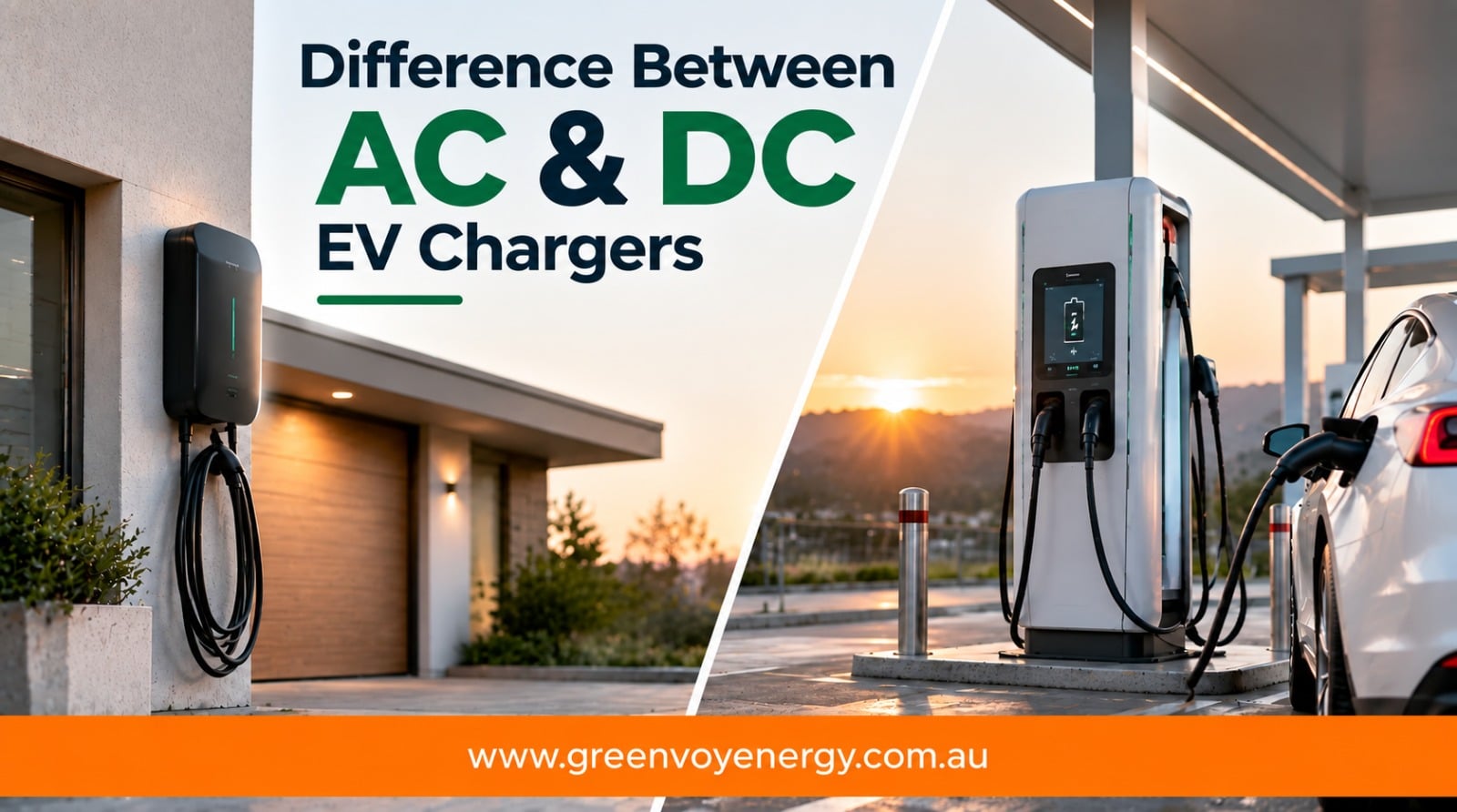
You bring your new electric vehicle home, plug it in and then another question starts playing in your mind: should you use an AC charger or a DC charger? At first, it sounds like a simple decision, but once you start looking into EV charging, you quickly come across terms such as 7kW, 22kW, fast charging, Type 2, home EV charging, DC fast charging, and smart charging solutions.
So, what’s the key difference between AC and DC EV chargers, and which one is the right choice for your home? The answer depends on how your EV is used, how long it normally stays parked, what your vehicle can accept and what your home’s electrical system can handle.
At Greenvoy Energy, EV charging is viewed as part of the bigger home energy picture. Your EV, solar panels, battery storage, electricity supply and everyday driving habits can all influence which charging solution is right for you.
What Is an AC EV Charger?
An AC EV charger delivers alternating current (AC) power to your electric vehicle. The vehicle then uses its onboard charger to convert that AC electricity into DC power that can be stored in the battery. Because the conversion happens within the vehicle, the EV’s own onboard charging capability has an important role in determining charging speed.
AC charging is commonly associated with home and destination charging because the vehicle is usually parked for a longer period. You may arrive home in the evening, plug your EV in and leave it charging overnight while you sleep.
For many homeowners, that makes a dedicated home AC EV charger a practical everyday solution. Greenvoy Energy provides residential EV charging solutions alongside solar, batteries and other home energy services, allowing homeowners to consider their charging setup as part of a wider energy plan.
What Is a DC EV Charger?
A DC EV charger converts AC power into direct current (DC) inside the charging unit before delivering it to the vehicle’s battery. Because the conversion is managed by the charger itself, DC systems can deliver much higher charging power than typical AC home charging equipment.
This is why DC fast chargers are widely used at public charging stations, highways, and other places where drivers need to recharge their vehicles quickly rather than wait for several hours. They are designed for situations where getting back on the road quickly matters.
However, DC charging is not simply a faster version of the same thing in every situation. The vehicle, charger output and battery conditions all affect how quickly an EV can actually charge, so a higher-rated charger does not automatically mean every vehicle will charge at that maximum speed.
AC vs DC EV Charging: What Is the Main Difference?
The basic difference is quite straightforward once you look at what happens to the electricity. With AC charging, the electricity reaches the vehicle as alternating current and the vehicle’s onboard charger converts it for the battery.
With DC charging, the conversion happens in the external charging equipment and DC power is delivered directly to the vehicle’s battery system. That allows much greater charging power and is the main reason DC fast charging can add substantial energy in a shorter period.
But charging speed is not the only factor that matters. Greenvoy Energy looks at where the EV is being charged, how often it is used and how it fits with the property’s electrical system before considering which solution is appropriate.
Why AC Charging Makes Sense for Many Homes
Think about a normal working day. You leave home in the morning, drive to work, perhaps do a few errands, and then return in the evening. Once you park the EV at home, it may remain there for ten or twelve hours before you need it again.
That gives you plenty of time to charge.
In this kind of routine, there may be little reason to install extremely high-powered charging equipment simply because it exists. A properly selected AC home charger can use those overnight hours to steadily recharge the vehicle while you sleep.
That is one reason AC charging is so relevant to residential EV owners. Greenvoy Energy can help homeowners look at the charging requirement alongside their existing electrical setup, solar generation and battery plans.
What Is a 7kW EV Charger?
A 7kW EV charger is one of the common charging options considered for residential use. It provides dedicated EV charging and can be particularly useful for people who normally have their vehicle parked at home for several hours.
For someone who drives a normal daily distance and charges overnight, a 7kW setup may provide a straightforward and convenient routine. You connect the vehicle when you get home and let it charge while you are sleeping or going about your evening.
There is an important detail, though. The charger rating is only part of the picture because the EV also has its own charging limit. If the vehicle cannot accept the full output, it will not simply charge at 7kW because the wall charger is rated for it.
This is why Greenvoy Energy considers the charger, vehicle and property together instead of focusing only on the number printed on the charger.
What About a 22kW AC EV Charger?
A 22kW AC EV charger offers significantly higher charging capacity, but that level of power may not be required for every home. Your electrical supply needs to be suitable, and the EV itself must also be capable of accepting the available charging rate.
For homes with appropriate three-phase electrical infrastructure and a compatible vehicle, a higher-powered AC charger can be useful. For other homeowners, the additional capacity may make little practical difference to their daily charging routine.
This is why the question should not simply be, “Can I install a 22kW charger?” A better question is, “Will a 22kW charger actually benefit the way I use my EV?”
At Greenvoy Energy, the aim is to match the charging setup to the real requirements of your home instead of automatically choosing the highest possible power rating.
Why Does DC Fast Charging Feel So Different?
Now imagine you are travelling a long distance and your battery is getting low. You still have a couple of hours of driving ahead and you do not want to spend most of the afternoon waiting beside the car.
This is where DC fast charging becomes valuable. Higher-powered public DC chargers can deliver energy much more quickly than typical residential AC charging, making them particularly useful for road trips and other situations where charging time matters.
The actual charging speed still depends on the vehicle, battery condition, state of charge and the charger’s capabilities. A DC charger advertised with a high maximum output does not mean every EV will continuously accept that full output.
So, DC fast charging does not mean instant charging. It means the system is designed to provide substantially more power and reduce the time needed for a useful charging session.
AC or DC: Which One Is Better for Home Charging?
This is usually the question people really want answered, but there is no universal answer. The better option depends on your routine and how your vehicle is normally used.
If your EV spends most nights at home, AC charging can fit naturally into your routine because you have several hours available. If you regularly travel long distances and need rapid charging away from home, public DC fast chargers can become a very important part of your overall charging strategy.
For many residential situations, the home charger and the public fast charger simply have different jobs. Greenvoy Energy focuses on understanding that difference instead of assuming the fastest charging option is always the right home solution.
AC Charging and Solar Panels
Now add solar panels to the picture, and home EV charging becomes even more interesting. If your solar system is generating electricity while your EV is parked at home, you may be able to use some of that energy directly for charging.
This can be especially useful for households that generate a reasonable amount of solar power during the day. Instead of treating the EV as a completely separate load, it can become another way of using the electricity your solar system produces.
For homeowners already thinking about solar EV charging, the charger itself is only one part of the equation. Greenvoy Energy works across solar panels, batteries and EV charging, which means these technologies can be considered together when planning the home’s energy use.
What If You Also Have a Home Battery?
A home battery adds another layer to the charging strategy. Solar panels produce most of their energy during daylight hours, while many people do most of their EV charging later in the day or at night.
Depending on the system and the home’s energy needs, stored solar energy can potentially form part of the overall charging strategy. Your EV becomes another flexible energy load alongside the rest of the household.
There is no single setup that works for every homeowner. Someone with high daytime solar generation may have very different charging opportunities from a person whose EV is away from home all day.
This is where Greenvoy Energy can look at the relationship between solar generation, battery storage, EV charging and normal household electricity use rather than treating each product as an isolated purchase.
Smart EV Charging Can Make a Difference
Modern smart EV chargers can do much more than simply start and stop charging. Depending on the equipment, smart charging can offer scheduling, monitoring and other controls that help homeowners manage when the vehicle uses electricity.
This becomes especially useful when an EV is combined with solar panels or battery storage. Instead of charging whenever electricity is available from the grid, the charging schedule can potentially be managed around household energy requirements and available solar generation.
That wider approach is important because EV charging is not really just about the car. It is also about how your home generates, stores and uses electricity.
At Greenvoy Energy, EV charging can be considered alongside solar and battery solutions so homeowners can plan a more connected energy setup.
Installation Matters More Than People Think
Choosing an EV charger online may be easy, but choosing the right installation is a different matter. Your switchboard, electrical supply, cable route, parking location and charging position all need to be considered before the work begins.
The physical layout of your home can matter too. A charger that looks great on paper may become inconvenient if the parking position is too far away or the cable does not reach comfortably.
Future needs are also worth thinking about. You may buy a second EV later, add solar panels, install a home battery or simply start driving more kilometres each week.
That is why professional assessment is important. Greenvoy Energy can consider these factors when planning an EV charging solution rather than treating installation as an afterthought.
How Greenvoy Energy Approaches EV Charging
At Greenvoy Energy, EV charging is part of a broader approach to smarter home energy. Instead of looking at an EV charger by itself, the focus can include your vehicle, daily driving, electrical supply, solar generation, battery storage and future energy plans.
For one homeowner, a straightforward 7kW AC charger may be all that is needed. Another household may have different requirements because of three-phase electricity, a compatible 22kW-capable vehicle, solar generation or a larger battery system.
That is why there is value in looking at the complete picture before choosing an EV charger. The goal is not simply to install the biggest or fastest charger, but to create a charging solution that makes sense for the way your home actually operates.
Final Thoughts
The difference between AC and DC EV chargers mainly comes down to how electricity is converted and delivered to the vehicle, but the practical decision is really about how and where you want to charge.
AC charging is commonly suited to homes, workplaces and situations where the vehicle is parked for longer periods. DC charging is designed around higher charging power and faster charging sessions, which is why it is widely used in public charging networks.
For homeowners, a suitable AC charger can become even more useful when it is considered alongside solar panels, battery storage and smart charging.
That is exactly why Greenvoy Energy takes a broader view of EV charging. The right setup is not necessarily the charger with the highest power rating; it is the one that matches your vehicle, your home, your electrical capacity, your driving routine and your future plans.
Frequently Asked Questions
Q1. What is the main difference between AC and DC EV chargers?
AC chargers supply alternating current to the EV, and the vehicle’s onboard charger converts it for battery storage. DC chargers perform the conversion externally and can deliver much higher charging power.
Q2. Is AC or DC charging better for home use?
AC charging is commonly suitable for home use because the vehicle can charge while parked for several hours. DC charging is generally more useful for fast public charging when reducing charging time is the priority.
Q3. Is a 7kW EV charger AC or DC?
A typical 7kW residential wall charger is an AC charger. It can be a practical option for overnight charging when the vehicle and home’s electrical setup support it.
Q4. Is a 22kW EV charger AC or DC?
A 22kW residential charger is generally an AC charger and usually requires suitable electrical infrastructure. The EV must also be capable of accepting the available AC charging rate.
Q5. Can I charge my EV using solar panels?
Yes, a suitable EV charging system can use electricity generated by solar panels. Charging during daylight hours can help make better use of available solar generation.
Q6. Can I combine an EV charger with a home battery?
Yes, an EV charger can form part of a wider solar and battery energy setup. The way the systems work together depends on the equipment, household electricity use and charging requirements.
Q7. Do I need a DC fast charger at home?
Most homeowners do not necessarily need high-powered DC charging if their EV is parked for several hours. A suitable AC home charger can provide practical everyday charging for many households.
Q8. Does a higher kW charger always charge an EV faster?
No. The EV has its own charging limits, so it may not accept the maximum output of a higher-rated charger. The vehicle, charger and home’s electrical capacity all need to be considered.
Q9. Can Greenvoy Energy help with EV charging and solar?
Yes. Greenvoy Energy works with EV charging alongside solar and battery solutions, allowing homeowners to consider their charging needs as part of a wider home energy system.
Leave a comment