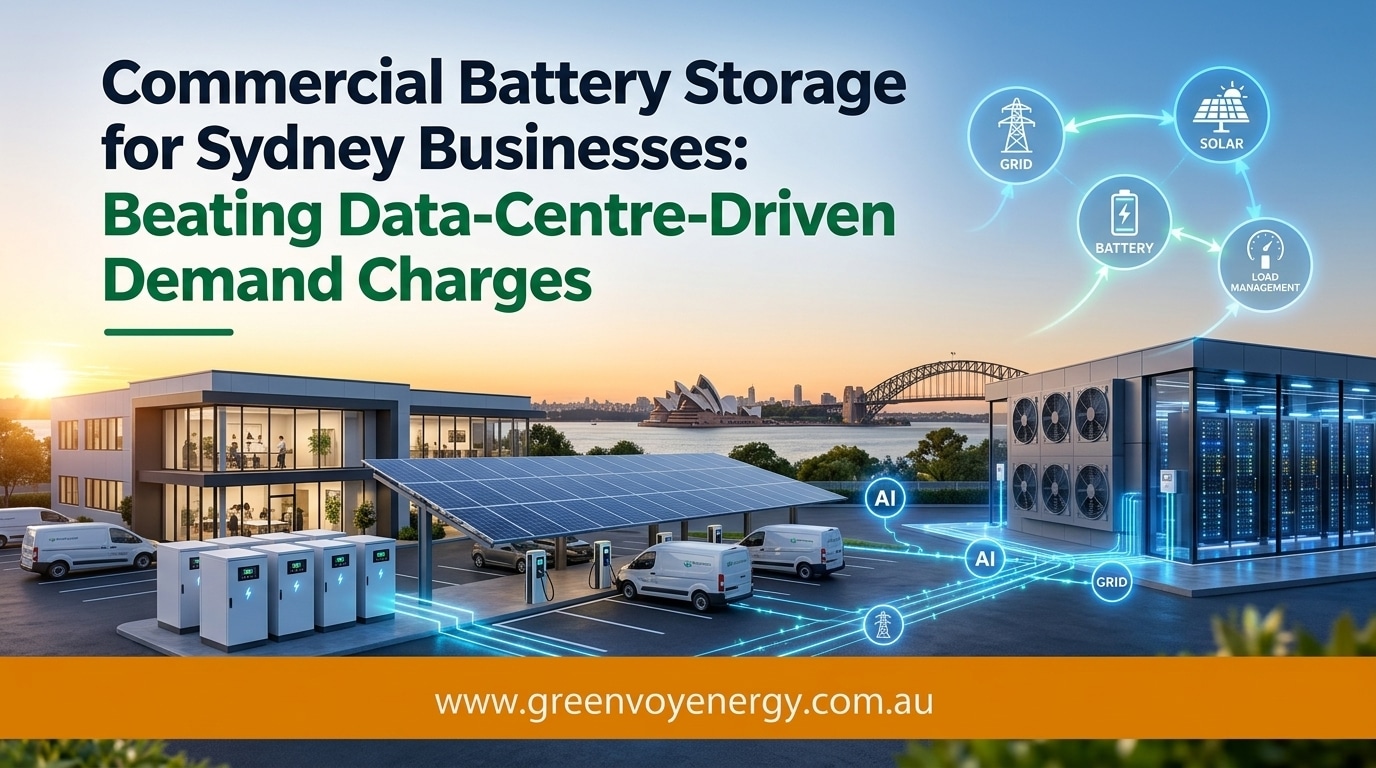
Sydney businesses are entering a very different energy market. Electricity demand is growing, large data centres are seeking enormous amounts of new grid capacity, and the NSW Government is already looking at how the cost of additional electricity infrastructure should be allocated.
For businesses, the bigger question is not simply what is causing electricity demand to rise. It is how can you take greater control of your own energy costs? That is where commercial battery storage for Sydney businesses is becoming increasingly important.
At Greenvoy Energy, we help businesses look beyond simply installing solar panels. A properly designed commercial solar and battery system can help businesses manage peak electricity demand, improve solar self-consumption and reduce reliance on grid electricity during expensive periods.
And the important part is this: the right battery isn’t necessarily the biggest battery. It is the battery that is designed around how your business actually uses energy.
Why Sydney Businesses Are Paying More Attention to Electricity Demand
Most businesses naturally focus on how much electricity they consume. That amount is generally measured in kilowatt-hours (kWh), and it is an important part of any electricity bill. However, some commercial electricity tariffs also include charges related to peak electricity demand.
In simple terms, your business may use a relatively normal amount of electricity throughout the day, but a short period of unusually high demand can still have a noticeable impact on your electricity costs. Think about a warehouse.
During one part of the day, several air-conditioning units, refrigeration equipment, machinery, pumps and EV chargers might operate simultaneously. Suddenly, the site’s electricity demand jumps.
A battery energy storage system can potentially reduce that grid demand by supplying some of the required power from stored energy. This strategy is commonly known as peak shaving. For businesses dealing with significant demand charges, it can be one of the most valuable applications of commercial battery storage.
What Do Data Centres Have to Do With Sydney’s Energy Demand?
It is important to make a distinction here. A Sydney business is not necessarily paying a specific electricity charge because there happens to be a data centre nearby. The issue is much broader.
NSW is experiencing growing demand for electricity-intensive infrastructure, including data centres. The NSW Government has been consulting on reforms concerning new data-centre connections and the infrastructure required to support this additional demand. That matters because electricity infrastructure has to evolve as major new loads are connected to the grid.
For existing businesses, this creates a strong reason to think more seriously about energy management, onsite solar generation and battery storage. Businesses cannot control how much electricity new infrastructure requires. They can control more of their own electricity consumption.
And that is exactly where Greenvoy Energy sees commercial battery storage becoming an increasingly useful tool for Sydney businesses.
How Commercial Battery Storage Can Reduce Peak Demand
Think of a commercial battery as an energy buffer between your business and the electricity grid. Without battery storage, a sudden increase in demand may have to be supplied entirely by the grid. With a suitably designed battery system, some of that demand can potentially come from stored electricity.
For example:
Without battery storage:
Grid → Business → High demand spike
With battery storage:
Grid + Battery → Business → Lower grid demand
The battery does not necessarily need to run the entire business. Instead, it can be programmed to respond during specific high-demand periods. This is the basic principle behind commercial peak shaving.
The actual savings depend on the site’s electricity tariff, demand profile, battery capacity, battery power output, operating strategy and other factors. That is why professional system design matters.
Commercial Solar + Battery Storage: A Strong Combination
For many Sydney businesses, battery storage makes even more sense when paired with commercial solar. Solar panels generate electricity during daylight hours. A business operating during the day can use a large portion of that electricity directly.
But there may also be times when solar generation exceeds the site’s immediate electricity demand. Instead of exporting all surplus electricity to the grid, a battery can store some of that energy for later. The stored electricity can then be used when solar generation falls.
For example:
Morning:
Business demand begins increasing.
Midday:
Solar generation is high and the battery charges with surplus solar energy.
Afternoon:
Solar production begins falling while business demand remains high.
Peak period:
The battery discharges to help reduce grid electricity demand. This creates a more flexible energy system.
For businesses investing in commercial solar Sydney solutions, that flexibility can be extremely useful.
The Benefits Go Beyond Demand Charge Reduction
Peak shaving is only one potential benefit.
A commercial battery energy storage system can potentially help businesses with:
- Peak demand reduction
- Solar self-consumption
- Time-of-use energy shifting
- Reduced grid electricity purchases
- Better utilisation of commercial solar
- Energy resilience
- Backup power for selected loads
- Energy management
- Greater control over electricity consumption
The best combination depends on the individual business. A manufacturing facility may have large machinery creating predictable demand peaks. A cold-storage business may have substantial refrigeration loads.
An office building may have significant HVAC demand. A warehouse might combine solar, refrigeration, lighting, automation and EV charging. Each site needs a different strategy.
NSW Battery Incentives Can Improve the Business Case
Government incentives are another reason businesses should investigate battery storage carefully. NSW currently has programs designed to encourage battery adoption and demand reduction, with eligibility, system requirements and incentive values depending on the specific program and project. However, businesses should avoid making a battery investment based entirely on an advertised rebate.
The underlying economics still matter. A good commercial battery project should make sense because the system is solving a genuine energy problem.
Greenvoy Energy can help businesses assess the relationship between their electricity consumption, solar generation, battery storage and potential energy savings before making an investment.
That approach is much more useful than simply asking, “How much does a 500 kWh battery cost?”
How Much Battery Storage Does a Sydney Business Need?
There is no single battery size that works for every commercial property. A small office and a large manufacturing facility can have completely different energy requirements. Even two businesses with similar annual electricity bills may have completely different demand profiles. One business might consume electricity steadily throughout the day.
Another might have several short but significant demand spikes. The second business may have a stronger case for peak shaving. That is why interval electricity data is so important. It helps identify when the business uses electricity, how high demand becomes, and how consistently those peaks occur.
A professional assessment should consider:
- Electricity consumption
- Interval data
- Existing electricity tariff
- Demand charges
- Peak demand periods
- Operating hours
- Existing solar capacity
- Solar generation
- Battery capacity
- Battery power output
- Future EV charging
- Planned business expansion
- Backup requirements
The question should not simply be:
“How big a battery can we install?”
It should be:
“What battery system can deliver the best financial and operational outcome for this business?”
Why Electricity Data Matters More Than Your Annual Bill
Annual electricity consumption gives you a useful starting point. But it does not tell the full story.
A business consuming 500,000 kWh per year could have a very different battery opportunity from another business consuming exactly the same amount.
One may have predictable peaks. The other may have relatively flat demand.
This is why Greenvoy Energy focuses on understanding the business’s actual energy profile when considering commercial solar and battery solutions. The more accurately you understand the site’s energy behaviour, the more intelligently you can design the system.
Why Sydney Businesses Should Think About Energy Storage Now
The electricity system is changing.
Data centres are expanding.
Businesses are electrifying equipment.
EV charging is increasing.
Renewable generation is growing.
And electricity demand is becoming more dynamic.
For businesses, this means electricity should increasingly be viewed as something that can be managed, rather than simply purchased.
Commercial solar can generate electricity onsite. Battery storage can store it. Energy management systems can determine when that energy should be used.
And peak shaving can potentially reduce the amount of electricity a business needs to draw from the grid during high-demand periods.
This is the bigger opportunity behind commercial battery storage. It is not simply a large box full of batteries. It is an energy management asset.
Is Commercial Battery Storage Right for Your Sydney Business?
Not every business needs a battery. For some businesses, commercial solar alone may provide the strongest return. For others, battery storage could significantly improve the value of their solar investment.
Businesses with repeatable demand peaks, substantial solar generation, high electricity consumption or critical energy requirements may have particularly interesting opportunities to investigate.
The right answer comes from analysing the site’s actual numbers.
At Greenvoy Energy, our approach is to look at the whole picture — commercial solar, battery storage, electricity usage, demand patterns and the business’s future energy requirements. That means you’re not simply buying a battery. You’re investing in a strategy for managing energy costs.
Take Control of Your Business Energy With Greenvoy Energy
The future of commercial electricity is going to be more dynamic. As Sydney’s electricity demand grows and the grid accommodates increasingly large loads, businesses have a growing reason to look at how they generate, store and consume electricity.
Commercial battery storage for Sydney businesses can provide an opportunity to reduce peak demand, make better use of solar and gain greater control over energy costs. But the key is getting the system design right.
At Greenvoy Energy, we help businesses explore the potential of commercial solar, battery storage and smarter energy management based on their actual requirements.
If your Sydney business is dealing with high electricity bills, demand charges, solar exports or increasing energy requirements, it may be time to look beyond simply buying more electricity from the grid.
Talk to Greenvoy Energy about a commercial solar and battery solution designed around your business.
Frequently Asked Questions About Commercial Battery Storage in Sydney
Q1. What is commercial battery storage?
Commercial battery storage allows businesses to store electricity and use it when needed. It can help improve solar self-consumption, reduce grid electricity use and manage peak demand periods.
Q2. Can a commercial battery reduce demand charges in Sydney?
Yes, a suitably designed battery can discharge during periods of high electricity demand, helping reduce grid demand and potentially lower demand charges. Actual savings depend on your tariff and energy usage profile.
Q3. Is commercial battery storage better with solar?
Solar and battery storage can work together to maximise onsite energy use. Excess solar can be stored during the day and used later when solar generation drops or electricity demand increases.
Q4. How large should a commercial battery be?
The right battery size depends on your electricity consumption, peak demand, solar generation and business operating hours. A professional energy assessment can identify the appropriate battery capacity and power output.
Q5. Can a commercial battery provide backup power?
Yes, certain commercial battery systems can provide backup power for selected equipment or an entire site, depending on system design. Critical loads such as refrigeration, IT equipment and security systems can be prioritised.
Q6. Are there battery incentives for NSW businesses?
Eligible NSW businesses may be able to access battery incentives and demand-reduction programs. Eligibility and program conditions can change, so current requirements should be checked before investing.
Q7. Is commercial battery storage worth it for a small business?
It can be, particularly for businesses with high electricity costs, demand peaks or existing solar. The best way to assess the potential return is to analyse the business’s actual electricity usage and tariff.

Leave a comment