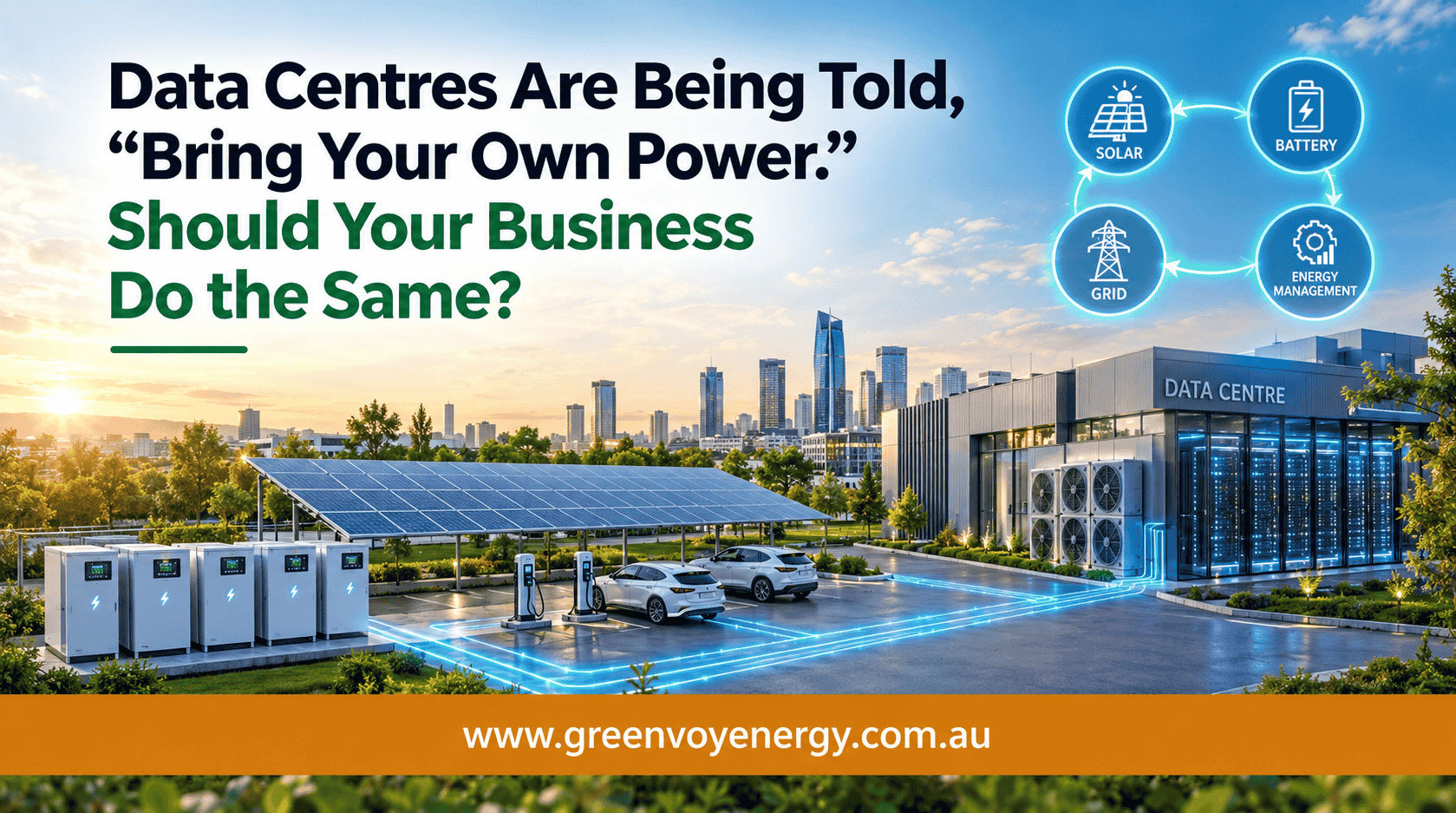
There is a new phrase making its way into Australia’s energy conversation:
Bring Your Own Power.
It sounds simple. But behind those four words is a much bigger change in how Australia thinks about electricity-hungry businesses.
Data centres, particularly those being developed to support artificial intelligence and cloud computing, are placing enormous new demands on electricity networks. Governments and energy authorities are increasingly looking at ways to make these large new users contribute to the generation and firming capacity needed to support their demand. So here’s the interesting question for ordinary businesses:
If the biggest energy users are being encouraged to bring more of their own power, should your business be thinking the same way?
For many Australian and Sydney businesses, the answer could be yes. Not because your warehouse, factory or office needs to build a power station.
But because commercial solar and battery storage can give your business more control over where its electricity comes from and when it uses it. And that’s exactly the type of energy strategy Greenvoy Energy helps businesses explore.
What Does “Bring Your Own Power” Actually Mean?
Let’s clear up one thing first.
“Bring Your Own Power” does not necessarily mean a data centre needs to disconnect completely from the electricity grid.
The idea is broader.
Large new electricity users may increasingly be expected to contribute generation, storage, renewable energy or other firming capacity to help support the additional demand they create.
The reason is fairly obvious.
If a massive new facility suddenly needs huge amounts of electricity, someone has to provide that electricity — and the network needs to be capable of delivering it. Australia is now seeing this issue more clearly because of the rapid growth of data centres and AI infrastructure.
The bigger lesson for businesses is simple:
Electricity is becoming something worth managing strategically. And this is where Greenvoy Energy believes businesses can learn something from the data-centre conversation.
Why Should a Normal Business Care?
You might be thinking:
“I’m not running a data centre. Why should I care?”
Fair question.
Your business may only use a fraction of the electricity consumed by a large data centre, but the underlying problem is similar.
You rely on electricity.
Your electricity costs money.
Your business is exposed to changes in energy prices, tariffs, network conditions and demand. And if your electricity usage grows, your exposure grows with it.
A business that installs commercial solar and battery storage is effectively creating its own smaller energy system.
You still have the grid. But you aren’t relying on it for every kilowatt-hour at every moment. That’s a meaningful difference.
Commercial Solar Is the First Step
For many businesses, the most obvious way to start producing their own electricity is rooftop solar. A large warehouse, factory, shopping centre, office building or commercial property can have substantial roof space that is otherwise doing very little.
Commercial solar panels turn that space into an onsite electricity generator. During the day, your business can use the electricity generated by the solar system directly. That can reduce the amount of power purchased from the grid. But there is one limitation.
The sun doesn’t follow your business schedule.
Solar generation is strongest during the middle of the day. Your business might have its highest electricity demand in the morning, late afternoon or evening. That’s where battery storage becomes interesting.
Add a Battery and You Start Controlling When You Use Your Energy
A commercial battery energy storage system (BESS) allows electricity to be stored and used later. Imagine a Sydney warehouse with strong solar generation around midday. The business doesn’t need all of that electricity immediately. Instead of exporting some of the surplus, the battery can store it.
Later in the afternoon, when solar generation starts falling and electricity demand remains high, the battery can discharge. The business gets more value from the energy it generated earlier.
This is one of the simplest reasons commercial solar battery systems are becoming more attractive. Solar generates the energy. The battery provides flexibility. The grid becomes one part of the energy strategy rather than the only source.
Battery Storage Can Also Help With Peak Demand
There is another important benefit:
Peak demand reduction.
Some businesses have short periods when electricity demand suddenly becomes very high. Perhaps multiple HVAC systems start together. Maybe refrigeration equipment is running heavily.
Perhaps production machinery starts up. Or a growing business has introduced EV charging at its premises. Those short demand spikes can matter under certain commercial electricity tariffs.
A battery can potentially discharge during these periods and reduce the amount of electricity being pulled from the grid. That’s known as peak shaving. And for the right business, it can be one of the strongest reasons to consider commercial battery storage.
Greenvoy Energy can help businesses look at this from a practical perspective — not just how much energy a battery stores, but how it can operate around the site’s actual demand profile.
You Don’t Need to Become Fully Off-Grid
This is an important point.
When people hear “bring your own power”, they sometimes imagine going completely off-grid. For most Sydney businesses, that’s not the goal. The grid remains extremely useful.
You need it when solar generation is low. You may need it when the battery is depleted. And you need reliable infrastructure for normal business operations.
The smarter approach is often greater energy independence while remaining grid-connected.
Generate some electricity yourself.
Store some of it.
Use energy intelligently.
And purchase electricity from the grid when you actually need it.
That’s very different from trying to disconnect from the grid completely.
What Could a Business Energy System Look Like?
A modern commercial energy setup might look something like this:
Solar panels → Business loads → Battery storage → Grid
During the day, solar powers the business. Any suitable surplus can charge the battery. When solar production falls, stored electricity can be used.
During periods of high demand, the battery can potentially support the business and reduce grid demand. Energy monitoring and intelligent battery controls can help manage when the system charges and discharges. It sounds fairly straightforward. But getting the economics right requires more than simply installing panels and a battery.
The Battery Should Be Designed Around Your Business
This is where businesses sometimes get it wrong.
They start by asking:
“How much does a 500 kWh battery cost?”
That’s not necessarily the right starting point.
The better question is:
“What is my business trying to achieve?”
Maybe you want to reduce demand charges.
Maybe your goal is to maximise solar self-consumption.
Maybe you need backup power for critical equipment.
Maybe electricity costs are rising and you want greater control.
Maybe your business is preparing for EV charging.
Or perhaps you’re planning an expansion that will significantly increase electricity demand.
Each situation can require a different battery configuration.
Battery capacity is important.
But so is battery power output, charging and discharge behaviour, tariff structure, solar generation, load profile and the control strategy.
This is why Greenvoy Energy takes a site-specific approach when assessing commercial solar and battery opportunities.
This Is Where Greenvoy Energy Can Help
At Greenvoy Energy, we believe commercial energy projects should start with the business rather than the equipment catalogue.
A battery isn’t valuable just because it is large. Solar panels aren’t automatically valuable because there are lots of them. The system needs to make sense for the site’s actual electricity usage.
For businesses considering commercial solar in Sydney, the assessment should look at the relationship between solar generation, electricity consumption, peak demand and potential battery operation. That’s how you move from simply buying energy equipment to building a useful energy strategy.
Greenvoy Energy can help businesses consider the practical questions first:
- How much electricity does the site actually use?
- When does demand peak?
- How much solar can the property generate?
- Would battery storage improve solar utilisation?
- Could peak shaving reduce demand-related costs?
- Is backup power important?
- What might future electricity demand look like?
These questions are far more useful than simply asking which battery has the biggest capacity.
What About Energy Resilience?
There is another reason businesses are looking at onsite generation and battery storage:
Resilience.
Electricity interruptions can be more than an inconvenience.
For some businesses, losing power can mean:
- Production downtime
- Refrigeration losses
- IT disruption
- Security system interruptions
- Lost trading hours
- Equipment shutdowns
- Operational problems
A correctly designed commercial battery system may provide backup power for selected critical loads. It won’t necessarily keep the entire site operating indefinitely.
But keeping essential systems running during an outage can be extremely valuable for some businesses.
This is one reason Greenvoy Energy sees commercial battery storage as more than an electricity-saving device. For the right business, it can also become part of a broader energy resilience strategy.
NSW Is Moving Towards Smarter Energy Management
The move towards more flexible energy use isn’t theoretical. NSW has established programs designed to reduce electricity demand during periods when demand on the grid is highest.
The state is also investing in renewable generation and battery storage as part of its broader electricity transition. The direction is fairly clear. Australia needs more electricity.
But it also needs electricity to be generated, stored and used more intelligently. Businesses with flexible loads, solar and batteries can potentially become part of that solution.
Does Your Business Need to “Bring Its Own Power”?
Not literally.
You don’t necessarily need to generate 100% of your electricity onsite.
And you don’t need to install a huge commercial battery simply because data centres are being asked to provide or support new power capacity.
But the underlying principle is worth considering.
How much of your business’s electricity can you generate, store and manage yourself?
That’s a much better question.
For one business, the answer might be a rooftop solar system.
For another, it could be solar plus a commercial battery.
For a larger facility, it might involve solar, battery storage, smart energy management and EV charging.
The right solution depends on the site.
The Future Is Probably Not “Grid or Solar”
It is both.
The grid will continue to play an essential role.
But businesses are increasingly able to combine grid electricity with onsite generation and energy storage.
That creates a more flexible model:
Generate → Store → Manage → Use → Buy what you need.
And as electricity demand grows across NSW, that flexibility could become increasingly valuable. Data centres may be the businesses forcing governments and energy planners to rethink how new electricity demand is accommodated. But they are not the only businesses that can learn from the change.
Should Your Business Start Bringing Its Own Power?
If your business has a large roof, high electricity consumption, regular demand peaks, significant daytime energy use or concerns about future electricity costs, it is worth investigating.
You don’t need to commit to a battery immediately.
Start with the numbers.
Look at your electricity bills.
Review your interval data.
Understand your tariff.
Identify your peak demand periods.
Look at your existing or planned solar generation.
Then model what a commercial battery storage system could actually do. That is where the business case becomes real.
At Greenvoy Energy, we help businesses explore commercial solar, business battery storage and smarter energy management based on their actual energy requirements.
Because “Bring Your Own Power” doesn’t have to mean building your own power station. For many Australian businesses, it could simply mean taking the first serious step towards producing, storing and controlling more of their own energy.
And that might be one of the smarter business decisions you make as Australia’s electricity system continues to change.
Ready to see whether solar and battery storage could work for your business? Talk to Greenvoy Energy about a commercial energy solution designed around your site’s actual electricity use.
Frequently Asked Questions
Q1. What does “Bring Your Own Power” mean for businesses?
It generally means generating, storing or securing some of your own electricity instead of relying entirely on the grid. For businesses, this can involve commercial solar, battery storage or other energy solutions.
Q2. Can commercial solar help businesses reduce electricity costs?
Yes, commercial solar can reduce the amount of electricity a business needs to purchase from the grid. The potential savings depend on system size, energy consumption, solar generation and the business’s electricity tariff.
Q3. What is a commercial battery energy storage system?
A commercial BESS stores electricity for later use. Businesses can use battery storage to improve solar self-consumption, shift energy use, reduce peak demand and potentially provide backup power.
Q4. Can a business battery reduce peak demand charges?
A suitably designed battery can discharge during high-demand periods, potentially reducing the amount of electricity drawn from the grid. The financial benefit depends on the business’s tariff and actual demand profile.
Q5. Does a business need to go off-grid to generate its own power?
No. Most businesses can remain connected to the grid while using commercial solar and battery storage to generate and manage part of their electricity onsite.
Q6. Is battery storage suitable for small businesses?
It can be. A small business may benefit from battery storage if it has suitable solar generation, high electricity costs, peak demand or a need for greater energy resilience.
Q7. How can Greenvoy Energy help with commercial solar and batteries?
Greenvoy Energy can assess a business’s energy requirements and help identify suitable commercial solar, battery storage and energy management options based on the site’s electricity usage and objectives.

Leave a comment