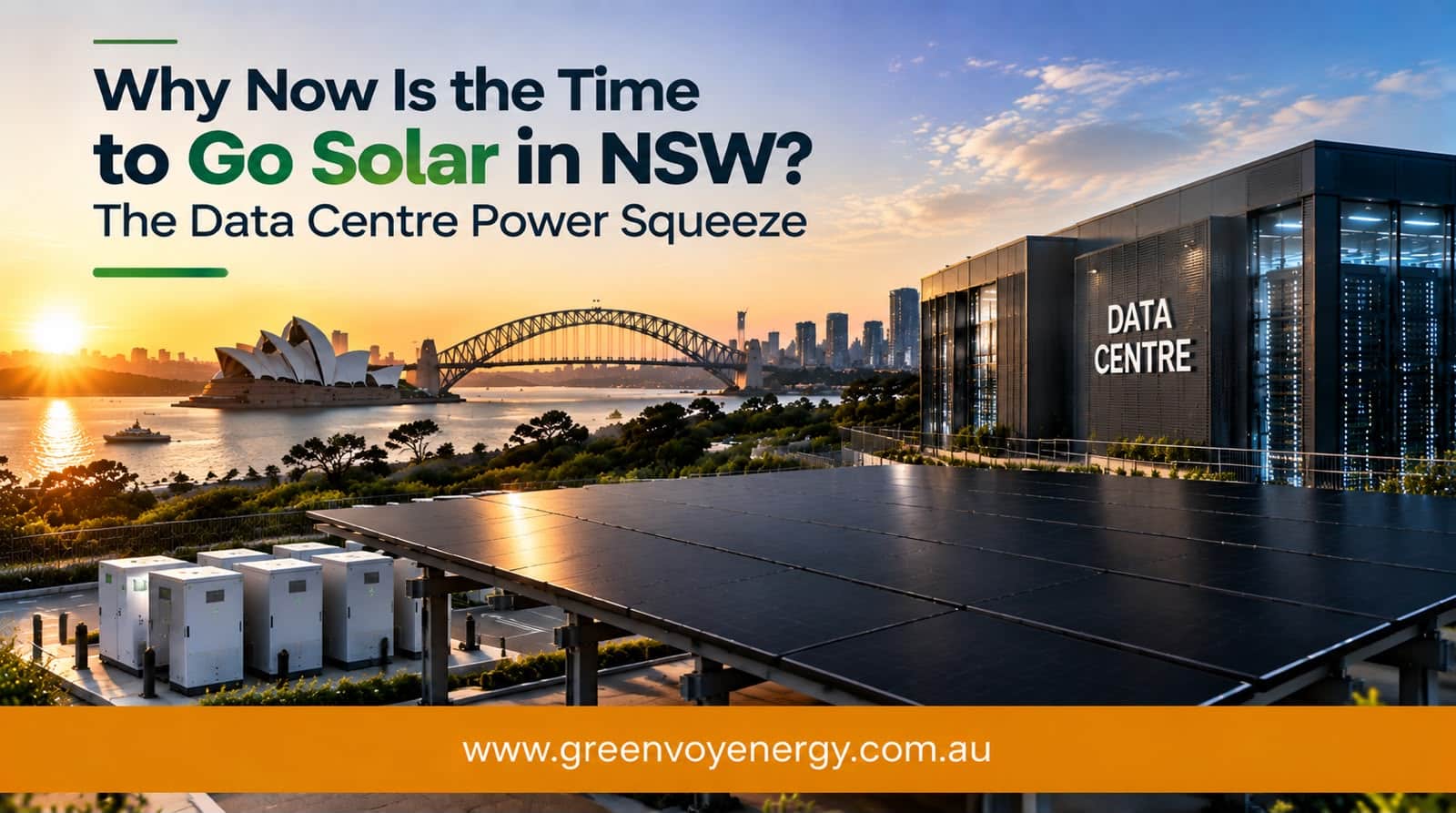
Picture a business owner in Sydney looking at another electricity bill.
The business is doing well. More staff have been added, equipment has increased, air conditioning is running harder, and there are plans for further growth. But there is one problem that keeps getting harder to ignore: electricity is becoming a bigger part of the cost of doing business.
Now add something else to the picture.
NSW is entering a period where electricity demand is changing significantly. Data centres are expanding, businesses are becoming more electricity-dependent, and the state is investing heavily in renewable energy and battery storage.
For a business owner, this raises a simple question: is it still sensible to rely almost entirely on the grid for the energy your business needs?
This is where Greenvoy Energy believes commercial solar deserves a much closer look.
Going solar is no longer just about putting panels on a roof because it is good for the environment. For NSW businesses, it can be part of a wider strategy to generate electricity on-site, reduce reliance on grid power and prepare for changing energy needs.
NSW’s Electricity Demand Is Changing
The energy landscape in NSW is not standing still.
The NSW Government’s 2025 Energy Security Target Monitor identified growing electricity demand from data centres as one of the challenges affecting future electricity forecasts. The report projects a forecast firm-capacity shortfall in 2027–28 and another in 2033–34 if additional capacity is not delivered.
One figure stands out.
The 2025 forecast includes around 900 MW of additional peak demand from data centres by 2033–34.
Now, that does not mean your business is going to receive an extra charge simply because a data centre is using electricity somewhere in NSW. The electricity market and network pricing system are far more complicated than that. But it does tell us something important.
Electricity demand is growing, and the businesses that start thinking about their energy strategy early may have more options than those that simply wait and react later. For Greenvoy Energy, this is an important part of the conversation with businesses considering commercial solar in NSW.
Why Going Solar in NSW Makes More Sense
Let’s return to our business owner.
Instead of buying every unit of electricity from the grid, what if part of that electricity could be generated right on the business premises?
That is the basic idea behind commercial solar.
Solar panels installed on a suitable commercial property can generate electricity during daylight hours. If the business is operating during those same hours, a significant portion of the generated energy can potentially be used immediately.
An office can use it for lighting, computers and air conditioning. A warehouse can use it for refrigeration, lighting and equipment. A manufacturing business can use solar generation to support machinery and other daytime loads.
The exact benefits depend on the business, but the principle is simple: generate electricity where you use it. At Greenvoy Energy, this is why solar system design should start with understanding the business rather than simply looking at how many panels will fit on a roof.
The Biggest Solar System Isn’t Always the Right One
It is easy to think that more solar automatically means more savings. In reality, it is a little more complicated. Imagine two businesses with exactly the same roof space.
The first business operates from 8am to 5pm and consumes most of its electricity during the day. The second business uses relatively little electricity during daylight hours but has heavy evening demand.
Their ideal solar strategies could look completely different.
This is why Greenvoy Energy looks at factors such as electricity consumption, operating hours, available roof space, system size, future energy requirements and the way a business actually uses power.
A well-designed business solar system is not simply about maximum generation. It is about useful generation. And that difference can have a major impact on how the system performs over time.
What Happens When Solar Production Is Higher Than Demand?
There will be times when a solar system produces more electricity than a business is using. This is where the conversation naturally moves beyond solar panels. A business might export excess electricity to the grid, depending on its circumstances and electricity arrangements. Another option worth considering is commercial battery storage.
A battery can store some of that excess energy so it can potentially be used later. For example, solar panels may generate plenty of electricity around lunchtime, while the business continues operating into the evening. Instead of treating those periods as completely separate, a battery can help shift some of that solar energy to a later time.
This is one reason Greenvoy Energy commercial solar and battery solutions can be worth considering together.
Solar generates the energy. Battery storage can help manage when that energy is used. Together, they can provide a more flexible energy strategy for the right business.
Commercial Battery Storage Can Add Another Layer of Control
There is another issue that some businesses need to think about: peak electricity demand. A business might use a reasonable amount of electricity overall but still experience short periods when demand suddenly jumps.
Perhaps several large pieces of equipment start at once. Maybe air conditioning is running heavily on a hot afternoon. Or perhaps production increases during a particular period. Depending on the electricity tariff and business load profile, these periods of high demand can matter.
Battery storage can potentially be used for peak shaving, where stored energy helps reduce the amount of electricity being drawn from the grid during certain high-demand periods. It is important not to promise the same savings to every business. Battery performance depends on many factors, including the tariff, load profile, battery capacity and operating strategy.
This is exactly why Greenvoy Energy approaches commercial battery storage as an energy-management decision, not simply as another piece of equipment to install.
Data Centres Are Making Energy Planning More Important
There is a reason data centres have become such a major part of the NSW energy conversation. Modern data centres need substantial amounts of electricity, often continuously. As cloud computing, digital services and artificial intelligence continue to expand, demand from these facilities is becoming increasingly important in electricity planning.
The NSW Government has specifically highlighted the growing impact of data centres on future electricity demand. For an ordinary commercial business, the takeaway is not that it needs to compete with data centres. It is that the energy environment is changing.
The electricity system your business relies on today may face very different demand patterns in the coming years. That makes commercial solar NSW a conversation worth having now, particularly for businesses that already have significant electricity consumption or expect that consumption to grow.
Greenvoy Energy: Helping Businesses Look Beyond the Roof
When people hear “commercial solar”, they often picture rows of panels installed on a warehouse roof.
But at Greenvoy Energy, the bigger picture matters. The roof is only one part of the equation.
The more useful questions are: How much electricity does the business use? When does it use it? What are the biggest loads? Is demand increasing? Is battery storage worthwhile? Could future electrification change the business’s energy profile?
These questions can help determine whether a business needs solar alone or whether a combination of commercial solar and battery storage makes more sense.
A Sydney office, manufacturing facility, warehouse or retail property can have completely different energy requirements. There is no sensible one-size-fits-all answer.
Solar Can Prepare Your Business for What’s Coming Next
There is another reason Greenvoy Energy sees value in businesses looking at solar before they absolutely need it. Businesses are becoming more dependent on electricity.
Electric vehicles are becoming more common. More equipment is being electrified. Cooling requirements can increase as businesses grow. Technology, automation and digital systems continue to add electrical loads.
A company that looks at its energy requirements only based on today’s consumption could find itself underprepared a few years from now.
Commercial solar can be part of a longer-term energy plan. And when battery storage is appropriate, it can provide another way to manage when and how electricity is used. This does not mean every business needs to become completely independent from the electricity grid.
For most businesses, that isn’t the goal. The goal is having more control over where some of your energy comes from and how you use it.
NSW Is Investing in Renewable Energy and Storage
The changes happening in NSW are not only about increasing electricity demand.
The state is also investing in renewable generation, Renewable Energy Zones and large-scale battery storage. NSW has announced major renewable energy procurement and additional battery investment as part of its electricity transition.
That investment is important for the wider electricity system. But individual businesses also have an opportunity to participate in the transition at their own premises.
Instead of waiting for the energy system to change around them, businesses can start looking at solar energy for businesses, energy efficiency and battery storage as practical parts of their own energy strategy.
This is where Greenvoy Energy can help turn a broad idea like “we should probably get solar” into a more structured conversation about what the business actually needs.
Before You Go Solar, Look at Your Energy First
If you are considering solar for your NSW business, don’t start by asking how many panels you can fit.
Start with your electricity bills.
Look at your consumption. Look at when your business uses the most electricity. If interval data is available, use it. Think about your operating hours and identify the equipment that consumes the most power.
Then look ahead.
Are you planning an expansion?
Will you add more machinery?
Are EV chargers on the roadmap?
Will your cooling requirements increase?
Are you considering battery storage?
These details can change the design of a commercial solar system considerably.
At Greenvoy Energy, understanding these requirements is an important first step before recommending a solar or battery solution.
So, Is Now the Time to Go Solar in NSW?
There is no universal solar system or energy strategy that works for every business. But there is a strong reason for NSW businesses to start paying closer attention to energy.
Electricity demand is changing. Data centres are becoming a larger part of future demand forecasts. Renewable energy and battery storage are expanding, while businesses themselves are becoming increasingly dependent on electricity.
For some businesses, that may mean starting with commercial solar. For others, the right approach may be commercial solar plus battery storage. And for businesses that aren’t sure where to begin, the first step may simply be understanding their energy consumption properly.
That’s where Greenvoy Energy can make the process easier.
Rather than treating solar as just another installation, Greenvoy Energy can help businesses look at the bigger picture — how solar generation, battery storage and energy consumption can work together around the way the business actually operates.
The energy squeeze affecting NSW isn’t something businesses need to panic about.
But it is something worth planning for.
If your NSW business is considering commercial solar, battery storage or a combination of both, talk to Greenvoy Energy about building an energy solution around your business — not just your roof.
Frequently Asked Questions
1. Why is now a good time to consider solar in NSW?
NSW electricity demand is changing, while businesses are becoming more energy-dependent. Commercial solar can help businesses generate part of their electricity on-site.
2. How can Greenvoy Energy help with commercial solar?
Greenvoy Energy can assess a business’s energy requirements and help develop a commercial solar solution suited to its consumption, property and future plans.
3. Can commercial solar reduce electricity costs?
Solar can reduce the amount of electricity a business needs to purchase from the grid. Actual savings depend on usage, system design, tariffs and other factors.
4. What does commercial battery storage do?
A commercial battery can store available energy for later use. It may also help businesses manage periods of higher electricity demand.
5. Does every business need solar and a battery?
No. Some businesses may benefit from solar alone, while others may have a stronger case for combining solar with battery storage.
6. How are data centres affecting NSW energy demand?
Data centres are becoming an important source of additional electricity demand. NSW forecasts include around 900 MW of additional peak demand from data centres by 2033–34.
7. Can Greenvoy Energy provide commercial solar in Sydney?
Yes. Greenvoy Energy works with businesses looking at commercial solar and battery solutions, including businesses seeking energy solutions in Sydney and across NSW.


Leave a comment