You’ve finally brought your new electric vehicle home. The excitement is still there, but then a very practical question comes up: how are you actually going to charge it every night?
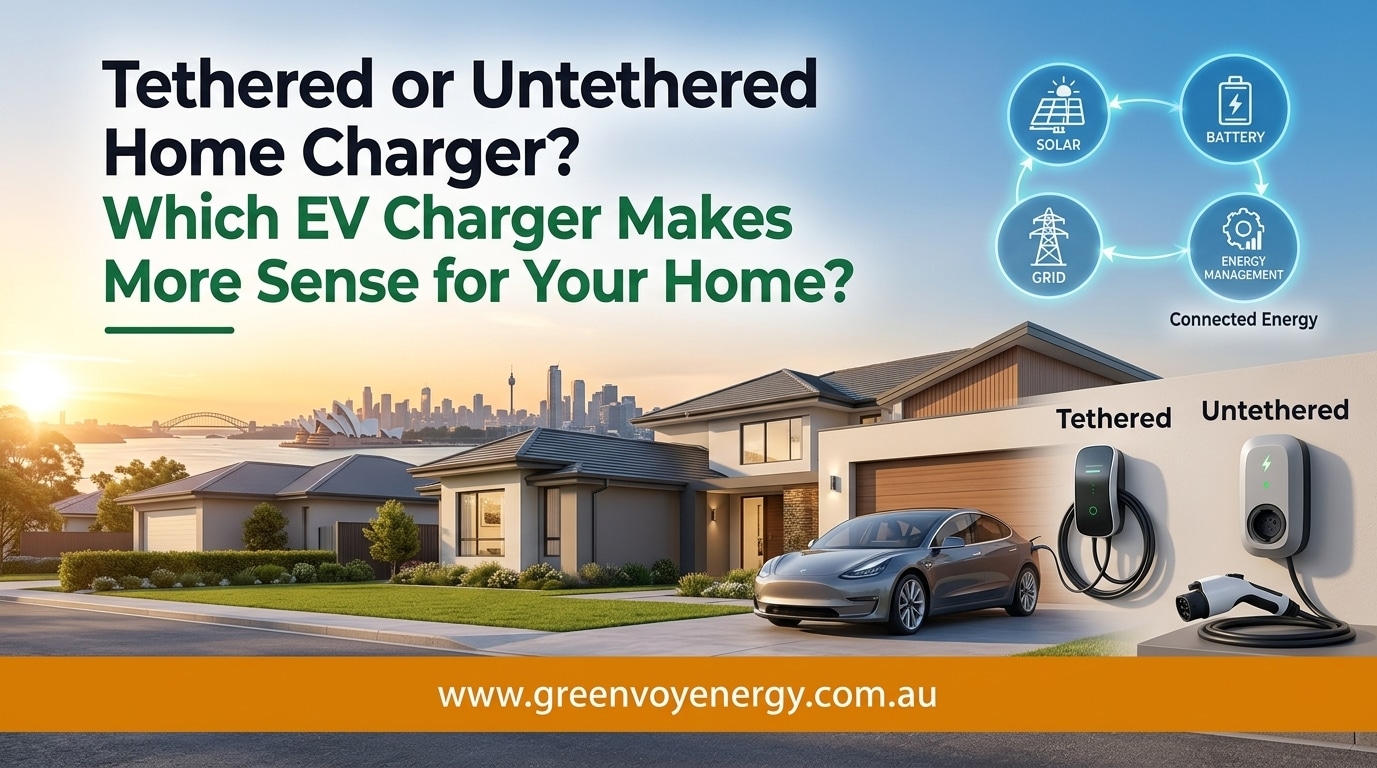
Once you begin exploring home EV charging options, you’ll probably come across two terms again and again — tethered and untethered chargers. The basic difference sounds easy enough: one comes with a permanently connected cable, while the other uses a separate charging cable.
But when you start thinking about your parking space, daily driving habits, solar panels, future EVs and even where you’ll keep the cable, the decision becomes a little more complicated.
This is where Greenvoy Energy can help make the whole process much simpler. Rather than choosing an EV charger just because it looks modern or comes with impressive specifications, it’s important to think about how well it will actually fit into your everyday home energy needs and setup.
What Is a Tethered EV Charger?
A tethered EV charger comes with a charging cable that stays permanently connected to the charging unit.
When you arrive home, you simply park your EV, take the attached cable and plug it into the vehicle. There’s no need to search for a separate cable or take one out of the boot every time you want to charge. For many EV owners, this everyday convenience is the main reason to consider a tethered setup.
Think about getting home after a long day at work, especially when it’s raining. You park the car, connect the cable and head inside. There’s no extra equipment to find and not much fuss involved.
A tethered home EV charger can work particularly well when one EV is regularly parked in the same place. There is, however, something to consider. Since the cable remains attached to the charger, you’ll need a suitable way to store or hang it when it’s not being used.
The cable length is important too. If the charger is installed some distance from where you normally park, you’ll want enough reach to connect comfortably without stretching the cable.
What Is an Untethered EV Charger?
An untethered EV charger works a little differently from a tethered model. It doesn’t have a charging cable permanently attached to the unit. Instead, it comes with a socket, so you simply plug in a compatible charging cable whenever you need to charge your EV.
One of the noticeable benefits is that the wall-mounted charger can look neater when it isn’t being used. Once the cable is unplugged, there isn’t a long charging lead hanging from the unit.
There’s also an element of flexibility.
If you eventually have more than one EV in the household, change vehicles or regularly need different charging cables, an untethered system can provide more freedom.
The small downside is convenience. You need to keep the charging cable somewhere handy and remember to bring it out whenever you want to plug in.
It may seem like a tiny extra step at first. But when you repeat it night after night, those little details can become surprisingly important.
Tethered or Untethered Home Charger: Which One Is More Convenient?
There isn’t one right answer for everyone. It mostly comes down to your daily routine, charging habits, and how you use your EV at home.
If your daily routine is straightforward — you come home, park in the same location and charge your EV overnight — a tethered charger can be very convenient.
You simply plug in the cable and carry on with your evening as usual.
An untethered EV charger may suit you better if you prefer a cleaner-looking installation or want greater flexibility with charging cables and different vehicles.
It’s also worth clearing up one common misunderstanding: a tethered charger does not automatically charge an EV faster.
Charging speed is influenced by several factors, including the charger’s power output, the vehicle’s onboard charger, the home’s electrical supply and the charging conditions.
So when comparing tethered and untethered chargers, the cable arrangement is mainly about convenience and flexibility, rather than charging speed.
What About 7kW and 22kW EV Chargers?
Another decision homeowners often face is choosing between different charging capacities.
A 7kW EV charger is a common choice for homes with a suitable single-phase electrical supply. For many drivers, this provides enough overnight charging to cover their normal daily travel.
Then there are 22kW EV chargers, which generally require a three-phase electrical supply, as well as an EV capable of accepting that level of AC charging.
There’s an important detail here, though.
Even if you install a 22kW charger, your EV may not actually charge at 22kW. The vehicle’s onboard AC charging capability also determines how much power it can receive.
This is why Greenvoy Energy looks at the complete setup rather than simply recommending the highest available charging capacity. For some homeowners, a properly installed 7kW charger may already provide everything they need.
Your Solar Panels Can Change the Conversation
Now imagine that your home already has solar panels.
Your EV might be sitting in the driveway during the middle of the day while your solar system is producing electricity. With the right setup, some of that solar generation can potentially be directed towards charging your vehicle.
This is where solar EV charging becomes particularly interesting.
NSW Government guidance highlights daytime EV charging as an option for households with solar, while households without solar may also consider charging during cheaper electricity periods, such as overnight.
For Greenvoy Energy, EV charging is therefore not just about putting a charger on the wall.
Your solar panels generate power, your EV needs power to charge, and your household appliances are using electricity throughout the day as well. Smart charging can help you manage when and how that energy is used, making your home energy setup work more efficiently.
And if your home also has battery storage, there’s another layer to consider.
Already Have a Home Battery? Here’s What to Consider
Suppose your solar panels generate more electricity during the day than your home needs at that moment. Instead of letting all that surplus energy go unused, a home battery can store some of it for later.
Depending on your setup and charging needs, that stored power can also play a useful role in managing your overall home energy use.
This is another reason Greenvoy Energy takes a whole-home approach to EV charging. Your EV doesn’t operate separately from everything else in your house. It becomes another significant electrical load that needs to fit into the overall energy picture.
When solar panels, battery storage and EV charging are considered together, homeowners can make decisions based on how their energy is actually generated and consumed.
Think About Your Future EV Needs
There’s one more question worth asking before making your decision: will this be the only EV your household ever has?
Perhaps you currently have one electric car, but your partner may switch to an EV later. Or maybe you’ll replace your current vehicle with another electric model in a few years.
An untethered charger can provide useful flexibility because the cable isn’t permanently attached to the charger. A tethered system, meanwhile, can remain very appealing if your priority is having a cable ready to use whenever you arrive home.
Neither option is automatically the right answer.
Your home, your vehicle and your routine are different from someone else’s, and your EV charging setup should reflect that.
Installation Matters More Than People Think
Choosing the charger is only one part of setting up EV charging at home.
The installation itself needs to be considered carefully. The electrical supply, charger location, cable routing, parking position and future energy requirements can all influence what makes sense.
NSW Government guidance recommends using a licensed electrician with EV charger experience for Level 2 wall charger installations and selecting compliant equipment.
This is an area where Greenvoy Energy focuses on more than simply supplying an EV charger.
The physical location of the charger can affect everyday convenience. Cable routing can affect appearance and practicality. Your home’s available electrical capacity can also influence which charger is suitable.
So a charger that looks perfect when you’re browsing online may not necessarily be the best fit once your actual home is taken into account.
Greenvoy Energy Looks at the Bigger Picture
At Greenvoy Energy, the conversation doesn’t have to begin with, “Which EV charger should I buy?”
It can begin with much simpler questions.
How often do you drive? Where does your vehicle normally park? Do you already have solar panels? Do you have a home battery? When do you normally return home? And do you want your EV charging to work alongside your solar system?
These questions help create a more practical home EV charging solution.
Greenvoy Energy brings together EV charging with solar and battery solutions, allowing homeowners to consider how their vehicle fits into their broader home energy system.
That bigger-picture approach can be useful because an EV isn’t just another appliance. Depending on how much you drive, it can become one of the more substantial and flexible electricity loads in your home.
Final Thoughts
So, tethered or untethered home charger — which should you choose? A tethered charger can make everyday charging simple because the cable is already attached and ready to go. An untethered charger can offer more flexibility and allows the cable to be stored away when you’re not charging.
Neither option is universally right or wrong.
The better choice depends on your EV, parking arrangement, daily routine, electrical supply and whether you want to combine EV charging with solar or battery storage. At Greenvoy Energy, the focus is on understanding the complete home energy picture rather than simply selecting a charger from a catalogue.
If you’re considering EV charger installation, solar EV charging or a combined solar, battery and EV charging setup, taking a little time to understand your needs first can make the final decision much easier.
Frequently Asked Questions
Q1. What is the difference between a tethered and untethered EV charger?
A tethered charger has a cable permanently connected to the unit. An untethered charger has a socket and uses a separate compatible charging cable.
Q2. Is a tethered EV charger faster than an untethered one?
Not automatically. The charging speed depends on the charger’s output, your EV’s onboard charger, the home’s electrical supply and other technical factors.
Q3. Is a 7kW EV charger suitable for home use?
For many households, a 7kW charger can provide enough overnight charging for normal daily driving. Your vehicle, driving distance and electrical setup should still be considered.
Q4. Can I use my solar panels to charge my EV?
Yes, solar electricity can be used for EV charging during daylight hours when your system is generating power. Smart charging can help make better use of available solar generation.
Q5. Do I need a 22kW charger for my home?
Not necessarily. A 22kW charger generally requires three-phase power and a vehicle that supports that charging rate, so a lower-powered charger may be more practical for many homes.
6. Can an EV charger work with a home battery?
Yes. EV charging can be included as part of a wider solar and battery system. The exact setup depends on the equipment and how the home’s energy system is designed.
7. Can Greenvoy Energy help me choose a home EV charger?
Yes, Greenvoy Energy can help homeowners consider EV charging alongside their broader solar and battery requirements, so the charging setup is suited to the home rather than chosen in isolation.


Leave a comment