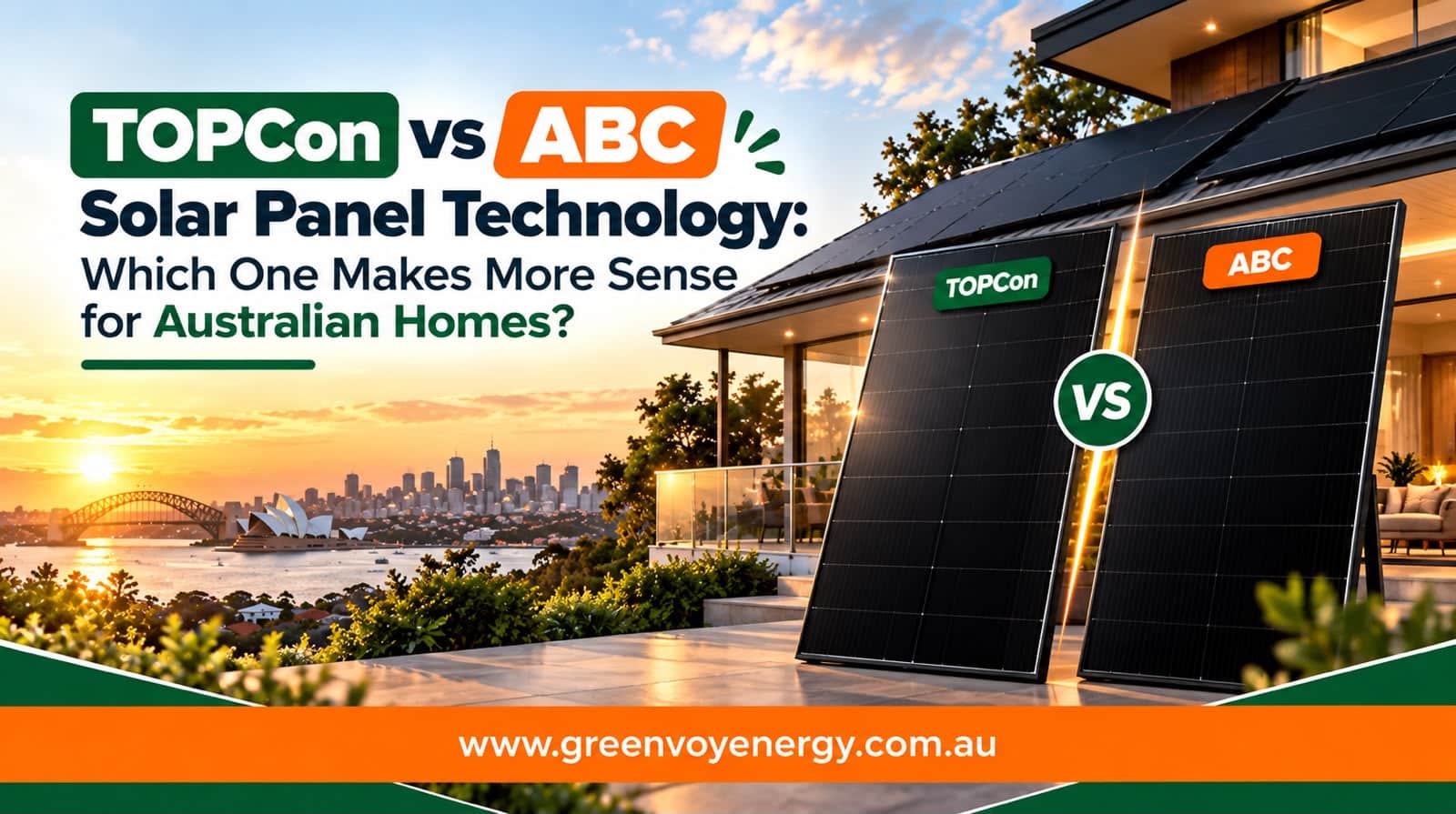
Solar technology has changed quickly over the last few years. If you researched solar panels five or six years ago, most conversations were about panel wattage, warranties, monocrystalline cells and brand reputation. Today, Australian homeowners are also coming across terms such as N-type solar panels, TOPCon solar technology and ABC solar panel technology.
For someone who is not working in the solar industry every day, these terms can easily become confusing. Both TOPCon and ABC are modern technologies designed to improve solar panel efficiency, energy production and long-term performance, but they achieve those improvements in different ways.
At Greenvoy Energy, we believe homeowners should understand the technology they are paying for rather than choosing a solar system simply because a product brochure contains impressive numbers. So, in this guide, we will compare TOPCon vs ABC solar panels in a simple and practical way.
What Is TOPCon Solar Technology?
TOPCon stands for Tunnel Oxide Passivated Contact. It is an N-type solar cell technology that has become increasingly common in residential and commercial solar systems. The technology is designed to reduce energy losses inside the solar cell and improve the movement of electrical charges.
In practical terms, this can result in strong panel efficiency, good long-term performance and lower degradation compared with many older P-type technologies. TOPCon has also become widely available because many solar manufacturers have been able to adapt existing production methods to manufacture it at scale.
For many Australian homes, quality TOPCon solar panels can provide a strong balance between price, performance and availability. However, most conventional TOPCon cells still use electrical contacts across part of the front surface of the solar cell.
What Is ABC Solar Panel Technology?
ABC stands for All Back Contact technology. Unlike conventional solar cell designs, ABC technology moves the electrical contacts to the back of the solar cell rather than placing them across the front surface.
This gives sunlight more usable surface area because there are no traditional front-side grid lines blocking part of the cell. AIKO, one of the well-known manufacturers developing ABC solar technology, uses this back-contact structure across its high-efficiency solar panel range.
Another noticeable benefit is appearance. ABC solar panels can have a much cleaner, more uniform black look. For homeowners who care about how their solar panels look on a modern roof, particularly when the system is visible from the street, this can be an attractive advantage.
TOPCon vs ABC Solar Panels: What Is the Main Difference?
The biggest difference between TOPCon and ABC solar panels is the location of the electrical contacts. TOPCon panels generally retain some form of front-side metallisation, while ABC solar cells move the contacts to the rear.
By removing electrical contacts from the front, ABC cells can use more of their front surface to capture sunlight. This can help manufacturers increase power generation from a similar physical panel area.
This difference becomes particularly important when roof space is limited. At Greenvoy Energy, system design starts with understanding how much usable roof area is actually available rather than simply looking at the total size of the roof.
Solar Panel Efficiency and Roof Space
Solar panel efficiency measures how effectively a panel converts sunlight into usable electricity. Higher-efficiency panels can generate more electricity from the same physical roof area, which can be particularly valuable for homes with limited usable space.
Many Australian rooftops have skylights, antennas, vents, chimneys or different roof orientations. These features can reduce the amount of space available for solar panels, even when the overall roof appears large.
High-efficiency ABC solar panels can be useful in these situations because they may allow more solar capacity to be installed within a smaller area. However, efficiency should never be the only factor considered when choosing a solar system.
How Do ABC Solar Panels Perform in Partial Shade?
Partial shading is common on residential properties. Trees, nearby buildings, chimneys and roof structures can create shadows at different times of the day, and even a relatively small shaded area can affect solar generation.
Certain ABC solar panels are designed with partial-shading optimisation that can help reduce the impact of shading on individual cells. This does not mean ABC panels are completely unaffected by shade, but the cell architecture may offer advantages under specific conditions.
At Greenvoy Energy, shading is considered as part of the complete solar system design. Panel placement, inverter choice, string configuration and roof orientation can all influence how well a solar system performs throughout the day.
How Do TOPCon and ABC Panels Handle Australian Heat?
Australian rooftops can become extremely hot, particularly during summer. Solar panels generally lose a small amount of output as their operating temperature increases, which is why the temperature coefficient is an important specification.
A lower negative temperature coefficient means the panel loses less performance as the cell temperature rises. Modern N-type technologies, including TOPCon and ABC, can provide strong temperature performance, although exact figures depend on the individual panel model.
When Greenvoy Energy assesses solar products, headline wattage is only one part of the comparison. Temperature performance, efficiency, degradation and overall product quality are also important when selecting panels for Australian conditions.
What About Long-Term Solar Panel Degradation?
Solar panels are designed to operate for decades, so long-term degradation matters. Degradation refers to the gradual reduction in the maximum output of a solar panel as it ages.
Modern N-type technologies such as TOPCon and ABC are designed to reduce long-term performance losses compared with many older solar cell technologies. However, the actual degradation rate depends on the specific manufacturer and product.
This is why Greenvoy Energy considers product warranty, performance warranty, manufacturer reputation and installation quality together. A high-quality solar panel still needs to be installed correctly if it is expected to perform well over the long term.
Is ABC Better Than TOPCon?
There is no simple answer that applies to every home. ABC technology offers some clear advantages, especially when maximum panel efficiency, clean appearance and high power density are important.
TOPCon remains a highly capable modern solar technology. It is widely available from major manufacturers and can provide excellent performance and value for many residential and commercial systems.
The better question is not whether ABC is automatically better than TOPCon. The more useful question is which technology makes more sense for your roof, electricity usage, available budget and long-term energy plans.
When Does ABC Technology Make More Sense?
ABC solar panels can be particularly attractive when usable roof space is limited. If a homeowner wants to install as much solar capacity as possible within a restricted area, high-efficiency back-contact technology may provide an advantage.
ABC technology can also appeal to homeowners who prefer an all-black, cleaner-looking solar panel. On modern homes, this aesthetic difference can be noticeable, especially when panels are installed on highly visible sections of the roof.
For customers exploring premium solar options, Greenvoy Energy can help compare ABC technology with other available panel technologies based on the actual requirements of the property.
When Can TOPCon Be a Strong Choice?
TOPCon panels can make excellent sense when a homeowner wants modern N-type technology while maintaining a strong balance between system performance and overall investment.
If a property has plenty of usable roof space, there may be less need to pay for the highest possible efficiency per square metre. In this situation, a well-selected TOPCon system can still provide excellent electricity generation and long-term value.
The manufacturer, panel model, warranty, inverter and installation quality should all be considered alongside the solar cell technology itself.
The Solar Panel Is Only One Part of the System
It is easy to spend a lot of time comparing solar panels and forget that they are only one part of a complete solar energy system. The inverter, panel orientation, roof layout, shading, household electricity usage and future energy needs can all affect the final result.
A homeowner planning to install a battery or EV charger in the future may also need a different system design from someone who simply wants to reduce daytime grid electricity consumption.
Greenvoy Energy provides solar panels, solar inverters, battery solutions, EV charging, monitoring and maintenance services. This allows the complete system to be considered rather than selecting components individually without understanding how they will work together.
Why Solar System Design Matters More Than One Specification
A panel with higher efficiency does not automatically mean the complete solar system will produce better financial results. A slightly lower-efficiency panel installed on a properly designed system can often make more sense than a premium panel installed in the wrong position or paired with unsuitable components.
System design should consider how much electricity the household uses during the day, how much roof space is available, where shading occurs and whether electricity consumption is expected to increase in the future.
This is why Greenvoy Energy focuses on designing solar solutions around the property rather than simply recommending a product based on one impressive technical specification.
Choosing TOPCon or ABC Solar Panels in Australia
Before choosing between TOPCon and ABC solar panels, homeowners should look closely at their property and energy requirements. Roof size, orientation, shading and electricity consumption can all influence which panel technology makes the most sense.
Future requirements should also be considered. If you expect to add a battery, electric vehicle or other high-energy equipment, your electricity usage could look very different in a few years.
A properly designed system should account for both current and future energy needs. Greenvoy Energy works with homeowners to understand those requirements before recommending a solar system configuration.
Final Thoughts
The TOPCon vs ABC solar panel comparison shows how quickly solar technology continues to develop. TOPCon offers strong modern N-type performance, good efficiency and broad availability, while ABC technology takes a different approach by moving electrical contacts to the rear of the cell.
For homes with limited roof space, premium efficiency requirements or a preference for clean all-black panels, ABC technology can be very attractive. For other properties, a quality TOPCon system may provide an excellent combination of performance and value.
The most important thing is not choosing a technology simply because it is newer. Your solar system should be designed around your property, energy usage, future requirements and budget.
If you are considering solar in Australia, Greenvoy Energy can help you compare panel technologies, inverters and complete solar system options based on what actually makes sense for your home.
Frequently Asked Questions
Q1. What is the main difference between TOPCon and ABC solar panels?
The main difference is where the electrical contacts are located. TOPCon panels generally retain electrical contacts on the front of the solar cell, while ABC, or All Back Contact technology, moves those contacts to the rear. This gives ABC cells a cleaner front surface and can help increase the usable area available for absorbing sunlight.
Q2. Are ABC solar panels more efficient than TOPCon panels?
Some ABC solar panels can achieve higher efficiency than many conventional TOPCon panels because the front surface is free from traditional electrical contacts. However, efficiency varies between manufacturers and individual models, so homeowners should compare actual product specifications rather than assuming every ABC panel will outperform every TOPCon panel.
Q3. Are TOPCon solar panels a good choice for Australian homes?
Yes. TOPCon is a modern N-type solar technology used by many leading manufacturers. Quality TOPCon panels can provide strong efficiency, good long-term performance and competitive value, making them suitable for many Australian residential and commercial solar systems.
Q4. Are ABC solar panels better for small roofs?
ABC technology can be especially useful on smaller roofs because high-efficiency panels can help generate more electricity from limited usable space. If skylights, vents, chimneys or different roof orientations reduce the available installation area, higher power density can become an important advantage.
Q5. Do ABC solar panels perform better in partial shade?
Certain ABC solar panels include cell designs intended to reduce the impact of partial shading. This can help under some conditions, but it does not mean shade becomes irrelevant. Proper panel placement, inverter selection and system design still play an important role in overall performance.
Q6. Should I choose solar panels based only on efficiency?
No. Solar panel efficiency is important, but homeowners should also consider degradation, temperature coefficient, warranties, manufacturer reliability, inverter compatibility, shading and installation quality. Greenvoy Energy considers these factors together when assessing the best system configuration for a property.
Q7. How can Greenvoy Energy help me choose between TOPCon and ABC?
Greenvoy Energy can assess your roof, electricity usage, available space, shading conditions and future energy requirements before recommending a suitable solar system. Instead of selecting technology based purely on marketing claims, the goal is to choose a panel and system design that performs effectively for your specific property.
Leave a comment