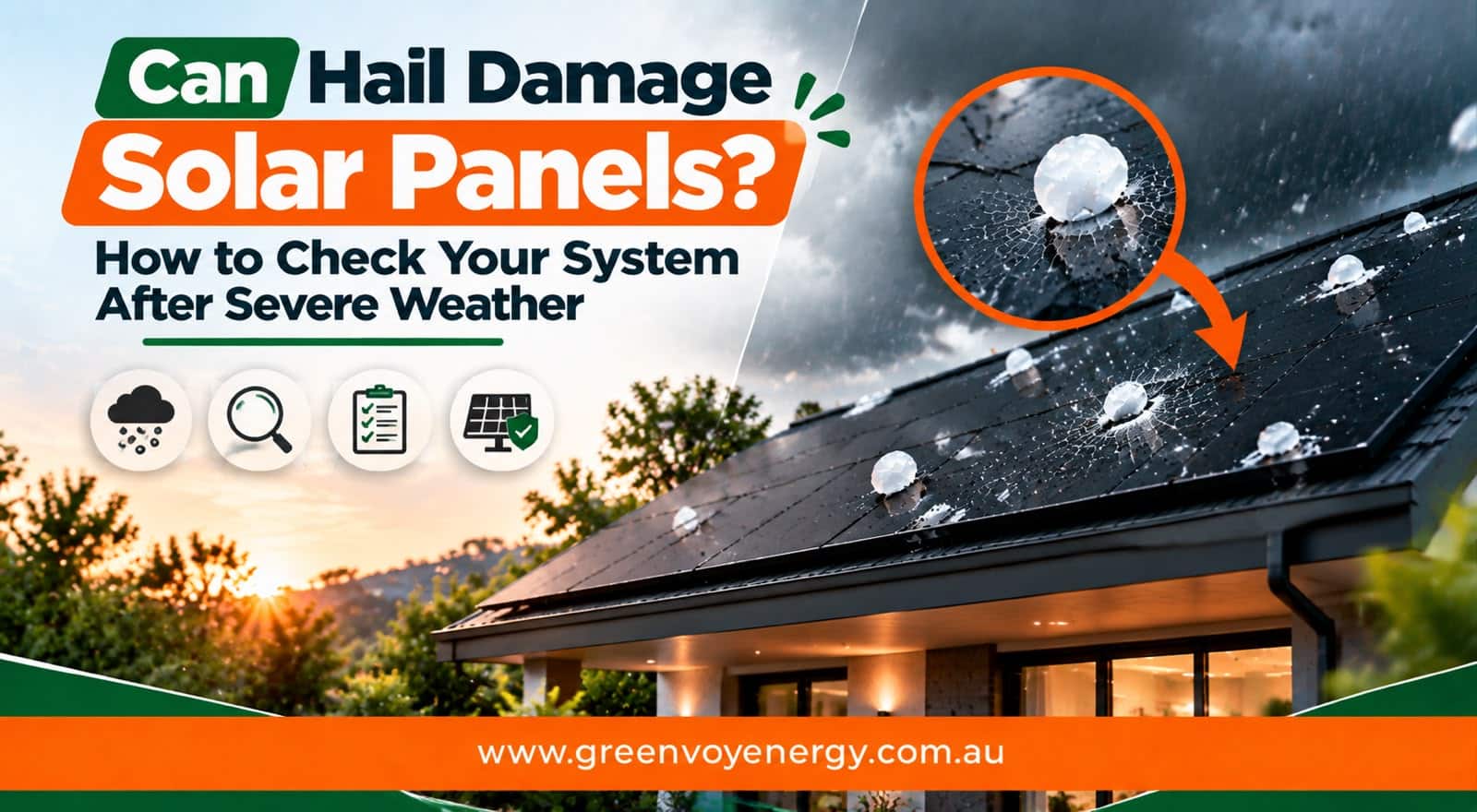
You wake up after a rough night of weather and there is hail scattered across the driveway, garden and roof. Your first thought may be about the roof itself, but if you have solar panels, another question usually comes pretty quickly: can hail damage solar panels?
The short answer is yes. Modern solar panels are designed and tested to handle outdoor conditions, including defined levels of hail impact, but very severe storms can still cause damage. Large or high-speed hail can crack protective glass, affect solar cells or create faults that are not immediately obvious from the ground.
For Australian homeowners, knowing what to do after severe weather can save a lot of stress and potentially prevent a small problem from becoming a bigger one. At Greenvoy Energy, solar is viewed as a long-term energy investment, so monitoring system performance and getting professional support after major weather events are important parts of looking after that investment.
Can Hail Damage Solar Panels?
Yes, hail can damage solar panels, although the severity depends on the size and force of the hail, the panel design and the conditions during the storm. Solar modules use protective glass and are tested against defined impact conditions, but no panel should be considered completely immune to extreme weather.
The Clean Energy Council maintains an approved PV module list based on relevant standards, while IEC testing includes hail-impact requirements for photovoltaic modules. These standards provide an important baseline for durability, but they should not be treated as a promise that a panel will survive every hailstorm.
Australian research has also highlighted the extra risk created by larger hailstones. CSIRO notes that hail above around 25 mm can carry substantially greater destructive energy because larger stones are heavier and can reach higher terminal velocities.
This is why Greenvoy Energy recommends looking at the actual condition and performance of the solar system after a major hail event rather than assuming that all panels are either damaged or completely unaffected.
Why Can Large Hail Be a Problem for Solar Panels?
At first glance, solar panels look incredibly tough. They sit outside year after year through heat, rain and wind, and the glass surface is specifically designed to protect the electrical components underneath.
The challenge is the amount of impact energy delivered by a large hailstone travelling at speed. A concentrated impact can damage the glass or create cracks in the solar cells beneath it, particularly during an unusually severe storm.
CSIRO has documented hail-related damage to photovoltaic panels in Australia, including damage from golf-ball-sized hail during a severe Canberra storm. Events like this show why hail resistant solar panels should not be confused with completely hail-proof panels.
For homeowners working with Greenvoy Energy, durability is only one part of the solar discussion. Product quality, installation, monitoring and long-term maintenance all matter when you are protecting a solar investment.
What Does Hail Damage on Solar Panels Look Like?
The most obvious signs of solar panel hail damage include cracked glass, chips, circular impact marks, fractures or visibly damaged sections across a panel. In more serious cases, the damage can be easy to spot even from a distance.
But not every problem looks dramatic. A strong hail impact can affect internal solar cells or electrical connections without leaving a large crack that is obvious from the ground.
That is why solar performance is another useful clue after a severe storm. If your system was operating normally before the weather and then suddenly starts producing less electricity afterwards, it is worth finding out why rather than assuming it is just a temporary change.
Greenvoy Energy offers active monitoring for solar and battery systems, helping homeowners keep track of performance and identify faults that may otherwise go unnoticed.
Can Hail Damage Solar Cells Without Breaking the Glass?
It is possible for internal solar cells to be damaged even when the surface does not appear badly broken. The cells and their electrical connections are protected beneath several layers, so some faults are not easy to identify with a simple visual check.
Small cracks can interfere with the electrical pathways inside the module and reduce the amount of electricity a panel can produce. In some cases, the impact may not create an immediate dramatic drop, which makes ongoing monitoring particularly useful.
This is why checking your solar generation data after severe weather can be valuable. At Greenvoy Energy, system monitoring can provide an early indication that something has changed, although a professional inspection may still be necessary to determine the exact cause.
The important point is that a panel does not have to look completely shattered before it deserves attention.
How to Check Your Solar System After a Hailstorm
The first step is actually not to climb onto the roof. After severe weather, the roof may be wet or damaged, and solar equipment can present electrical hazards that are not obvious to someone without the right training.
From a safe position on the ground, you can look for obvious signs such as cracked glass, visible impact marks, displaced panels or anything that looks different from before the storm. You can also check your solar monitoring system to see whether generation has changed significantly.
If you can see broken equipment, exposed wiring or other serious damage, do not touch it. Contact your installer or a suitably qualified electrical and solar professional who can inspect the system safely.
For a Greenvoy Energy customer, arranging professional support after a serious storm is a safer and more reliable way to establish whether there is actual damage.
Check Your Solar Monitoring Data
After the storm has passed, your monitoring system can provide another useful piece of information. Compare recent solar generation with your normal production, while remembering that clouds, rain and shading can naturally affect output.
What you are looking for is an unusual change that continues once ordinary weather conditions return. If the system was consistently performing at a certain level before the storm and then remains noticeably lower afterwards, that is a reason to investigate.
Greenvoy Energy’s active monitoring service is designed to track solar and battery performance, identify faults and support remote troubleshooting where possible. When a problem cannot be resolved remotely, further assistance can be arranged.
This does not mean monitoring can diagnose every type of hail damage by itself. It simply gives homeowners another useful way to spot when something may have changed.
Look for Inverter Warnings
The inverter is another part of your solar system worth checking after severe weather. Depending on the model, it may display warning messages, fault codes or notifications if the system is not operating as expected.
A new warning after a storm does not automatically prove hail damage, but it is certainly something that should not be ignored. The issue could relate to a panel, wiring, electrical protection, the inverter itself or another part of the installation.
Do not open the inverter or attempt electrical repairs yourself. Greenvoy Energy can help investigate unusual solar-system behaviour and determine whether professional inspection or repair is required.
Do Not Touch Damaged Solar Panels
This point is especially important after severe weather. A damaged solar panel can still generate electricity whenever it is exposed to daylight, even if the glass is cracked or the system appears to have stopped working normally.
If you see broken panels, exposed cables or damaged electrical equipment, keep your distance and avoid touching anything. Energy-safety guidance recommends having damaged solar equipment assessed by appropriately qualified professionals rather than attempting to make repairs yourself.
That is one reason post-storm inspections should always be treated as a safety issue as well as a maintenance issue. Greenvoy Energy can assess the system professionally instead of asking homeowners to take unnecessary risks on the roof.
Does Hail Damage Mean You Need New Solar Panels?
Not necessarily. It can be tempting to assume that a major storm means the entire array needs to be replaced, especially when one or two panels show obvious damage.
In reality, the extent of the problem needs to be assessed first. Some modules may be damaged while others remain in good condition, while in other situations the issue could involve cabling, connectors, mounting hardware or the inverter rather than the panels themselves.
A professional inspection can help determine whether the system needs individual panel replacement, repairs or more extensive work. Greenvoy Energy can take a system-wide approach rather than recommending full replacement simply because a storm has occurred.
The aim should be to repair or replace what is actually damaged and preserve everything that is still working correctly.
Check More Than Just the Panels
When people search for hail damaged solar panels, they often think only about the modules on the roof. But the panels are just one part of the overall solar system.
Your inverter, electrical cabling, isolators, mounting structure and other components all contribute to safe and reliable operation. A severe storm can affect different parts of the installation in different ways, and some of those problems may not be visible during a quick inspection.
That is why a professional post-storm assessment should consider the complete installation. Greenvoy Energy works across solar, battery, monitoring, repair and maintenance, making it possible to look at the wider system rather than focusing on one component.
What About Solar Panel Insurance?
Insurance is another question that often comes up immediately after a major storm. The answer depends on your particular policy, insurer, exclusions and the way the solar system is covered.
Some Australian home insurance policies can cover permanently attached solar panels when hail is an insured event, but homeowners should always check their Product Disclosure Statement rather than assuming coverage. The excess, claim conditions and limits can also vary.
If your panels appear damaged, document what you can safely from the ground and keep relevant installation records, invoices and system details. Your insurer can then explain the claim process and what evidence is required.
Greenvoy Energy can assist with the solar-system assessment, while your insurer determines what is covered under your individual policy.
Does a Solar Panel Warranty Cover Hail Damage?
This is where homeowners need to distinguish between a product warranty, workmanship warranty and insurance policy. They are separate things and they can have different conditions.
A manufacturer warranty usually covers specified product faults, while an installer’s workmanship warranty relates to the quality and performance of the installation within the stated terms. Weather events can fall under different exclusions or conditions depending on the warranty.
Greenvoy Energy’s published warranty information explains its product and workmanship warranty processes and outlines relevant terms and exclusions. Homeowners should therefore check the actual documents for their system instead of assuming that hail damage is automatically covered.
When in doubt, it is better to confirm the warranty position before arranging major replacement work.
How Can You Choose Hail Resistant Solar Panels?
You cannot control whether a hailstorm hits your home, but you can make informed choices when selecting solar equipment. Panel quality, certification, manufacturer specifications and installation standards all deserve attention.
The Clean Energy Council maintains an approved PV module list for products meeting its current requirements. Homeowners who live in areas with frequent or severe hail can also ask about the specific panel model’s impact testing and whether the manufacturer performs additional testing beyond the baseline requirements.
At Greenvoy Energy, choosing solar equipment should be about more than efficiency and price. Long-term durability, quality products and ongoing support are also important when building a system that is expected to operate for many years.
When Should You Call a Solar Professional?
You do not have to wait until a panel is visibly shattered before arranging an inspection. Cracked glass, sudden production drops, inverter warnings, unusual system behaviour or visible movement around the solar array are all good reasons to investigate.
It is especially important to seek professional help if you can see physical damage. Solar panels can remain electrically active during daylight, so DIY repairs or roof access after a storm can create unnecessary risk.
For homeowners in Sydney and nearby areas, Greenvoy Energy provides solar and battery support, active monitoring, repair and maintenance services. A professional assessment can help determine whether your system needs attention and, just as importantly, what does not need to be replaced.
Why Post-Storm Solar Maintenance Matters
A severe storm does not automatically mean your solar system is ruined. Often, the most important thing is simply finding out what happened before making a decision about repair or replacement.
Regular monitoring helps because you have a performance history to compare. If solar production changes immediately after a major weather event, that gives your installer a useful clue when investigating the issue.
For Greenvoy Energy, ongoing support is part of the solar ownership journey. Its active monitoring service is designed to detect faults, support remote troubleshooting where possible and arrange further assistance when the issue cannot be resolved remotely.
That can be particularly valuable when storm damage is hidden or when the system continues operating but is no longer performing as expected.
How Greenvoy Energy Can Help After Severe Weather
A serious hailstorm can leave homeowners wondering whether their solar system is safe, whether it is still producing properly and whether repairs are actually needed. Getting clear answers matters before spending money on unnecessary replacement.
Greenvoy Energy provides solar, battery, active monitoring, repair and maintenance services, allowing homeowners to look at both system performance and physical condition. This broader approach can help identify whether the problem is with individual panels, the inverter, wiring, mounting equipment or another part of the installation.
For a homeowner, that means the next step does not have to be guesswork. A proper professional assessment can turn “I think something is wrong” into a much clearer picture of what actually needs to happen.
Final Thoughts
So, can hail damage solar panels? Yes, particularly when the hail is large, heavy and travelling at high speed. But that does not mean every severe storm damages every panel, and it certainly does not mean an entire solar system needs to be replaced after a single weather event.
The safest approach after major hail is to stay off the roof, look for obvious damage from the ground, check your monitoring data and take inverter warnings seriously. If something appears unusual, a qualified professional can inspect the system and work out what has actually been affected.
At Greenvoy Energy, the focus goes beyond the solar panels themselves. Solar performance, battery operation, monitoring, repair and maintenance can all be considered together when assessing the impact of severe weather.
Your solar system is a long-term investment. Choosing quality equipment, understanding your warranty and insurance position, monitoring performance and getting professional help after major storms can all help protect that investment over the years.
Frequently Asked Questions
Q1. Can hail damage solar panels?
Yes. Modern solar panels are tested for defined hail-impact conditions, but large or unusually severe hail can still crack the glass, damage solar cells or affect other components.
Q2. How can I tell if hail damaged my solar panels?
Look for visible cracks or impact marks from a safe location and check your solar monitoring data for unusual production changes. Internal damage may not always be visible from the ground.
Q3. Should I climb onto my roof to inspect hail damage?
No. A wet or damaged roof can be dangerous, and damaged solar equipment may present electrical risks. It is safer to inspect from the ground and arrange a professional assessment.
Q4. Can a damaged solar panel still produce electricity?
Yes. Solar panels can continue generating electricity when exposed to daylight, even when they have been damaged. This is why damaged panels, wiring and electrical equipment should not be touched.
Q5. Do I need to replace all my solar panels after a hailstorm?
Not necessarily. A professional inspection can identify which parts of the system are actually damaged, meaning individual panels or other components may be repaired or replaced instead of the entire system.
Q6. Does home insurance cover hail damage to solar panels?
It depends on your individual policy and insurer. Some policies may cover permanently installed solar panels for insured hail events, but homeowners should check their specific terms and claim conditions.
Q7. Does a solar panel warranty cover hail damage?
Not automatically. Product warranties and workmanship warranties have different conditions, and weather-related damage may be treated differently from manufacturing or installation defects.
Q8. Can solar monitoring detect hail damage?
Monitoring can help identify unusual changes in system performance after a storm, but it cannot always determine the exact cause or location of physical damage. A professional inspection may still be required.
Q9. Can Greenvoy Energy help after hail damage to solar panels?
Greenvoy Energy provides solar and battery support, active monitoring, repair and maintenance services. A professional assessment can help determine whether your system has been affected and what action is actually required.

Leave a comment