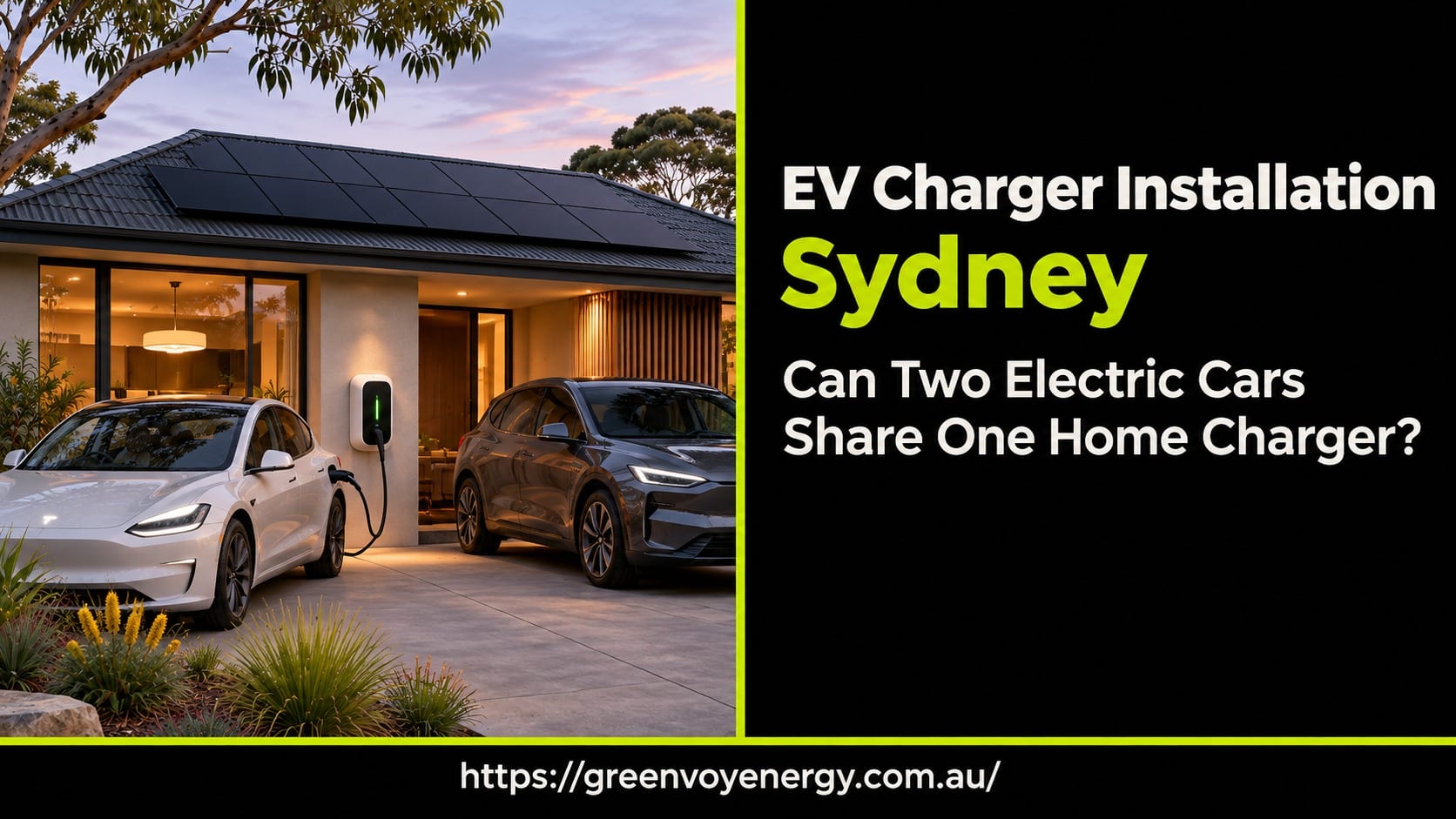
When Hannah and Luke bought their second electric car, they expected the changeover to be simple. Their home in Ryde already had a wall-mounted charger for Hannah’s daily commute. Luke figured they could both plug in when needed and leave the petrol station behind for good.
Then came their first Monday morning with two low batteries. Hannah needed to leave early, while Luke had a longer drive across Sydney. The charger worked perfectly; the problem was deciding whose car got it overnight.
For families exploring EV Charger Installation Sydney, sharing one home charger is often possible. The real question is whether one charging point can comfortably cover two driving routines. Greenvoy Energy helps Sydney homeowners explore EV charging options alongside their household electrical supply, parking space and energy plans.
Can Two Electric Cars Use the Same Home EV Charger?
Yes. Two compatible electric vehicles can generally use the same home wallbox, provided they connect separately and the charger suits both vehicles. With a typical single-outlet charger, that means charging one car and then moving the connector to the other. It doesn’t mean plugging both cars into one outlet simultaneously.
Many Australian-market electric cars use a Type 2 connection for AC charging, but you should check each vehicle’s specifications and the charger’s connector before buying. Different cars can also accept different maximum charging rates.
Hannah and Luke’s shared charger was technically capable of charging both cars. What they needed to work out was whether their available parking time and daily kilometres made sharing convenient.
Work Out How Much Charging Each Car Actually Needs
Battery size alone isn’t a good guide to household charging demand. A car with a large battery might need only a small top-up after a short commute, while a smaller car driven long distances could need more electricity each night.
Start with an ordinary week. Record roughly how far each car travels, which nights it returns with a low charge, and when it needs to leave again. Driving efficiency and weather affect the energy required, so treat your figures as estimates rather than guarantees.
For illustration, if Hannah needs 12kWh replenished and Luke needs 18kWh, that’s 30kWh delivered to the cars. At a sustained 7kW, the theoretical charging time is just over four hours; real sessions take longer because of losses, vehicle limits and changes in charging power.
Can One 7kW EV Charger Handle Two Cars Overnight?
A dedicated single-phase home charger is commonly rated around 7kW, though actual output depends on the installation and the vehicle. With sufficient overnight parking time, one unit may replenish both cars on alternating nights or in separate sessions.
Hannah’s car usually arrived home first. They considered giving it the earlier slot on days when she had an early start, then swapping the connector before bedtime.
For EV Charger Installation Sydney, ask whether a scheduled charging arrangement would suit your household. A faster-rated charger isn’t automatically more useful if the car cannot accept its full output or the home’s electrical supply cannot support it.
Does Sharing a Charger Work With Tesla, BYD and Other EVs?
A compatible Type 2 wallbox can generally be used with different Type 2-equipped vehicles, including many Australian-market Tesla and BYD models. The cars needn’t be from the same manufacturer, and a branded charger isn’t always restricted to that brand.
Still, check the precise vehicle model, charging port, cable arrangement and any charger settings. A tethered charger keeps its cable attached; an untethered unit requires a suitable separate cable.
Greenvoy Energy’s EV charging solutions are worth discussing with details of both cars and where they park. Positioning the unit sensibly can matter as much as its advertised speed.
When Is a Second Home EV Charger Worth Considering?
One charger becomes less convenient when both drivers regularly cover long distances, arrive late and need substantial charging before the next morning. Moving the connector between cars may also be awkward if one parks behind the other or in a separate driveway.
That was Luke’s concern during weeks with client visits. Their usual driving patterns fitted a shared charger, but occasional busy days created a scheduling headache.
Two charging points can offer more flexibility, but they also increase the potential electrical load. Before adding another wallbox, have the home’s supply and switchboard assessed rather than assuming a second unit can simply connect beside the first.
What Is EV Charger Load Management?
Load management helps control how much electricity charging equipment draws, especially when household appliances are also operating. A suitable system can reduce charging power to stay within configured electrical limits. With compatible paired chargers, load sharing may distribute available charging capacity between two vehicles.
This doesn’t create extra supply capacity. If both cars charge simultaneously, each may receive less power than it would on its own.
Homeowners comparing EV Charger Installation Sydney options should ask whether dynamic load management is supported, which equipment is required and how it behaves during heavy household usage. Greenvoy Energy can discuss these questions as part of choosing a suitable charging arrangement.
Can Rooftop Solar Help Charge Two Electric Cars?
Solar charging can lower the amount of grid electricity needed when a car is home during the day.
A solar-aware charger may prioritise available surplus generation when a vehicle is plugged in. On weekends or work-from-home days, this could make better use of electricity that might otherwise be exported. Overnight charging, however, will usually depend on grid supply unless an appropriate home battery is also involved.
Explore Greenvoy Energy’s solar panel options and its guide to smart EV charging in Sydney if solar integration is part of your plan. Savings depend on your electricity tariff, solar surplus and charging schedule.
Will You Need a Switchboard Upgrade for Two EVs?
Not every home needs a switchboard replacement, but two-vehicle charging makes an electrical assessment particularly important. An installer should review the existing supply, circuit capacity, protective equipment, cable routes and whether simultaneous charging is proposed.
Older properties may need changes before a dedicated charger can be installed safely. Where appropriate, load management may offer a way to manage demand, but the electrical design must confirm that.
In NSW, a fixed wallbox must be installed by an appropriately licensed electrician. Greenvoy Energy can be contacted with switchboard and parking details to discuss the proposed scope; homeowners shouldn’t attempt charger wiring or modifications themselves.
How Much Does a Shared EV Charger Setup Cost in Sydney?
The installed price depends on the charger model, distance from the switchboard, mounting position and any additional electrical work. A single suitable wallbox may be more economical than installing two separate units, especially if both vehicles have modest daily charging needs.
However, a cheaper charger isn’t good value if the cable can’t reach the second car or the setup becomes frustrating to use. If you are comparing one charger with a two-charger load-sharing design, request itemised quotes covering hardware, cabling, circuit protection, commissioning and optional controls.
Greenvoy Energy offers residential charging solutions and can discuss which equipment fits the property. If you’re still choosing between tethered and untethered models, see its home charger comparison guide.
Final Thoughts: Plan Two-Car Charging With Greenvoy Energy
Hannah and Luke discovered that their problem wasn’t necessarily a lack of chargers. Most weeks, one wallbox could meet their needs. What mattered was being realistic about busy evenings, parking arrangements and how much charge each vehicle actually required.
For EV Charger Installation Sydney, start by comparing both cars’ daily driving and time parked at home. One charger can be practical when the vehicles charge in turns; two load-managed chargers may be worth considering when both need power at once.
Contact Greenvoy Energy with your vehicle models, parking layout and existing electrical details. Ask about a compatible home charging arrangement that works for today’s household and any future EV plans.
Frequently Asked Questions
Q1. Can two electric cars use one Type 2 home charger?
Yes, if both vehicles and the charger have compatible connections. A single-outlet wallbox normally charges one vehicle at a time, so the connector needs to be moved between cars.
Q2. Can a Tesla and BYD share one home EV charger?
Many Australian-market Tesla and BYD vehicles can use the same compatible Type 2 AC charger. Check both exact models and the charger’s specifications before installation.
Q3. Do I need a second charger for two EVs?
Not necessarily. One charger may be sufficient if daily driving needs are moderate and the cars have enough time to charge in separate sessions.
Q4. Can two home EV chargers run at the same time?
Yes, where the electrical installation supports it. Suitable load sharing or management may be needed to control the combined demand and available charging power.
Q5. Can Greenvoy Energy help plan charging for two vehicles?
Greenvoy Energy offers residential EV charging options for Sydney homeowners. Share both vehicle models, your parking arrangements and electrical supply details to discuss suitable configurations.



Leave a comment