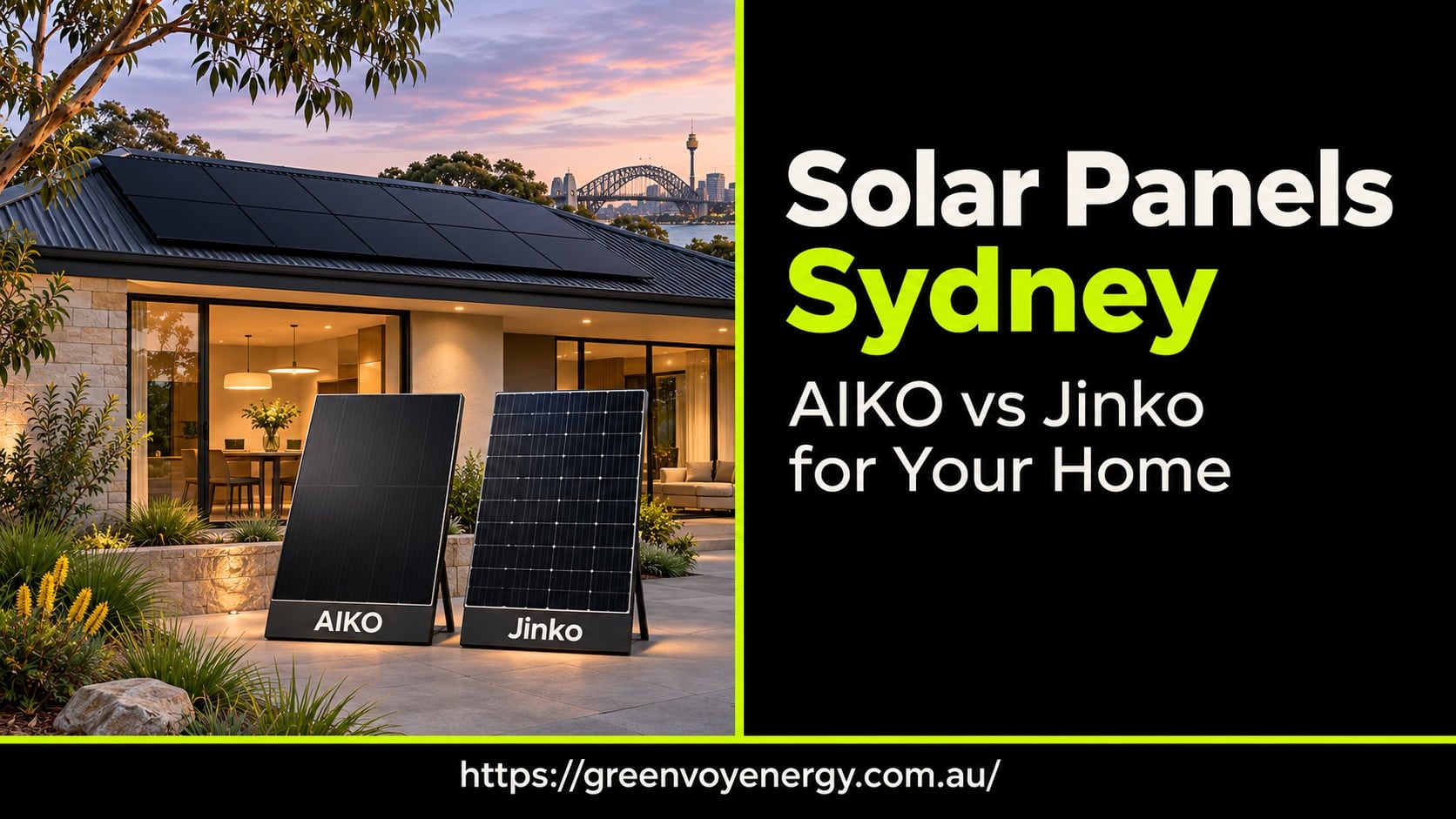
When Priya and Daniel started looking at solar for their family home in Ryde, they thought choosing the system size would be the difficult part. Their electricity bills suggested that rooftop solar was worth exploring, and both had agreed that a tidy-looking installation mattered. Then two quotes arrived: one recommended AIKO panels, while the other specified Jinko Solar.
Both brands sounded promising. The trouble was that the quotes used different panel models, wattages and warranties, making a simple price comparison almost impossible. They didn’t want to choose a brand because it looked impressive in a brochure.
For homeowners researching Solar Panels Sydney, that uncertainty is familiar. Greenvoy Energy offers AIKO and Jinko solar panel solutions, helping Sydney households compare equipment against their roof space, electricity use and budget. The right decision comes from reviewing the complete system, not a brand name alone.
AIKO vs Jinko Solar Panels: What’s the Main Difference?
AIKO is known for its n-type all-back-contact (ABC) solar cell technology. By moving electrical contacts to the rear of the cells, the design reduces obstruction across the front surface. Some AIKO residential ranges also have a distinctive all-black appearance that appeals to homeowners with visible rooflines.
Jinko’s Tiger Neo family uses n-type TOPCon technology, designed to deliver strong conversion efficiency and long-term performance. Jinko offers several residential panel configurations, so a quote may include a different size, construction or power rating from another Jinko proposal.
Neither technology alone tells you which installation will produce more electricity at your address. Ask Greenvoy Energy for the exact model numbers and datasheets so you’re comparing panels that will actually be installed.
Does Higher Panel Efficiency Matter on a Sydney Roof?
Panel efficiency describes how much sunlight a panel converts into electricity under standard testing conditions. Higher efficiency can be helpful when roof space is limited, because more rated capacity may fit within the same usable area.
Priya’s roof had a vent, skylight and a section shaded by a neighbour’s tree. Even though the house looked large from the street, the usable panel area was smaller than expected. A compact arrangement with higher-efficiency modules could be more useful than simply choosing the highest wattage printed on a datasheet.
For Solar Panels Sydney, compare the proposed number of panels, their dimensions and total array capacity. A 500W panel isn’t necessarily a better fit than a 475W panel if its size means fewer modules can be installed.
Which Solar Panels Perform Better in Shade?
Both manufacturers discuss performance in challenging conditions, but shade behaviour varies by model and system design. A nearby chimney, antenna or tree can affect generation, especially when it shades the same roof section regularly.
AIKO promotes partial-shading features within its back-contact technology, while Jinko’s TOPCon models have their own electrical and cell-design characteristics. Marketing claims don’t replace a site-specific shade assessment, and neither brand can eliminate losses caused by shade.
Daniel wanted to know what would happen during late afternoons when their neighbour’s tree crossed the roof. Greenvoy Energy can discuss panel placement, inverter design and whether suitable optimisers or microinverters are worth evaluating. Sometimes relocating a panel is a better answer than paying extra for a particular product.
What About Sydney’s Summer Heat and Winter Sun?
Solar panels can generate strongly on bright days, but high cell temperatures reduce output compared with the panel’s rated test conditions. Manufacturers publish a temperature coefficient showing how performance changes as temperature rises.
Sydney homeowners should compare the temperature coefficient of the exact AIKO and Jinko models on their quotes, not assume that one brand always performs better in summer. Roof ventilation, panel positioning and installation quality also influence operating temperatures.
Winter brings shorter days and different sun angles. An east-west roof may have a different daily production pattern from a north-facing roof, regardless of whether AIKO or Jinko panels are installed. Ask Greenvoy Energy for monthly, rather than only annual, generation estimates.
AIKO vs Jinko Warranties: What Should You Check?
Solar panel warranties generally include a product warranty covering defined defects and a performance warranty specifying retained output over time. They are separate promises, and the conditions matter as much as the headline number of years.
AIKO has announced Australian residential ranges with long product and performance warranties, while Australian Jinko Tiger Neo documents also list extended coverage for specified models. Those terms differ between products and may change with newer releases.
Priya initially circled the biggest warranty number on each quote. A better question was who would handle a claim, which labour or transport expenses were covered, and what evidence she would need. Review Greenvoy Energy’s warranty information alongside the manufacturer’s model-specific documents.
Is AIKO More Expensive Than Jinko in Sydney?
You may find AIKO offered as a higher-priced option and Jinko positioned as a value-focused alternative, but actual pricing depends on the model, supplier, inverter, installation complexity and the quote itself. Brand stereotypes won’t tell you the installed price on your roof.
For a fair comparison, ask for the same target system capacity and similar installation scope. Check whether the proposal includes mounting hardware, monitoring, switchboard work and grid connection arrangements.
Greenvoy Energy can help discuss complete solar panel installation options rather than a panel-only price. An apparently cheaper package may be less attractive if it excludes essential work or produces less energy because of its layout.
Does Panel Appearance Make a Difference?
It can, especially on a roof visible from the street. AIKO’s all-black designs may appeal to homeowners who prefer a uniform, discreet appearance. Jinko also offers dark-panel configurations, although frames, cell patterns and finished appearance differ by model.
Priya cared about the roof’s appearance because the panels would be visible above the front veranda. Daniel was more interested in output. They asked for a roof layout showing where each module would sit, rather than deciding from product photographs alone.
A good design should satisfy practical requirements first, including suitable clearances, safe access and expected generation. Appearance can then help choose between genuinely comparable options.
How Do AIKO and Jinko Compare for Battery-Ready Homes?
Both brands produce photovoltaic panels that may form part of a solar-plus-battery system. Battery compatibility primarily depends on the inverter, battery equipment and overall electrical design rather than the panel brand alone.
If you plan to store excess solar for evening use, make that clear before choosing an array. The system should be sized around your household’s actual consumption and available daytime surplus, not just how many high-wattage panels fit on the roof.
Explore Greenvoy Energy’s solar inverter options and home battery solutions while comparing designs. A sensible upgrade pathway is often more valuable than selecting panels based on a single performance claim.
What Should a Sydney Solar Quote Show?
By the time Priya and Daniel revisited their quotes, they had a clearer checklist. They wanted the exact AIKO and Jinko models, an accurate roof layout, expected annual and seasonal generation, inverter details and the total installed price.
They also asked about product approvals, electrical work, workmanship coverage and who would support the installation after handover. In Australia, appropriate panel approval and accredited installation are important checks before accepting a proposal.
If you’re comparing Solar Panels Sydney, ask Greenvoy Energy to explain why a recommended design suits your roof rather than simply describing one manufacturer as superior. That conversation makes it easier to identify the differences that genuinely affect your household.
Final Thoughts: Compare AIKO and Jinko With Greenvoy Energy
Priya and Daniel didn’t end up needing a universal winner. They needed a proposal they could understand: the panels that fit, the output they could reasonably expect and the complete cost of installation.
For Solar Panels Sydney, AIKO’s back-contact technology and Jinko’s TOPCon ranges are both worth considering. The better choice depends on the exact models, roof layout, warranty details, system design and budget.
Request a quote from Greenvoy Energy with your electricity bills, suburb and roof details. Ask the team to compare suitable AIKO and Jinko configurations for your Sydney home.
Frequently Asked Questions
Q1. Are AIKO solar panels better than Jinko panels?
Neither brand is universally better. Compare the exact models, efficiency, dimensions, warranties and expected generation for your roof before deciding.
Q2. Are AIKO panels more efficient than Jinko Tiger Neo?
Some AIKO models offer higher published efficiency than some Jinko models, but both ranges evolve. Use current datasheets for an accurate model-to-model comparison.
Q3. Which brand is better for a small Sydney roof?
Higher-efficiency panels may help where roof area is limited, but panel dimensions and layout matter. A roof-specific design will show which configuration fits best.
Q4. Can AIKO or Jinko solar panels work with a battery?
Yes, either may be used in a properly designed solar-and-battery installation. Compatibility depends mainly on the inverter, battery and system configuration.
Q5. Can Greenvoy Energy help compare AIKO and Jinko quotes?
Greenvoy Energy lists both brands among its solar panel options. Contact the team to discuss model specifications, roof suitability and installation requirements.

Leave a comment